


What lanolin is
Lanolin is also called wool wax, formerly wool fat. It is the purified secretion of the sebaceous glands of sheep and settles on the wool fibres. It is obtained when the shorn wool is washed; raw wool wax makes up about 5 to 25 per cent of the weight of freshly shorn wool. Since 1882 it has been centrifuged from the wash water on an industrial scale (Lis 2024).
Chemically, lanolin is a mixture of esters and polyesters. It contains no triglycerides and is therefore not a fat but a wax. Typical components are sterols such as cholesterol and lanosterol as well as fatty alcohols, free or bound to fatty acids (Lis 2024; Jenkins & Belsito 2023).
Lanolin is yellowish, semi-solid and has a faint smell of its own. It melts at 36 to 42 °C. Its special feature: it does not dissolve in water, but it can take up about twice its own weight in water and forms a stable water-in-oil emulsion in the process (Lis 2024). That is why it has long served as a base for ointments and creams. What an emulsifier does is explained on the page Emulsifiers in Cosmetics: What They Do.
What beeswax is
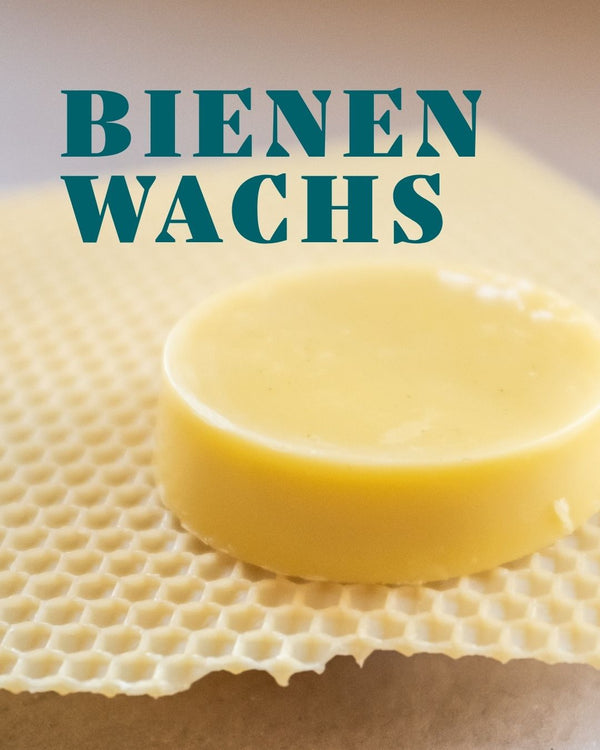
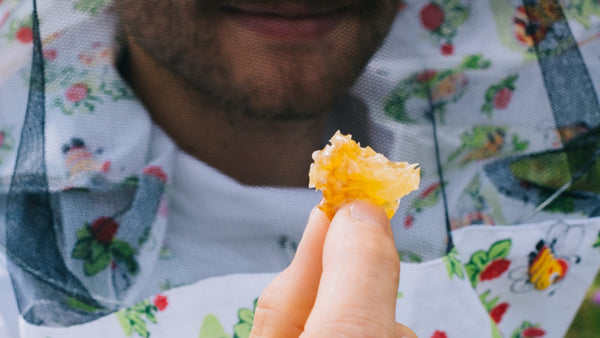
Beeswax is produced by young worker honey bees in wax glands on the abdomen and used to build the comb. It consists of more than 300 substances, mainly wax esters, hydrocarbons and free fatty acids. It melts over a range of about 61 to 66 °C and becomes pliable at around 32 °C (Huanbutta et al. 2026). On an ingredient list it appears as Cera Alba (CosIng).
In ointments and solid creams, beeswax mainly gives consistency: it holds liquid oils in a firm structure. On the skin it forms a film that reduces evaporation (Huanbutta et al. 2026). This is described in detail on the page Beeswax in skin care: composition and role.
Lanolin and beeswax compared
| Feature | Lanolin (wool wax) | Beeswax |
|---|---|---|
| Origin | secretion of the sheep's sebaceous glands, adheres to the wool | wax glands of the honey bee, building material of the comb |
| How it is obtained | from the wash water of shorn wool, then purified | from the comb, then purified |
| Chemical make-up | esters and polyesters of sterols (such as cholesterol), fatty alcohols and fatty acids; no triglycerides | wax esters, hydrocarbons, free fatty acids; more than 300 constituents |
| Melting | 36–42 °C | 61–66 °C, pliable from about 32 °C |
| Consistency | semi-solid, ointment-like | firm |
| Behaviour with water | takes up about twice its own weight, forms water-in-oil emulsions | used as an emulsifier and stabiliser in water-in-oil emulsions |
| Film on the skin | reduces water loss; one review gives 20–30 per cent | forms an occlusive film; we did not find a comparable figure |
| Smell | faint smell of its own | honey-like |
| INCI name | Lanolin; derivatives such as Lanolin Alcohol, Lanolin Cera, Lanolin Oil | Cera Alba, also Beeswax |
| Vegan | no | no |
Sources for the table: Lis 2024, Huanbutta et al. 2026, Sethi et al. 2016, CosIng. The values vary with origin and processing.
What each wax is used for
Lanolin is the classic building block for soft, supple bases. Because it can take up water, it acts as an emulsifier itself in an ointment. On the skin it reduces water loss. One review gives 20 to 30 per cent for this, clearly less than for petroleum jelly (Sethi et al. 2016). The comparison with mineral fats is made on the page Petroleum jelly or beeswax salve: the difference.
Beeswax turns oils into a firm balm. In creams and ointments, proportions of 5 to 20 per cent are usual; the more wax, the firmer the product (Huanbutta et al. 2026). In a water-free formula no water has to be bound, so no emulsifier is needed.
For your choice this means:
- Soft, ointment-like care that may also contain water: lanolin is often used for this.
- Firm, water-free care in a tin or as a stick: beeswax or a plant wax is mostly used for this.
- Care without animal-derived raw materials: plant waxes are the option here. More on this under Candelilla wax or beeswax: the differences and, for the lips, under Lip balm with beeswax or vegan: what is the difference?
Neither of the two waxes is "better" as a matter of principle.
What the literature says about allergies
In the specialist literature, lanolin is regarded as a weak trigger of contact allergy. For the European population a frequency of 0.4 per cent is reported (Jenkins & Belsito 2023). The figures are higher among people who are tested because of skin complaints: for them, the literature gives 1.2 to 6.9 per cent depending on the study (Knijp et al. 2019). Such figures come from practices and clinics. They say nothing about how often the general population reacts.
How to classify this has been disputed for decades. Which test substance shows a lanolin allergy best has not been settled. Some people with a positive test nevertheless tolerate lanolin on intact skin. People with certain chronic skin conditions, as well as children and older people, are affected more often (Jenkins & Belsito 2023).
Beeswax is not free of allergy risks either. A recent review calls the evidence inconsistent: reactions to residues of propolis in the wax cannot be ruled out, but they appear to be rare and mainly concern lip care (de Groot et al. 2026). More on this under Allergic to tree resin, colophony or propolis?
When to seek medical advice?
If your skin turns red, swells, forms small blisters or stings after application, stop using the product. If the reaction does not go away or comes back, get medical advice. Whether there is a contact allergy to lanolin, propolis or another substance is clarified by a patch test at a skin specialist's practice. If you already know of such an allergy, read the ingredient list before you buy. Try a new product on a small area first: Trying a new product: how do I test it on a small area?
What customers say
A selection of verified reviews from our shop (collected via Judge.me), translated from German and partly shortened.
"I am very happy with the solid vegan hand cream; the cream cares for my hands and they do not stay greasy […]. It also smells good"
Customer review of Solid Vegan Hand Cream - Bergamot, 5 out of 5 stars, December 2025, verified purchase
Frequently asked questions
Is lanolin the same as wool wax or wool fat?
Yes. All three names mean the purified secretion from sheep's wool. In the European Pharmacopoeia it is called Adeps lanae (CosIng). Chemically it is a wax, not a fat, because it contains no triglycerides.
Are lanolin and beeswax vegan?
No, both are of animal origin. Lanolin is obtained from the wool of shorn sheep, beeswax from the comb. Plant alternatives are, for example, candelilla or carnauba wax.
How do I recognise lanolin on the ingredient list?
By "Lanolin" and by names that begin with it, such as Lanolin Alcohol, Lanolin Cera or Lanolin Oil (CosIng). Beeswax is listed as Cera Alba. How to read the list is explained on the page How to Read an INCI List.
Why is a solid cream with beeswax harder than a lanolin ointment?
Beeswax only melts above 60 °C, lanolin at around 40 °C. A cream with a lot of beeswax therefore stays firm at room temperature. Warm it between your fingers for a few seconds, then it spreads.
What do the two waxes smell like?
Beeswax brings aroma compounds with it that are reminiscent of honey; more on this under Why does beeswax smell of honey, and why does the scent change? Lanolin has a faint smell of its own. According to its INCI list, the Solid Hand Cream - Beeswax contains no essential oils; its scent comes from the raw materials.
At forpeople
In the ingredient lists published in our shop (as of 3 October 2026), lanolin does not appear in any of our products. That is a statement of fact, not a judgement on lanolin. Beeswax (Cera Alba) is on these lists, among others:
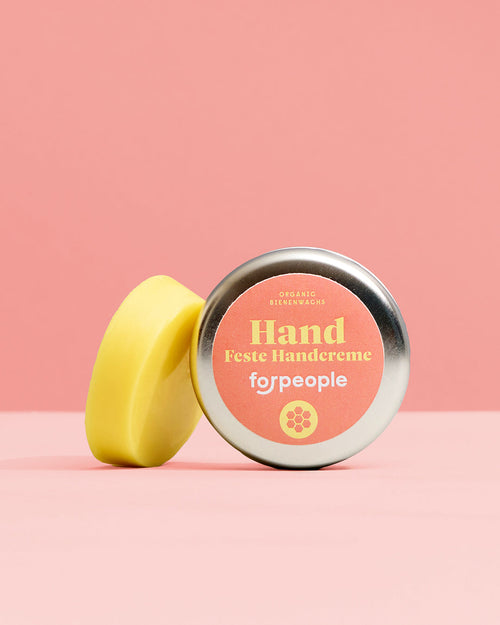
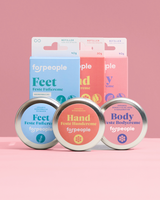
- Solid Hand Cream - Beeswax, 30 g, €9.90: Cera Alba in first place, plus olive and sunflower oil, St. John's wort and aloe extract; without essential oils.
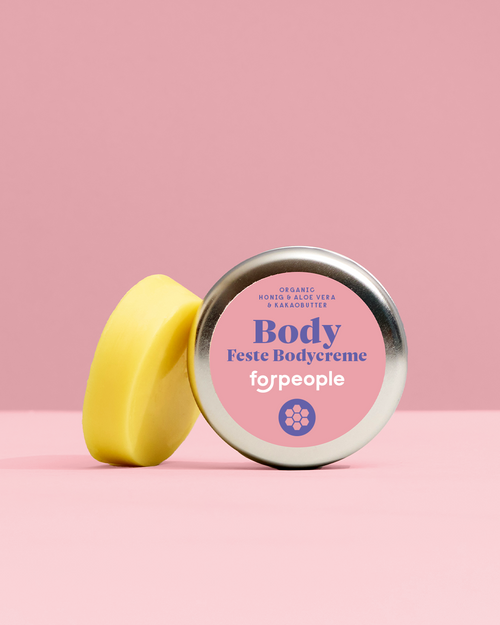
- Solid Body Butter - Beeswax & Aloe Vera, 40 g, €9.90: cocoa butter, olive oil, beeswax, sunflower oil, shea butter, aloe extract.
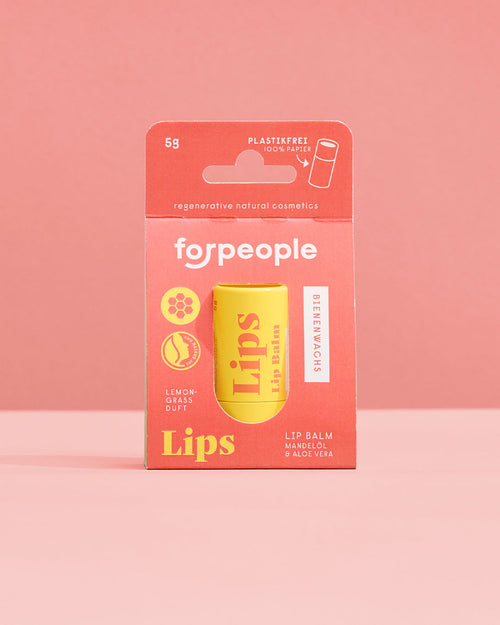
- Lip Balm - Lemongrass, 5 g, €4.90: beeswax, sunflower oil, shea butter, almond oil, hemp seed oil, aloe extract and lemongrass oil.
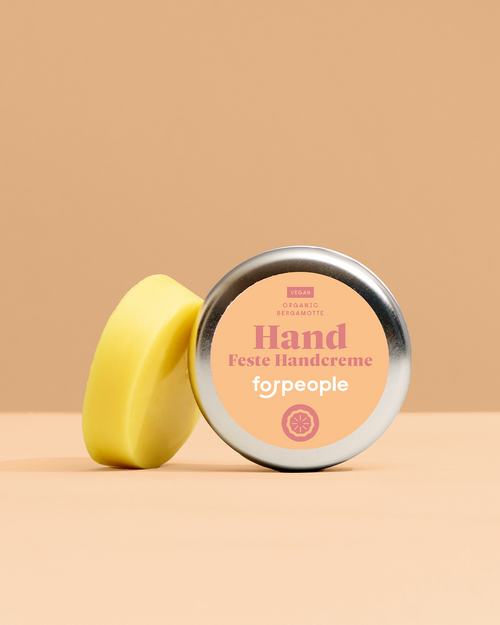
Without beeswax and vegan: the Solid Vegan Hand Cream - Bergamot (30 g, €9.90) with candelilla wax and lemon and bergamot oil.
More on this: Beeswax in skin care · Candelilla wax or beeswax · Allergy to resin and propolis · Does glycerin dry out the skin?
From the blog: Beeswax in Cosmetics: What It Does – and Why We Love It · The many talents of beeswax
Sources
- Lis K (2024): Hypersensitivity to Lanolin: An Old–New Problem. Life (Basel) 14(12): 1553. https://doi.org/10.3390/life14121553
- Jenkins BA, Belsito DV (2023): Lanolin. Dermatitis 34(1): 4–12. https://doi.org/10.1089/derm.2022.0002
- Knijp J, Bruynzeel DP, Rustemeyer T (2019): Diagnosing lanolin contact allergy with lanolin alcohol and Amerchol L101. Contact Dermatitis 80(5): 298–303. https://doi.org/10.1111/cod.13210
- Huanbutta K, Chuttong B, Danmek K, Sriamornsak P, Suwanpitak K, Sangnim T (2026): Beeswax in Pharmaceutical Sciences: A Comprehensive Review of Its Chemical Composition, Functional Applications, Types, and Formulation Roles. Int J Mol Sci 27(8): 3486. https://doi.org/10.3390/ijms27083486
- de Groot AC, Ipenburg NA, Rustemeyer T (2026): Propolis and Beeswax in Cosmetics: A Market Survey and Literature Review on Their Relationship and Role in Allergic Contact Dermatitis. Contact Dermatitis 94(5): 494–503. https://doi.org/10.1111/cod.70108
- Sethi A, Kaur T, Malhotra SK, Gambhir ML (2016): Moisturizers: The Slippery Road. Indian J Dermatol 61(3): 279–287. https://doi.org/10.4103/0019-5154.182427
- European Commission: CosIng – database of cosmetic ingredients, entries LANOLIN, LANOLIN ALCOHOL, LANOLIN CERA, LANOLIN OIL and CERA ALBA, accessed 2 October 2026. https://ec.europa.eu/growth/tools-databases/cosing/