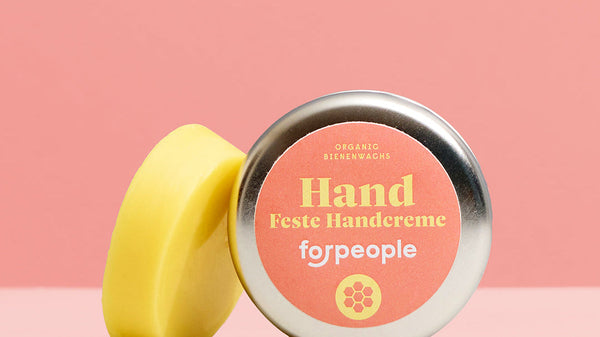
The tin sits by the washbasin, the cream inside is as firm as a candle, and from a tube you are used to a dollop. Anyone who switches usually asks: How do I get anything out, why does my skin look shiny afterwards, and is it worth the price? Critical reviews of our own products, too, are mostly about texture, an effect that did not show, and amount or price.
What counts as solid cosmetics
“Solid cosmetics” covers two groups that have little in common apart from their form:
- Care without water: solid creams, body butters, balms, lip and sun sticks, deodorant creams. They are made of oils, plant butters and waxes. How to recognise them in the ingredient list is explained in Water-free cosmetics: what they are and what to look out for.
- Cleansing in a bar: bar soap, shampoo soap, shampoo bars and shower bars. Soaps are made by saponifying oils and fats; shampoo bars usually contain cleansing agents similar to those in liquid shampoo (Verbraucherzentrale NRW 2026). Soap is made with water and is not water-free.
The table puts our solid products next to the usual alternative. It describes composition and use, not a ranking.
| For | Solid form at forpeople | Usual alternative | What changes day to day |
|---|---|---|---|
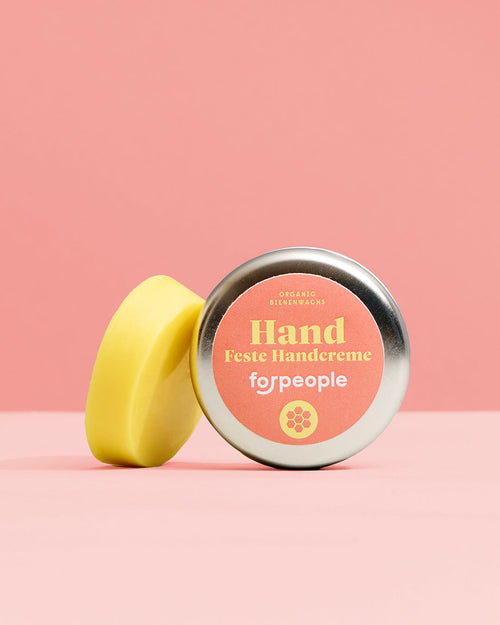
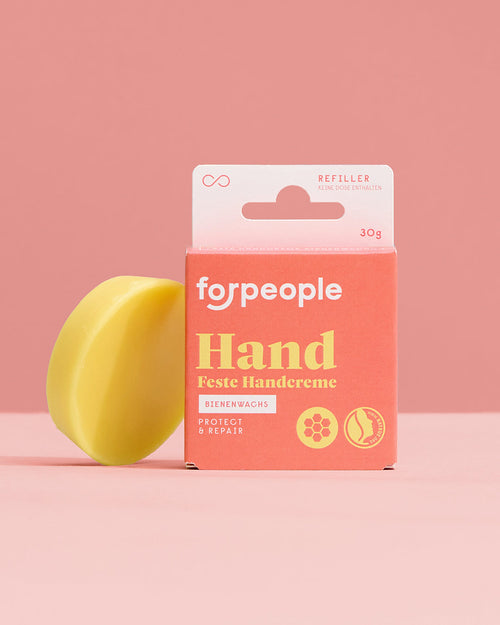
| Hands | Solid Hand Cream - Beeswax: beeswax, olive and sunflower oil | Hand cream from a tube: an emulsion with water and an emulsifier, usually preserved | warm it up, take a little, a thin film stays |
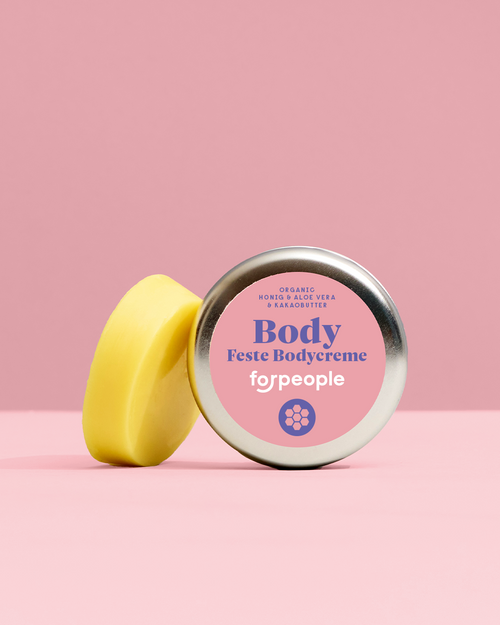
| Body | Solid Body Butter - Beeswax & Aloe Vera: cocoa and shea butter, oils, beeswax | Body lotion, as a rule more than half water | apply to damp skin after showering; large areas take longer |
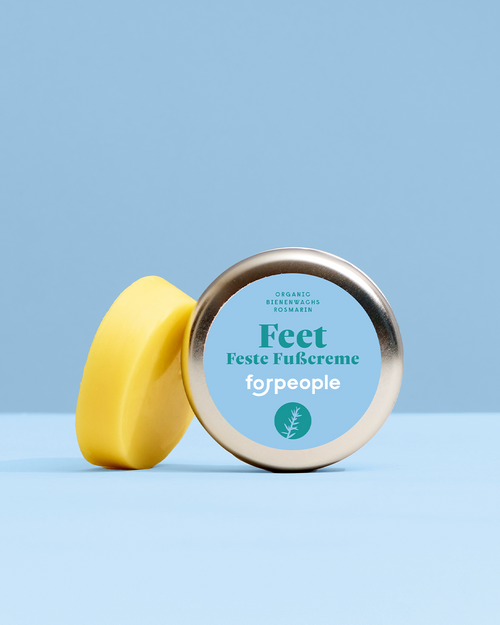
| Feet | Solid Foot Cream – Rosemary & Sage: oils, beeswax, shea butter, essential oils | Foot cream with urea, usually an emulsion | a film instead of a humectant; for thick hard skin, urea may be the better fit |
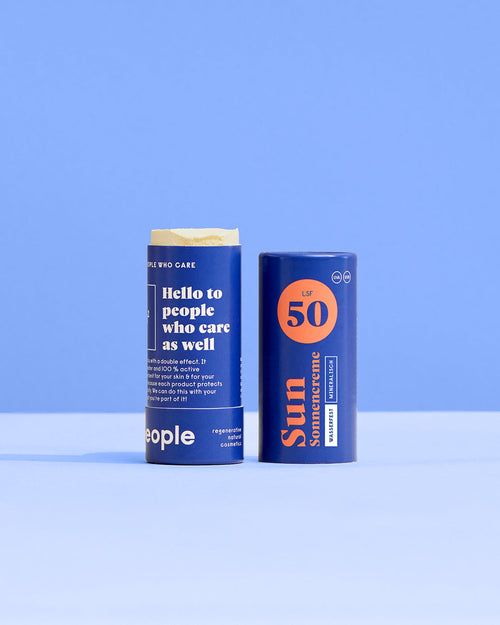
| Sun | Solid Sunscreen SPF50: zinc oxide and titanium dioxide (non-nano) in shea butter and beeswax | Sun lotion or spray | apply directly, spread generously; a whitish film is possible |
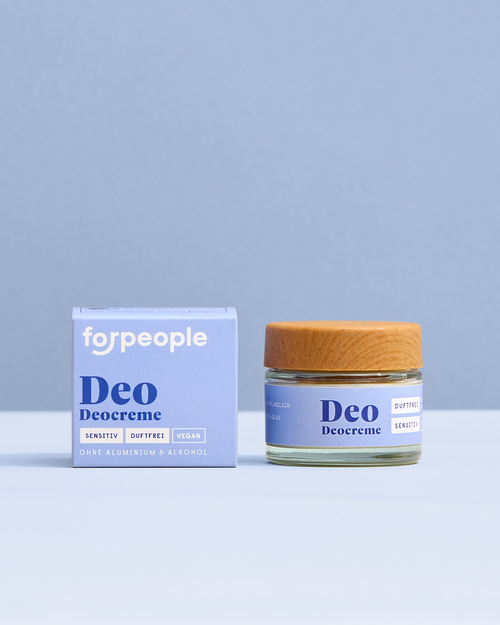
| Underarms | Sensitive Deodorant Cream: starch, shea butter, sodium bicarbonate, candelilla wax, no added fragrance | Deodorant spray, roll-on or antiperspirant | apply thinly with your fingers; without aluminium salts it does not reduce the amount of sweat |
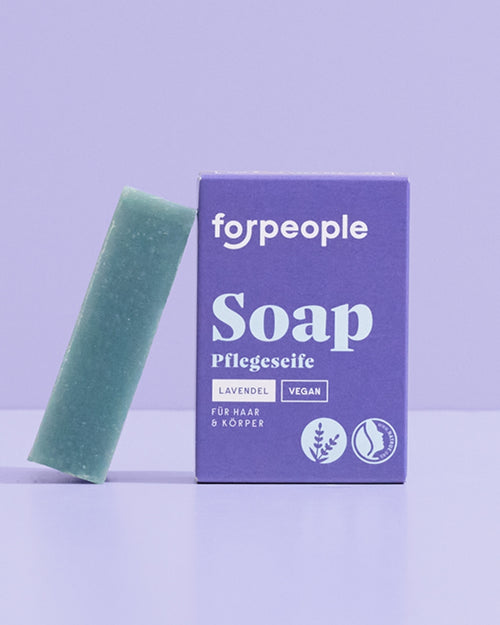
| Washing | Aloe Vera Soap – Lavender: saponified plant oils, essential oils | Shower gel or liquid soap with around 70 to 90 per cent water | the bar has to dry; soap is alkaline |
Water content according to Verbraucherzentrale NRW 2026, our products according to their INCI. The INCI lists ingredients in descending order of weight (Regulation (EC) No 1223/2009, Art. 19): if “Aqua” comes first, water is the largest component.
The advantages: what the solid form actually changes
- Concentrated: Without water, every gram consists of oils, butters and waxes. You therefore need less; for both hands, two to three strokes over the palm are usually enough. What determines how long it lasts is explained in Why does solid cream last so long?
- Usually no emulsifier and no preservative: Water is the main component of most cosmetics and at the same time what microorganisms need to grow (Halla et al. 2018). Water-free products can therefore count as microbiologically low-risk; how a manufacturer assesses this is described in a standard (ISO 29621:2017). This follows from the formula and is no verdict on preservatives: the permitted ones are on a positive list (Regulation (EC) No 1223/2009, Annex V).
- A film that slows evaporation: Occlusive substances form a water-repellent layer on the skin and slow down water loss, most clearly on slightly damp skin (Sethi et al. 2016). Waxes and plant butters form such a film. When that is the right kind of care and when moisture is what is missing is compared in Rich cream or moisturiser? What dry skin needs.
- Does not leak: practical in your bag, but no free pass at the airport (see below).
- Refillable: With our solid creams you keep the tin. The Solid Hand Cream Refill - Beeswax costs €7.90 instead of €9.90; how to insert it is shown in Refillable Hand Cream.
The drawbacks: what gets in the way
Most drawbacks follow directly from what makes solid care what it is: wax instead of water, a bar instead of a bottle.
| Drawback | Why | What you can do |
|---|---|---|
| has to be warmed up, hard in winter | According to the EU specification, beeswax melts only at 62 to 65 °C, candelilla wax at 68.5 to 72.5 °C (Regulation (EU) No 231/2012). The warmth of your skin only softens the oils and butters at the surface. | hold the tin in your hand for a moment, rub your palm over the surface; see How to apply a solid cream |
| unfamiliar skin feel, a film stays | The wax stays on the skin as a thin layer. A greasy feel is one of the typical limitations of occlusive substances (Sethi et al. 2016). | take less, massage in for one to two minutes, remove any excess with a cloth; see Greasy or well cared for? |
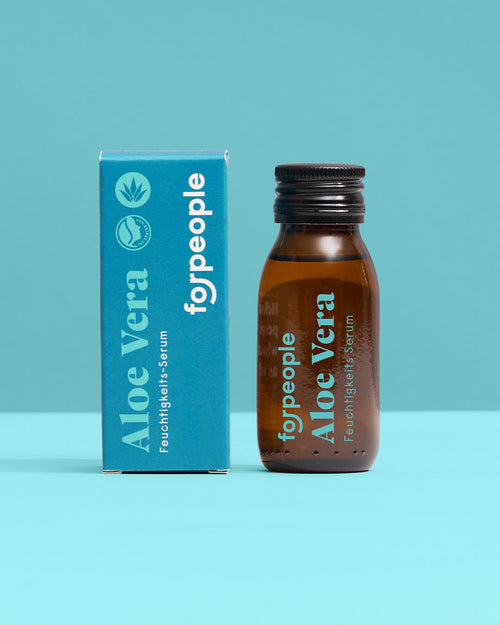
| brings no moisture of its own | Fat and wax keep water in the skin but do not supply any. | apply to slightly damp skin, or use a water-based serum such as the Aloe Vera Serum 99.6% first and the solid cream on top |
| softens in the heat | Butters and oils soften in summer warmth, long before the wax melts. | not in the car, not in the sun; see Storing solid cosmetics |
| fingers in the tin, oils age | Your fingers touch the cream every time you take some. If water gets in, the advantage of the water-free formula is gone. Oils can go rancid. | take it out with dry, clean fingers, close the lid, store it somewhere cool; see Hygiene and water-free cosmetics |
| soap goes soft and is alkaline | The bar sits in water. Soap reacts alkaline in water, and in hard water poorly soluble lime soaps can form (Verbraucherzentrale NRW 2026). | let it dry, for example in an Aluminium Soap Tin with Drainage Grid; if your skin feels tight, see Bar soap or shower gel |
| no free pass in hand luggage | EU rules also count pastes and creamy substances as liquids; a solid cream is a borderline case, a bar of soap usually is not. | put solid cream in the 1-litre bag; see Cream in hand luggage |
| often scented | Many solid products contain essential oils, at forpeople for example the Solid Vegan Hand Cream - Bergamot, the foot cream and the soaps. | read the INCI, try anything new on a small area first; see Essential oils and fragrance allergens |
Price: more per gram, per use it depends
At first glance, solid products often look more expensive. The Verbraucherzentrale NRW (a German consumer advice centre) explains this using shampoo: liquid shampoo is often cheaper but goes less far because it consists of around 70 to 90 per cent water; in a Stiftung Warentest test it was also often overdosed, while the solid kind was not. Solid deodorants, body butters and soaps can as a rule keep up on price, toothpaste tablets cannot (Verbraucherzentrale NRW 2026). Our unit prices:
| Product | Contents | Price | per 100 g |
|---|---|---|---|
| Solid Hand Cream - Beeswax | 30 g | €9.90 | €33.00 |
| Solid Hand Cream Refill - Beeswax | 30 g | €7.90 | €26.33 |
| Solid Body Butter - Beeswax & Aloe Vera | 40 g | €9.90 | €24.75 |
| Aloe Vera Soap – Lavender | 75 g | €8.90 | €11.87 |
Per gram, that is not little. A fairer comparison is per use, and that depends on two things. First, on water: if a lotion is half water, 100 g contain around 50 g of oils, waxes and other ingredients; a water-free butter delivers that amount in 50 g. Second, on how much you use: if you take a lot or cover large areas, a tin will be empty sooner than you think. That is why we do not give a number of applications per tin. And what you do not use stays expensive: start small, for example with a hand cream.
When solid care does not help
If nothing changes after a few weeks, it is usually for one of these reasons:
- Your skin lacks water, not fat. A film only holds what is already there. Apply the cream to slightly damp skin or use a water-based product underneath.
- Not applied often enough. Hand washing and friction wear the film away. If you wash your hands often, apply a thin layer every time afterwards.
- Thick hard skin. Fat and wax keep it supple but do not remove it. For very thick areas on the heels, a cream with urea may be the better fit; see Urea or water-free cream?
- The form does not suit you. If the film bothers you, you will use the cream less often, and care that stays in the tin does nothing. If the solid form still does not suit you after a few weeks, a cream from a tube is the better choice. What settles in at the start is described in Switching to solid skincare: what is different in the first weeks.
When to seek medical advice? If your skin stays cracked, red or flaky for weeks despite regular care, keeps itching, weeps or bleeds, have it looked at by a doctor; cosmetics care for the skin, they do not treat skin disease. If your skin reacts to a new product with redness, burning or itching, stop using it. What to do next is explained in Reacting to a cosmetic: what to do, who to report it to, can you return it?
Frequently asked questions
Does skin react less often to solid cosmetics?
That cannot be said in general. Whether your skin reacts depends on the ingredients, not on the form. Solid care can also contain fragrances, essential oils, resin or propolis.
Are solid cosmetics free from animal testing?
That is not a feature of the solid form. In the EU, animal testing to meet the requirements of the Cosmetics Regulation is banned, and cosmetics whose formulation or ingredients were tested on animals for that purpose may not be sold; the last transition periods ended on 11 March 2013 (Regulation (EC) No 1223/2009, Art. 18). This applies to all cosmetics.
Can I combine solid cream with moisturising care?
Yes, one after the other: first the water-based product, let it absorb for one to two minutes, then the solid cream on top. The two cannot be mixed, because water and wax do not combine without an emulsifier.
Is bar soap water-free too?
No. Soap is made from oils and a lye dissolved in water; some of the water stays in the bar. That is why the INCI of our soaps lists “Aqua”. At forpeople, the solid creams, balms, lip balms, the deodorant cream and the solid sunscreen are water-free.
Can solid cosmetics go off?
Yes. Germs struggle without water, but the oils oxidise over time and then smell rancid. The packaging shows either a best-before date or the symbol with the open jar. If a cream smells clearly different from when you opened it, stop using it.
At forpeople
Our solid creams and the deodorant cream are water-free and contain no emulsifier and no preservative; our soaps contain water from the production process. A small area such as your hands is a good place to try solid care.
- Solid Hand Cream - Beeswax, 30 g, €9.90: five ingredients, no essential oils.
- Solid Hand Cream Refill - Beeswax, 30 g, €7.90: the same cream for refilling the tin.
- Solid Care for Dry Skin – Hands, Feet & Body, €49.90: hand cream, foot cream and body butter in a tin, plus one refill for each. The foot cream contains essential oils and is not suitable for children under 7.
- Aluminium Soap Tin with Drainage Grid, €8.90: so that bar soap can dry between uses.
More on this: Water-free cosmetics · How to apply a solid cream · Why does solid cream last so long? · Hygiene and water-free cosmetics · Storing solid cosmetics
From the blog: Switching to solid skincare: what is different in the first weeks
Sources
- Verbraucherzentrale NRW (Stand 22. Juli 2026): Plastikmüll im Bad vermeiden mit Shampoobar & Co: Fest statt flüssig. verbraucherzentrale.nrw
- Verordnung (EG) Nr. 1223/2009 des Europäischen Parlaments und des Rates vom 30. November 2009 über kosmetische Mittel, Art. 18, Art. 19 Abs. 1 und Anhang V. ABl. L 342 vom 22.12.2009, S. 59. eur-lex.europa.eu/eli/reg/2009/1223/oj
- Halla N, Fernandes IP, Heleno SA, Costa P, Boucherit-Otmani Z, Boucherit K, Rodrigues AE, Ferreira ICFR, Barreiro MF (2018): Cosmetics Preservation: A Review on Present Strategies. Molecules 23(7): 1571. https://doi.org/10.3390/molecules23071571
- ISO 29621:2017: Cosmetics – Microbiology – Guidelines for the risk assessment and identification of microbiologically low-risk products. International Organization for Standardization, Genf. evs.ee/en/iso-29621-2017
- Sethi A, Kaur T, Malhotra SK, Gambhir ML (2016): Moisturizers: The Slippery Road. Indian J Dermatol 61(3): 279–287. https://doi.org/10.4103/0019-5154.182427
- Verordnung (EU) Nr. 231/2012 der Kommission vom 9. März 2012 mit Spezifikationen für die in den Anhängen II und III der Verordnung (EG) Nr. 1333/2008 aufgeführten Lebensmittelzusatzstoffe, Einträge E 901 Bienenwachs und E 902 Candelillawachs. ABl. L 83 vom 22.3.2012, S. 1. eur-lex.europa.eu/eli/reg/2012/231/oj