


What aloe juice actually is
Aloe is a succulent. It stores water in its thick leaves to survive dry periods. Inside the leaf is a clear, soft tissue of large, thin-walled cells in which the water is held as a viscous mucilage. According to one review, the raw leaf pulp is about 98.5% water, the mucilage or gel about 99.5%. The remaining 0.5 to 1% of solids are polysaccharides, vitamins, minerals, enzymes, phenolic compounds and organic acids (Hamman 2008). A second review gives a water content of 99 to 99.5% for the plant (Radha and Laxmipriya 2015).
In the EU database of cosmetic ingredients, "Aloe Barbadensis Leaf Juice" is described as the juice expressed from the leaves (CosIng). The name does not say which part of the leaf it comes from. More on this on the page Inner leaf or whole leaf.
Aqua or Aloe Barbadensis Leaf Juice: how it appears in the INCI
The ingredient list names each ingredient according to the amount added during production, in descending order (Regulation (EC) No 1223/2009, Art. 19). If water is replaced entirely by aloe juice, "Aqua" disappears from the list. If only part of it is replaced, both appear.
| How it appears in the INCI | What it means | Aloe instead of water? |
|---|---|---|
| Aloe Barbadensis Leaf Juice in first place, no Aqua | aloe juice is the liquid base | yes, completely |
| Aloe Barbadensis Leaf Juice before Aqua | more aloe juice than added water | partly |
| Aqua before Aloe Barbadensis Leaf Juice | water is the base, aloe juice is added | no |
| Aqua and Aloe Barbadensis Leaf Juice Powder | dried aloe juice, mixed back up with water | no, the liquid is water |
| Aloe Barbadensis Leaf Extract at the end of the list | a small amount of leaf extract | no, an additive |
How to read an INCI in general is explained on the page How to read an INCI list.
What the swap changes – and what it doesn't
A litre of aloe juice brings almost a litre of water with it. For the formula, that is the key fact. It determines what stays the same and what changes.
| Feature | with water | with aloe juice |
|---|---|---|
| Water content of the liquid phase | 100% | about 99 to 99.5% |
| Dissolved plant substances | none | about 0.5 to 1%, mainly polysaccharides |
| Preservation | needed | still needed |
| Emulsifier in a cream or lotion | needed | still needed |
| Water-free? | no | no |
| Name in the INCI | Aqua | Aloe Barbadensis Leaf Juice |
| Origin and cultivation | usually not stated | can be stated, e.g. from organic farming |
Water-based cosmetics need protection because of the freely available water: one review calls it the ideal growth factor for microorganisms and describes preservatives such as sorbic and benzoic acid, which work best in an acidic environment (Halla et al. 2018). That is why aloe products often contain citric acid. The EU guidelines on the safety report explicitly list water-based mixtures and plant raw materials among the raw materials that are highly susceptible to microbial growth (Implementing Decision 2013/674/EU). More on the page Preservation and water in cosmetics.
What the dissolved substances do on the skin cannot be deduced from the swap alone. A product with aloe juice as its base usually feels about as light as a watery product and absorbs quickly. If you'd also like a protective film, combine it with an oil or a solid cream; how to do that is on the page Combining aloe serum with oil and cream.
Aloe instead of water in solid soap
Soap is made when oils and fats react with a lye. For solid soap, sodium hydroxide is dissolved in a liquid. That liquid can be water, a plant juice or a mixture. In the INCI it appears as "Aqua", as "Aloe Barbadensis Leaf Juice" or as both, each in the amount added during production. Some of the liquid evaporates while the soap cures; how much remains in the finished bar is not shown on the list. A soap made "with aloe instead of water" is therefore not water-free either.
What to look for in such claims
- Is Aqua still in the INCI? Then aloe is only part of the liquid.
- Juice, powder or extract? Only "Leaf Juice" near the top means aloe juice as the base.
- What does the percentage mean? "99% aloe" describes the share of juice in the product, not the share of aloe solids. Even 99% aloe juice is mostly water.
- Is it advertised as "water-free"? A product with aloe juice is not water-free. The terms are explained on the page Water-free, low-water, anhydrous.
Frequently asked questions
Is a product with aloe instead of water water-free?
No. Aloe juice is almost entirely water. The product contains water, just in a different form.
Does an aloe serum need preservatives?
Yes. Every product with freely available water needs protection against microbes. That applies to aloe juice just as it does to water.
Is aloe juice a better base than water?
It brings a small amount of dissolved plant substances that water does not have. Whether that makes a difference for you depends on the product and your skin. Physically, it behaves largely like water in the formula.
Why is an aloe serum sometimes runny and sometimes gel-like?
Aloe juice is naturally thin. A gel only forms with a thickener, which then also appears in the INCI.
At forpeople
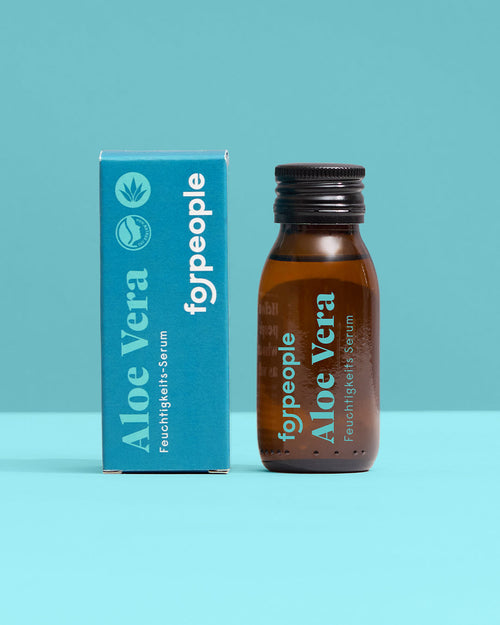
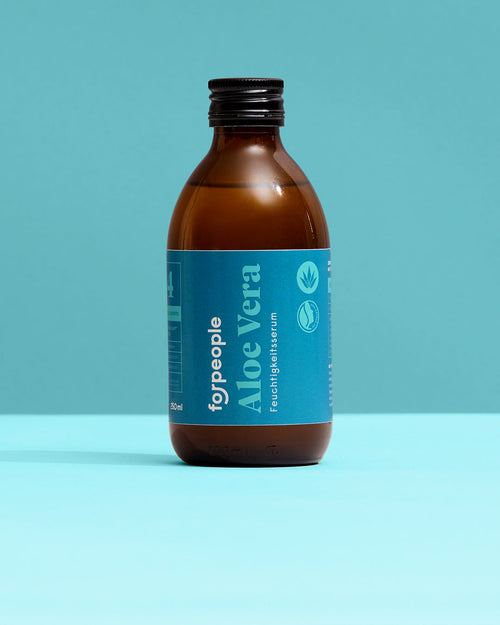
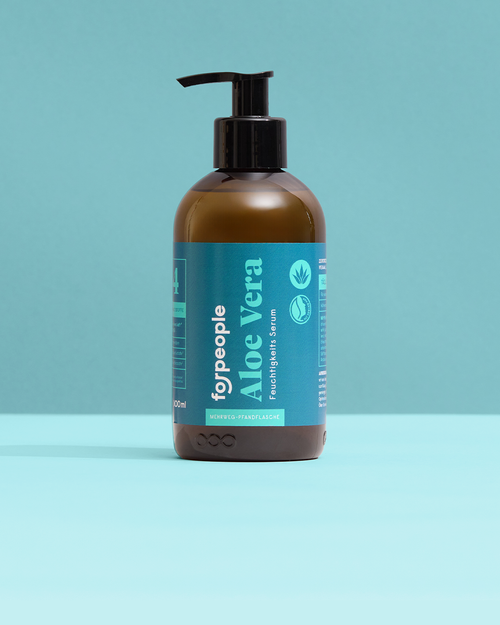
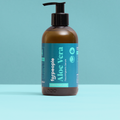
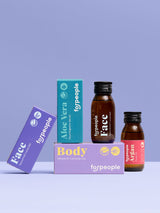
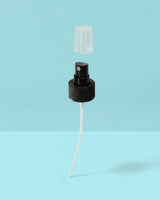
The Aloe Vera Serum 99.6% (50 ml, €9.90) is a product in which aloe juice makes up the entire liquid base. According to its INCI it contains Aloe Barbadensis Leaf Juice, Citric Acid, Potassium Sorbate and Sodium Benzoate – so no added water, but citric acid and two preservatives. It contains no thickener. The serum is also available as a 250 ml Aloe Vera Serum 99.6% and as the Aloe Vera Serum 99.6% - Pump Bottle.
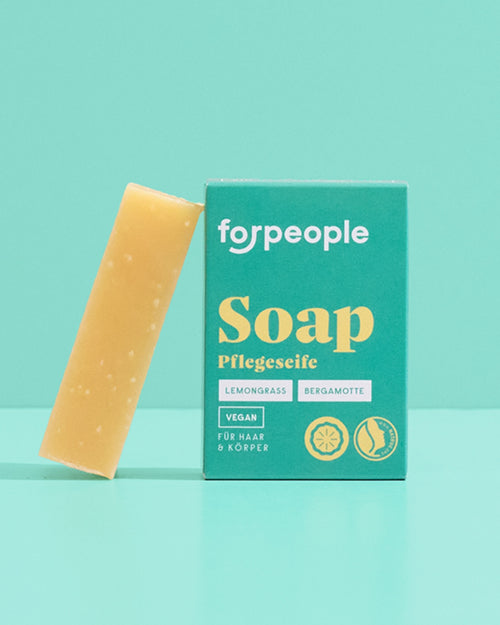
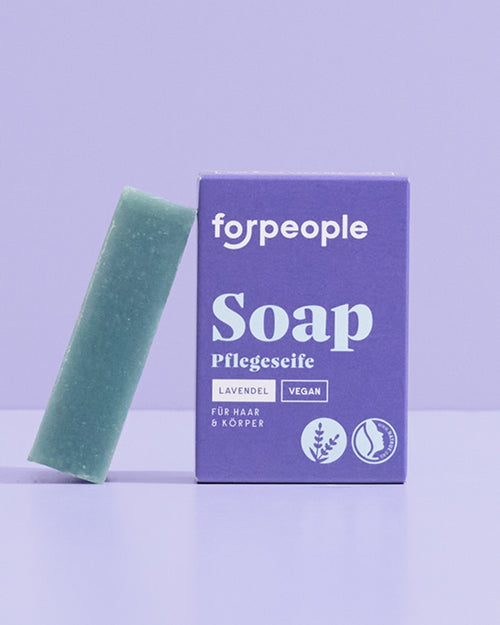
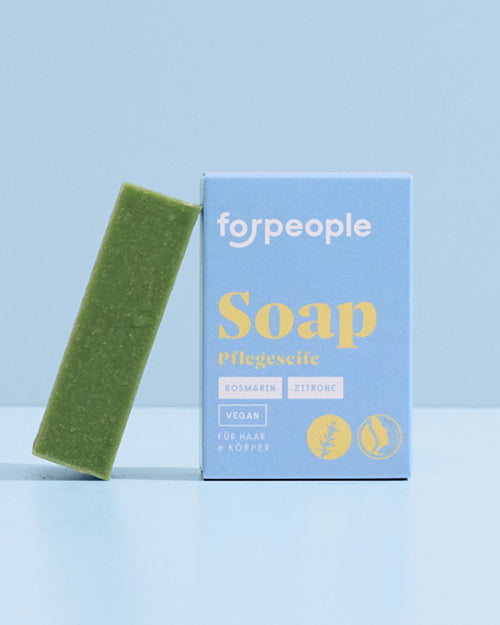
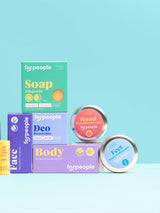
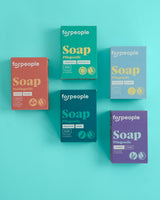
The soaps differ. In the Aloe Vera Soap - Lemongrass, Aloe Barbadensis Leaf Juice is in third place and Aqua further down; here, aloe juice replaces part of the water. In the Aloe Vera Soap – Lavender and the Aloe Vera Soap – Rosemary & Lemon, Aqua is in third place and "Aloe Barbadensis Leaf Extract" further down. According to their INCI, all soaps contain water.
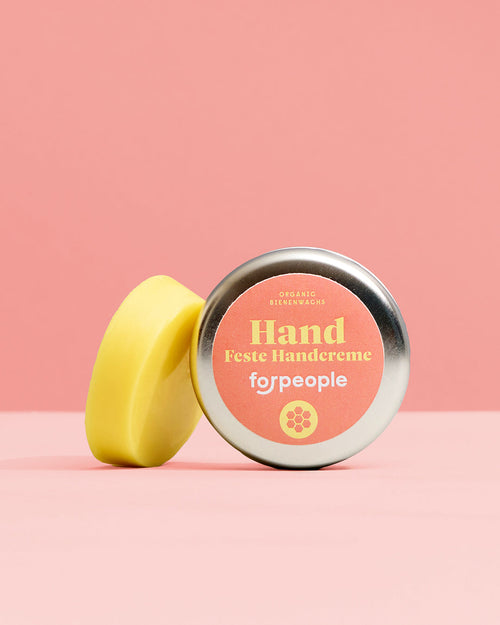
The solid creams, such as the Solid Hand Cream - Beeswax, are water-free; in them, aloe appears only as an extract at the end of the list.
Read more: Aloe vera serum 99.6%: what's inside? · How to recognise aloe vera quality · Water-free cosmetics · Hygiene and water-free cosmetics
Sources
- Hamman JH (2008): Composition and applications of Aloe vera leaf gel. Molecules 13(8): 1599–1616. doi:10.3390/molecules13081599
- Radha MH, Laxmipriya NP (2015): Evaluation of biological properties and clinical effectiveness of Aloe vera: A systematic review. J Tradit Complement Med 5(1): 21–26. doi:10.1016/j.jtcme.2014.10.006
- Europäische Kommission: CosIng – Datenbank kosmetischer Inhaltsstoffe, Einträge AQUA, ALOE BARBADENSIS LEAF JUICE, ALOE BARBADENSIS LEAF JUICE POWDER, ALOE BARBADENSIS LEAF EXTRACT (abgerufen am 30.09.2026). ec.europa.eu/growth/tools-databases/cosing
- Verordnung (EG) Nr. 1223/2009 des Europäischen Parlaments und des Rates vom 30. November 2009 über kosmetische Mittel, Art. 19 Abs. 1 Buchst. g. ABl. L 342 vom 22.12.2009, S. 59. eur-lex.europa.eu/eli/reg/2009/1223/oj
- Halla N, Fernandes IP, Heleno SA et al. (2018): Cosmetics Preservation: A Review on Present Strategies. Molecules 23(7): 1571. doi:10.3390/molecules23071571
- Durchführungsbeschluss 2013/674/EU der Kommission vom 25. November 2013 über Leitlinien zu Anhang I der Verordnung (EG) Nr. 1223/2009 über kosmetische Mittel, Teil A Nr. 3.3.1. ABl. L 315 vom 26.11.2013, S. 82. eur-lex.europa.eu/eli/dec_impl/2013/674/oj