

How an aloe leaf is built
An aloe leaf can be roughly divided into two parts: the outer green rind with the vascular bundles, and the colourless interior that contains the gel (Hamman 2008). According to a second review, the rind makes up about 20 to 30% of the leaf weight and the pulp 70 to 80% (Radha and Laxmipriya 2015). In between, in cells next to the vascular bundles, a bitter yellow sap forms – the so-called latex. It contains 1,8-dihydroxyanthraquinone derivatives and their glycosides (Hamman 2008).
| Part of the leaf | Description | Typical constituents |
|---|---|---|
| Rind | outer green layer with vascular bundles, about 20–30% of the leaf weight | cell wall components, including xylose-containing polysaccharides |
| Latex | yellow, bitter sap from cells just beneath the rind | 1,8-dihydroxyanthraquinone derivatives such as aloin A and B (barbaloin) |
| Inner leaf (gel) | clear, soft tissue, about 70–80% of the leaf weight | around 99.5% water, plus polysaccharides, minerals, organic acids |
The details on rind, latex and gel come from two reviews (Hamman 2008; Radha and Laxmipriya 2015).
What aloin is
Aloin is an anthraquinone glycoside, more precisely a mixture of aloin A and aloin B, which together are also called barbaloin (Hamman 2008). It is the best-known constituent of the latex. The aloe industry's trade association describes the latex as a bitter, yellow-brown to reddish substance that has mainly been used as a laxative (IASC). An expert panel of the US cosmetics industry also describes the anthraquinones in the latex as phototoxic and irritating to the gastrointestinal tract (Cosmetic Ingredient Review 2007).
Chemically, aloin and aloe-emodin belong to the hydroxyanthracene derivatives. This is also the term used in EU food law.
Inner leaf, whole leaf, filtered: how it is processed
The International Aloe Science Council (IASC), the industry's trade association, describes how aloe juice is obtained as follows (IASC):
| Process | How it works | What happens to the latex |
|---|---|---|
| Inner-leaf juice | the rind is removed by hand or by machine and the gel-like interior is crushed | rinsed away before processing |
| Whole-leaf juice | the entire leaf is ground, the rind and heavier material are broken down and the slurry is then filtered | usually filtered out with activated charcoal |
| Non-decolourised whole-leaf extract | whole leaf without activated-charcoal filtration, as used in animal studies | remains in the extract |
For aloe products intended for consumption, the IASC's own standard is an aloin content below 10 ppm; for products applied to the skin, it refers to the value of 50 ppm cited by the Cosmetic Ingredient Review (IASC). The panel itself refers to an industry-established limit for anthraquinones in aloe-derived material for non-medicinal use of 50 ppm or lower (Cosmetic Ingredient Review 2007). 50 ppm is 0.005%.
How well an inner-leaf juice or a filtered whole-leaf juice is freed of latex depends on the processing. The European Commission also notes that hydroxyanthracene derivatives can be removed by filtering to the point where only traces remain (Regulation (EU) 2021/468, recital 10).
What the regulations say
Food: Regulation (EU) 2021/468 added aloe-emodin, emodin and "preparations from the leaf of Aloe species containing hydroxyanthracene derivatives" to the list of substances prohibited in food (Regulation (EU) 2021/468, Art. 1). It was based on an opinion of the European Food Safety Authority (EFSA 2018). The regulation summarises it like this: aloe-emodin and emodin are genotoxic in the laboratory, for aloe-emodin this was also shown in animal studies, and whole-leaf aloe extract was shown to be carcinogenic. A safe daily intake could not be established (Regulation (EU) 2021/468, recitals 7 to 9). A well-known study on whole-leaf extract is a two-year study in which rats received a non-decolourised whole-leaf extract in their drinking water; they developed more tumours in the large intestine (Boudreau et al. 2013).
Cosmetics: this regulation governs food, not cosmetics. The studies concern intake by mouth. For aloe raw materials in cosmetics, the industry follows the 50 ppm limit mentioned above. Cosmetics are not meant to be swallowed, so you should not drink an aloe serum.
This is why many manufacturers use inner-leaf or filtered juice: leaf preparations containing these substances are banned in food, and for cosmetics there is the industry limit. The discussion concerns the latex, not the aloe gel itself. Because the gel is almost entirely water, products made from it need preservation; the page Preservation and water in cosmetics explains why. That a product with aloe juice is therefore not water-free either is covered on the page Water-free, low-water, anhydrous.
How to tell what is in your product
- The INCI doesn't help here. In the EU database, "Aloe Barbadensis Leaf Juice" is described as the juice expressed from the leaves, without saying whether it is inner leaf or whole leaf (CosIng).
- Terms such as "inner leaf", "fillet" or "decolourised" describe the processing. They are voluntary.
- Asking is the most reliable way. A manufacturer can ask its supplier how the juice is obtained and what aloin content the raw material analysis shows.
Other features that help you assess an aloe product are described on the page How to recognise aloe vera quality.
Frequently asked questions
Is aloin banned in cosmetics?
The 2021 EU ban applies to food. For cosmetics there is an industry-established limit of 50 ppm anthraquinones in aloe raw materials.
Is whole-leaf aloe worse than inner-leaf aloe?
Not in principle. What matters is whether the latex has been removed. A filtered whole-leaf juice can also contain little aloin; a non-decolourised extract, on the other hand, still contains the latex.
What do 10 or 50 ppm mean?
ppm stands for "parts per million". 50 ppm is 50 milligrams per kilogram, or 0.005%. Whether and how much aloin a raw material contains can only be determined by analysis.
Can I drink an aloe cosmetic product?
No. Cosmetics are not meant for consumption and are not made according to the rules for food.
At forpeople
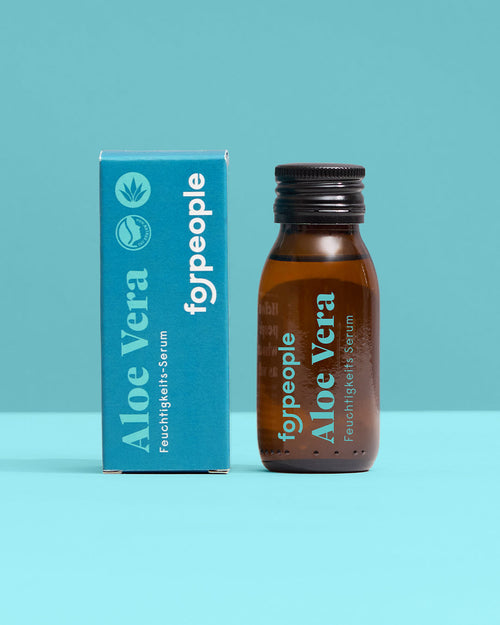
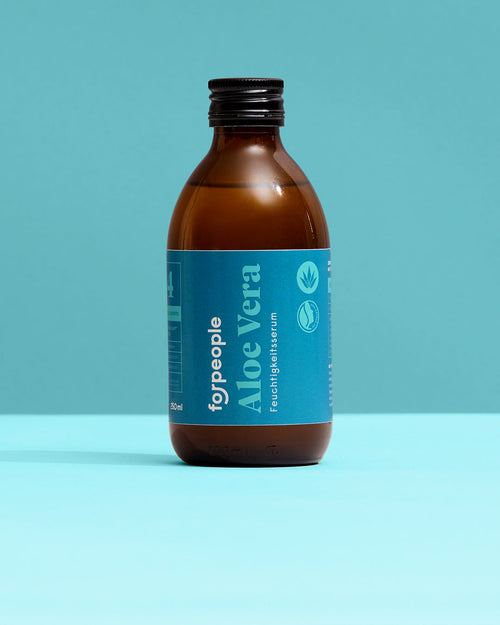
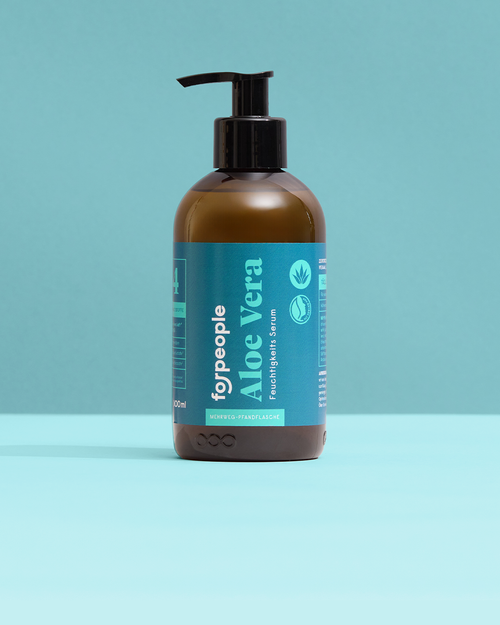
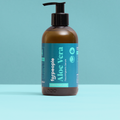
The product pages of the Aloe Vera Serum 99.6% (50 ml), the Aloe Vera Serum 99.6% (250 ml) and the Aloe Vera Serum 99.6% - Pump Bottle (300 ml) state: the aloe comes from controlled cultivation in Andalusia, Spain, and the aloe juice is not processed into powder but stays liquid. The INCI reads Aloe Barbadensis Leaf Juice, Citric Acid, Potassium Sorbate, Sodium Benzoate. Whether the juice comes from the inner leaf or from filtered whole leaf is not currently stated on the product pages.
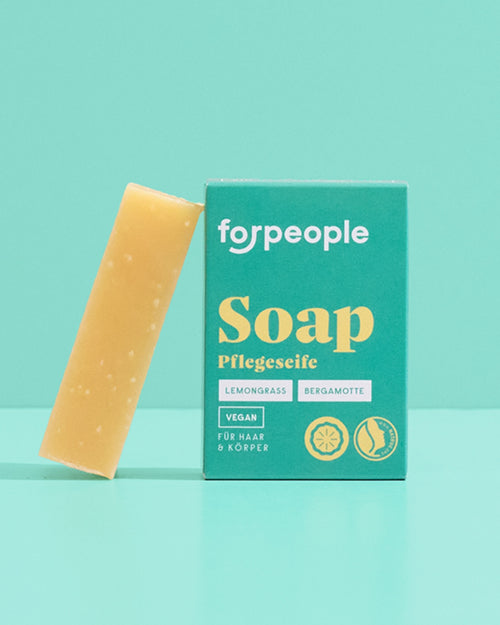
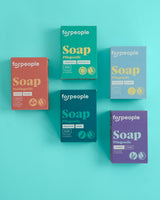
Aloe is also found in other products: in the Aloe Vera Soap - Lemongrass as aloe juice, and in the Solid Body Butter - Beeswax & Aloe Vera and the Solid Hand Cream - Beeswax as an extract at the end of the INCI.
Read more: Aloe vera serum 99.6%: what's inside? · Aloe vera instead of water · Combining aloe serum with oil and cream · How to read an INCI list
Sources
- Hamman JH (2008): Composition and applications of Aloe vera leaf gel. Molecules 13(8): 1599–1616. doi:10.3390/molecules13081599
- Radha MH, Laxmipriya NP (2015): Evaluation of biological properties and clinical effectiveness of Aloe vera: A systematic review. J Tradit Complement Med 5(1): 21–26. doi:10.1016/j.jtcme.2014.10.006
- Cosmetic Ingredient Review Expert Panel (2007): Final report on the safety assessment of Aloe Andongensis Extract, Aloe Andongensis Leaf Juice, Aloe Arborescens Leaf Extract, Aloe Arborescens Leaf Juice, Aloe Arborescens Leaf Protoplasts, Aloe Barbadensis Flower Extract, Aloe Barbadensis Leaf, Aloe Barbadensis Leaf Extract, Aloe Barbadensis Leaf Juice, Aloe Barbadensis Leaf Polysaccharides, Aloe Barbadensis Leaf Water, Aloe Ferox Leaf Extract, Aloe Ferox Leaf Juice, and Aloe Ferox Leaf Juice Extract. Int J Toxicol 26 Suppl 2: 1–50. doi:10.1080/10915810701351186
- Verordnung (EU) 2021/468 der Kommission vom 18. März 2021 zur Änderung des Anhangs III der Verordnung (EG) Nr. 1925/2006 in Bezug auf botanische Arten, die Hydroxyanthracen-Derivate enthalten. ABl. L 96 vom 19.3.2021, S. 6. eur-lex.europa.eu/eli/reg/2021/468/oj
- International Aloe Science Council (IASC): Aloe FAQs (abgerufen am 30.09.2026). iasc.org/aloe_faqs
- EFSA Panel on Food Additives and Nutrient Sources added to Food (ANS), Younes M, Aggett P et al. (2018): Safety of hydroxyanthracene derivatives for use in food. EFSA Journal 16(1): 5090. doi:10.2903/j.efsa.2018.5090
- Boudreau MD, Mellick PW, Olson GR et al. (2013): Clear evidence of carcinogenic activity by a whole-leaf extract of Aloe barbadensis miller (aloe vera) in F344/N rats. Toxicol Sci 131(1): 26–39. doi:10.1093/toxsci/kfs275
- Europäische Kommission: CosIng – Datenbank kosmetischer Inhaltsstoffe, Eintrag ALOE BARBADENSIS LEAF JUICE (abgerufen am 30.09.2026). ec.europa.eu/growth/tools-databases/cosing