







The problem: dry skin that won't settle
In winter the skin feels tight after showering, the shins flake, the hands get rough. Many people know this. It becomes worrying when there is more to it: a child scratches the backs of the knees at night, the inner elbows are red and rough, or patches appear on the neck and hands that itch, heal and come back. Then the question is whether the skin is just dry or whether atopic eczema is behind it, called atopic dermatitis or, in German, Neurodermitis.
Dry skin is very common: in skin examinations of 48,630 employees in Germany, 29.4 per cent had dry skin, and those with dry skin were considerably more likely to have atopic eczema as well (Augustin et al. 2019). In Germany, atopic eczema affects about 10 per cent of children and adolescents and 1.7 per cent of adults within a year (S3 guideline 2026). The table below shows typical features according to the German guideline and a dermatological source. It does not replace a diagnosis: atopic eczema is recognised by a doctor from the overall picture, and only a medical examination gives certainty.
| Feature | dry skin | atopic eczema |
|---|---|---|
| What it is | the horny layer lacks water and fat | chronic or recurring, non-contagious inflammatory skin disease |
| Itch | little to moderate, more a feeling of tightness | usually intense, often at night |
| Appearance | dull, rough, finely flaking, hardly red | in a flare red, small bumps, weeping, crusted, sometimes blisters; when longer-standing thickened, coarse, scaly, cracked |
| Typical areas | shins, arms, hands, over larger areas | depending on age: in babies face, scalp, outer sides of the limbs; then flexures such as inner elbows and backs of the knees; in adults also hands, neck, face |
| Course | improves with care within days | flares of varying length and severity, with dry skin in between |
| Onset | any age, more common with age | usually early: in 60 per cent in the first year of life, in 70 to 85 per cent before the age of five |
| Family history | none typical | atopic eczema, hay fever or asthma in parents or siblings |
Features based on S3 guideline 2026, DermNet: Atopic dermatitis and DermNet: Dry skin. There are also minor forms: cracked corners of the mouth, splits at the earlobe, flaky, cracked fingertips or toe tips can be minimal variants of atopic eczema according to the guideline (S3 guideline 2026). Hand eczema is covered separately in Dry hands or hand eczema? How to tell the difference.
Why it happens in autumn and winter
Dry skin develops in winter because low humidity, cold, wind and heated air draw water out of the horny layer, and hot baths, soap and friction remove fat (DermNet: Dry skin). In atopic eczema this meets skin whose barrier is impaired anyway: it shows as dry skin and lets allergens and irritants in more easily; a known cause is changes in the gene for filaggrin, a protein of the horny layer (S3 guideline 2026).
Cold and dry air weaken the barrier further, the skin reacts more strongly to irritants and allergens, and cold, dry weather raises the risk of flares (Engebretsen et al. 2016). In Denmark, people with atopic eczema sought medical help most often in winter and spring; for every degree of lower monthly temperature, more anti-inflammatory creams were prescribed, although a causal link could not be established with certainty (Hamann et al. 2018). The guideline lists triggers including wool and other rough fibres, sweating, unsuitable skin cleansing, extreme cold or dryness, stress, tobacco smoke and infections (S3 guideline 2026). In winter many of these come together: the wool jumper, sweating under thick clothing, the hot shower, the cold. Itching that occurs mainly in winter is found in older people with asteatotic eczema and often in atopic eczema (Weisshaar et al. 2025).
The solution step by step
| Step | What you do | Why |
|---|---|---|
| Now: slow down scratching | keep fingernails short, wear soft cotton at night, no wool directly on the skin | scratching keeps itch and inflammation going; rough textiles such as wool should be avoided with atopic eczema (S3 guideline 2026) |
| Every day: shower or bath | briefly and moderately warm; no alkaline soaps, rather mild cleansers with a pH between 5 and 6 | this is what the guideline recommends; daily bathing or showering does not make atopic eczema worse (S3 guideline 2026) |
| Every day: apply cream | straight after showering, after patting dry, on skin that is still slightly damp; for dry skin without eczema a rich care product, for atopic eczema the basic care chosen with your doctor | the guideline recommends basic care regularly, also between flares, and with a higher fat content in winter (S3 guideline 2026) |
| Prevent: know your triggers | don't overheat rooms, avoid sweating by dressing in layers, avoid tobacco smoke, manage stress | the guideline names individual triggers that should be identified and avoided (S3 guideline 2026) |
| After two weeks | dry skin should be clearly better by then; if the itch persists or the skin is red: have it checked by a doctor | in a flare, care alone is not enough; the doctor decides on treatment. The two weeks are a rule of thumb |
| Long term: training | ask about an eczema education programme; there are programmes for parents, children, teenagers and adults | the guideline recommends structured education programmes for chronic atopic eczema (S3 guideline 2026) |
How fat and moisture work together in the horny layer is explained in Fat and moisture: what belongs in which layer of the skin barrier; when to apply cream after showering, in How soon should you moisturise after a shower? The 3-minute rule.
What helps – and what doesn't really
| Measure | Assessment |
|---|---|
| Short, moderately warm showers, then cream | helps with dry skin and is part of the basics in atopic eczema (S3 guideline 2026) |
| Washing less because water is harmful | not necessary in atopic eczema; daily bathing or showering is not associated with a worsening (S3 guideline 2026) |
| Pure coconut or olive oil instead of a cream | rather not in atopic eczema; according to the guideline the skin dries out and loses more water (S3 guideline 2026) |
| Care products with fragrances | better avoided; fragrances, preservatives and emulsifiers in care products can trigger contact allergies (S3 guideline 2026) |
| Urea in babies | avoid, it can irritate the skin; toddlers need lower concentrations (S3 guideline 2026) |
| Wool wax in children under two | avoid, as well as preparations with protein allergens (S3 guideline 2026) |
| Cutting out foods on suspicion | rather not; whether a food plays a role is clarified specifically by the doctor, untargeted allergy screening is not recommended (S3 guideline 2026) |
| Wool directly on the skin | avoid (S3 guideline 2026); more in Wool itches on the skin: why, and what helps |
Which fragrances must be labelled is listed in Fragrance allergens: the list of substances that must be labelled; the difference between rich care and moisturiser is explained in Rich cream or moisturiser? What dry skin needs.
Common mistakes
- Treating red, itchy inner elbows only with more cream. If the skin is inflamed, care alone is not enough; it belongs with a doctor.
- Only caring for the skin during a flare. Basic care matters especially between flares.
- Pure oils as the only care in atopic eczema. According to the guideline they do not replace a cream or ointment.
- Trying many products at once, many of them fragranced. This raises the risk of a contact allergy and makes it unclear what helps.
- Cutting out foods without a proven allergy. Especially in children this can make the diet one-sided without benefiting the skin.
- Overlooking a fungal infection. A single, ring-shaped patch with a scaly edge, usually on one side, points more to a fungal skin infection than to atopic eczema (DermNet: Tinea corporis).
When to seek medical advice?
Whether it is atopic eczema is clarified by your GP, paediatrician or a dermatologist. Go if
- it itches intensely, especially if the itch disturbs sleep; in children atopic eczema is a common cause of sleep problems (S3 guideline 2026),
- the skin is red, weeps, crusts or thickens, especially in the inner elbows, backs of the knees, on the neck, face or hands,
- dry skin has not improved after about two weeks of consistent care or patches keep coming back,
- a baby or toddler has red, flaky or weeping patches,
- yellowish crusts, pus or spreading redness appear; infections are a common complication (S3 guideline 2026),
- a ring-shaped, flaky patch grows outwards; a fungal skin infection, which is contagious, is then possible (DermNet: Tinea corporis),
- the skin suddenly gets worse after a product; a patch test can then show whether there is also a contact allergy (S3 guideline 2026),
- the skin problems start for the first time in adulthood or do not respond to treatment; the doctor will then also check for other causes (S3 guideline 2026),
- your skin weighs heavily on you emotionally; the guideline recommends psychosocial counselling where needed (S3 guideline 2026).
On the same day, see a doctor or the out-of-hours service if, with known atopic eczema, you suddenly develop many blisters or small open sores, especially with fever or swollen lymph nodes; this can be a viral skin infection (eczema herpeticum) (S3 guideline 2026). Treatment of a flare, including anti-inflammatory creams, is decided by the doctor; do not stop prescribed treatment on your own. For children up to the age of 12, the guideline recommends that active-ingredient-free basic care with medicinal product status be prescribed at the expense of statutory health insurance in Germany (S3 guideline 2026); ask your doctor about it. For itchy skin in winter in general, see Itchy skin in winter: showering, care and when to see a doctor; for individual dry patches, Dry patches on the skin: when harmless, when to see a doctor?
Frequently asked questions
How can I tell whether I just have dry skin or atopic eczema?
Dry skin feels tight, flakes finely and improves with care within a few days. Intense itching, red or weeping patches, flares and typical areas such as the inner elbows and backs of the knees point more to atopic eczema. Only a medical examination gives certainty.
Why are the inner elbow and the back of the knee affected in particular?
That is the typical pattern after infancy: in babies the face, scalp and outer sides of the limbs are affected, later the flexures. In adults the pattern can remain or shift to the hands, neck and face.
Is atopic eczema contagious?
No. Atopic eczema is a non-contagious skin disease.
Why does atopic eczema get worse in winter?
Cold and dry air weaken the skin barrier, which is already impaired, and cold, dry weather raises the risk of flares. Wool, sweating under thick clothing, hot showers and infections add to this.
Can dry skin also be a fungal infection?
Yes. A fungal skin infection often shows as a single, ring-shaped patch with a scaly edge and a clearer centre, usually on one side only. Whether it is a fungus is clarified by examining skin scrapings at the doctor's.
Which cream helps with atopic eczema?
Basic care is chosen with your doctor. The guideline calls for regular care, with a higher fat content in winter, without relevant irritants and contact allergens; pure oils do not replace a cream. Treating a flare belongs in medical hands.
Does atopic eczema go away?
Often, yes: by early adulthood about 60 per cent of affected children are free of symptoms. At least 30 per cent, however, still have eczema at times as adults.
Can atopic eczema start in adulthood?
It usually begins in childhood. New eczema in adulthood should be checked by a doctor, because other conditions look similar.
At forpeople
We don't recommend any of our own products as basic care for atopic eczema; it is chosen with your doctor. The guideline names care creams and ointments without active ingredients for this, which often contain humectants such as urea or glycerin (S3 guideline 2026). Our water-free care contains no such humectant. For dry skin without eczema, this is suitable:
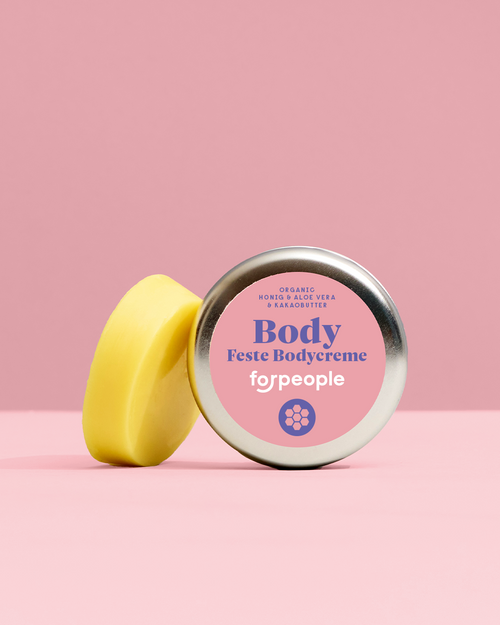
- Solid Body Butter - Beeswax & Aloe Vera, 40 g, €9.90: cocoa butter, olive oil, beeswax, sunflower oil, shea butter and aloe vera extract, water-free and without added fragrance; according to its product page applied after showering to still damp skin.
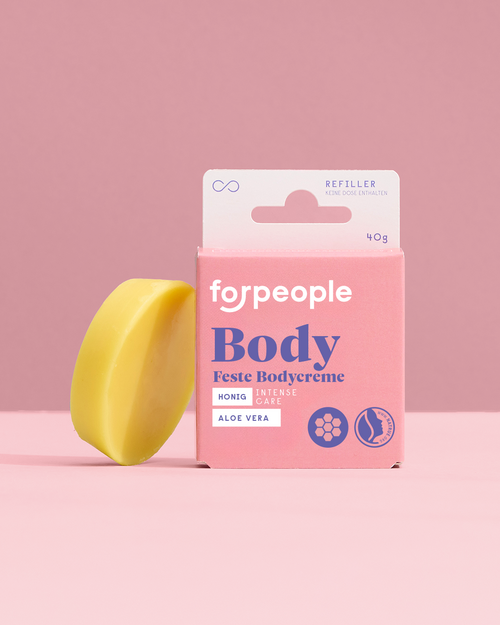
- Solid Body Butter Refill - Beeswax & Aloe Vera, 40 g, €7.90: the same butter for refilling the tin.
According to its product page it does not belong on red, weeping or scratched skin. The difference between urea and water-free care is explained in Urea or water-free cream? Rough heels and dry hands.
Read more: The skin barrier explained simply · Dry children's hands in winter: what helps · Dry skin in winter: what helps with cold and indoor heating · Humidity and skin: what dry heated air does and what helps
Sources
- Werfel T, Heratizadeh A, Aberer W, Augustin M, Bangert C, Bauer A et al. (2026): S3-Leitlinie Atopische Dermatitis (AD) [Neurodermitis; atopisches Ekzem]. AWMF register no. 013-027, version of 29 June 2026, valid until 15 June 2028. https://register.awmf.org/de/leitlinien/detail/013-027
- DermNet: Atopic dermatitis. Stanway A (2004), updated by Jarrett P (February 2021), minor update May 2023, accessed 29 October 2026. https://dermnetnz.org/topics/atopic-dermatitis
- DermNet: Dry skin (xeroderma). Oakley A (1997), updated March 2022, accessed 29 October 2026. https://dermnetnz.org/topics/dry-skin
- Augustin M, Kirsten N, Körber A, Wilsmann-Theis D, Itschert G, Staubach-Renz P, Maul JT, Zander N (2019): Prevalence, predictors and comorbidity of dry skin in the general population. Journal of the European Academy of Dermatology and Venereology 33(1): 147–150. https://doi.org/10.1111/jdv.15157
- Engebretsen KA, Johansen JD, Kezic S, Linneberg A, Thyssen JP (2016): The effect of environmental humidity and temperature on skin barrier function and dermatitis. Journal of the European Academy of Dermatology and Venereology 30(2): 223–249. https://doi.org/10.1111/jdv.13301
- Hamann CR, Andersen YMF, Engebretsen KA, Skov L, Silverberg JI, Egeberg A, Thyssen JP (2018): The effects of season and weather on healthcare utilization among patients with atopic dermatitis. Journal of the European Academy of Dermatology and Venereology 32(10): 1745–1753. https://doi.org/10.1111/jdv.15023
- DermNet: Tinea corporis. Created 2003, updated by Bell H, November 2020, accessed 29 October 2026. https://dermnetnz.org/topics/tinea-corporis
- Weisshaar E, Müller S, Szepietowski JC, Dalgard F, Garcovich S, Kupfer J et al. (2025): European S2k Guideline on Chronic Pruritus. Acta Dermato-Venereologica 105: adv44220. https://doi.org/10.2340/actadv.v105.44220