The problem: jumpers, scarves and tights itch
The new knitted jumper is warm, but after a few minutes it prickles on the neck, the wrists and the insides of the arms. The scarf scratches the chin, the woolly hat the forehead and behind the ears. Take the garment off and the feeling soon fades; sometimes red streaks from scratching remain. This is typical from October, when the woollens come out of the cupboard, and it often gets worse over the winter because the skin is drier by then. Some tights itch on the shins in a similar way, but for different reasons; more on that below.
Why wool itches more in autumn and winter
The prickle comes from fibre ends. Researchers have investigated what happens in the skin when a fabric "itches". The sensation is triggered by fibre ends that stick out of the fabric and press against the skin with a certain force before they bend; this force is enough to weakly activate pain nerve fibres. How strongly 55 test subjects perceived the prickle depended closely on how many such stiff fibre ends a fabric had (Garnsworthy et al. 1988). Thick fibres are stiffer and bend away later; that is why they itch.
From about 30 micrometres it becomes unpleasant. A review of a hundred years of literature concludes that skin irritation from wool is linked to fibre diameters from about 30 to 32 micrometres. Very fine merino wool, by contrast, does not activate enough nerve fibres to cause itch (Zallmann et al. 2017). This explains why two jumpers made of "100 % wool" can feel completely different.
The label names the fibre, not its fineness. In the EU, the label states which fibres a garment is made of, but not which chemicals were used in dyeing and finishing (German Federal Government 2016). You will not find a fibre diameter there. Fixed limits exist, for example, in US labelling law: cashmere may be no more than 19 micrometres thick on average and contain no more than 3 per cent fibres over 30 micrometres, and the label "Super 80's" requires wool averaging no more than 19.75 micrometres (15 U.S.C. § 68b). There are no such limits there for alpaca, mohair or ordinary sheep's wool; quality varies.
Dry skin reacts more strongly. According to a review, low humidity and cold reduce the skin's barrier function; it becomes more susceptible to mechanical stress and reacts more strongly to irritants (Engebretsen et al. 2016). Friction from rough clothing is itself one of the causes of dry skin (DermNet: Dry skin). So in autumn both come together: the wool season and skin that is already drier from heated air and hot showers. What the indoor air contributes is explained in Humidity and skin: what dry heated air does and what helps.
And the tights? Tights are usually made of synthetic fibres, which rarely itch because of thick fibre ends. But on the shins the skin has little fat of its own, close-fitting fabric rubs with every step, and freshly shaved skin is more sensitive. More in Why are shins dry and flaky in winter? and Moisturising after shaving your legs: what and when?
The solution step by step
| When | What you do | Why |
|---|---|---|
| Straight away | Take off the itchy garment, do not scratch, rinse the area with lukewarm water | Without fibre contact the prickle usually stops soon; scratching rubs the skin even more |
| Straight away | Wear a thin layer of cotton, silk or very fine merino wool under coarse knitwear, and a cloth under the scarf at the neck | The stiff fibre ends no longer reach the skin |
| Every evening | After a lukewarm shower, apply a rich, fatty product to still slightly damp skin, especially on the neck, arms and shins | Dry skin reacts more strongly to friction; the film of fat slows evaporation |
| Every evening | Let oil or butter absorb before putting on wool | Fat on wool leaves stains |
| Prevention | Wash new clothes before wearing them for the first time, following the care label; an extra rinse reduces detergent residue | Residues from production and detergent can strain the skin |
| Prevention | When buying, hold the garment against your neck or the inside of your wrist and ask about fibre and fineness | The skin there feels fibre ends most clearly |
Sources for the table: Garnsworthy et al. 1988, Zallmann et al. 2017, Engebretsen et al. 2016, DermNet, German Federal Government 2016; the routines themselves are common practice. Why the water should be lukewarm is explained in Itchy skin in winter: showering, care and when to see a doctor.
A body butter or a body oil suits the evening routine. According to its ingredient list, the Solid Body Butter - Beeswax & Aloe Vera consists of cocoa butter, olive oil, beeswax, sunflower oil, shea butter and aloe extract; its product page recommends it after showering on still-damp skin. The Body Oil - Lemongrass, made of sesame, safflower, sea buckthorn seed and sunflower oil with turmeric extract and lemongrass essential oil, spreads more thinly; according to its product page you let it absorb briefly before getting dressed. It contains the fragrance components citral, geraniol and citronellol. Which suits you better is covered in Body oil or body butter – which one when?; how to avoid stains in Does body oil stain? Clothes, bed linen, towels.
What helps – and what does not
| Measure or assumption | Assessment |
|---|---|
| Base layer of cotton or silk | helps; the wool's fibre ends do not reach the skin |
| Very fine merino wool, cashmere | itch much less because the fibres are thinner |
| Moisturising dry skin regularly | sensible; dry skin reacts more strongly to friction |
| "I have a wool allergy" | usually not the case; an allergy to the wool fibre has not been shown, the itch is irritation from thick fibres |
| "Lanolin in the jumper causes allergies" | very unlikely with modern woollen clothing; wool wax in creams is a separate topic |
| Putting a jumper in the freezer overnight | a common tip, not studied for the skin; cold does not change the fibre thickness |
| Hair conditioner or fabric softener in the wash | makes the surface feel softer, not studied; fabric softener can contain fragrances |
| A hot shower when it itches | rather unfavourable; hot water dries the skin out further |
Sources: Zallmann et al. 2017 on allergy, lanolin and fibre diameter, DermNet on lukewarm water. The entries on the freezer, hair conditioner and fabric softener are our assessment; we are not aware of studies on them.
On allergy in detail: according to the review, there is no evidence that the wool fibre is a contact allergen, and allergies caused by wool wax (lanolin), chromium or formaldehyde are very unlikely with modern woollen clothing (Zallmann et al. 2017). Official consumer pages still name wool as a possible trigger of intolerances (German Federal Government 2016); the more recent review of the evidence does not support this for the fibre itself. Wool wax as an ingredient of ointments and creams is a different matter, see Lanolin or beeswax: what is the difference? For textiles in general, certain dyes, known as disperse dyes, are considered the most important allergens (Malinauskiene et al. 2013).
Common mistakes
- Scratching. It rubs the skin even more and makes it drier.
- Taking a hot shower to get rid of the itch. Dermatological advice is to use lukewarm water (DermNet: Dry skin).
- Coarse wool directly on freshly shaved skin. Shaved legs or a shaved neck are particularly sensitive to friction at that moment.
- Applying oil and putting on the woollen jumper straight away. The oil goes into the fibres instead of the skin, and it stains.
- Avoiding all wool because you suspect an allergy. Usually fibre thickness is the cause; fine wool or a base layer often solves the problem.
- Washing wool too hot or too vigorously. It felts, the fabric becomes denser and harder; the care label gives the temperature.
When to get medical advice
The prickle from coarse wool disappears once the fabric is off. Have your skin looked at by a doctor if
- a rash with redness, blisters or weeping appears exactly where a particular garment touches the skin and remains after you take it off; this may be a contact allergy, for example to a textile dye, which a patch test can clarify (Malinauskiene et al. 2013),
- wheals appear, that is raised, itchy swellings like after nettle stings,
- it itches even without wool, especially at night or all over the body, or the skin stays dry and cracked for two to three weeks despite care,
- you or your child has atopic dermatitis or eczema and the skin gets worse under clothing; discuss which clothing suits with your dermatologist or paediatrician,
- the skin is broken from scratching, weeps or becomes inflamed.
A skincare cream keeps dry skin supple; it does not treat a rash.
Frequently asked questions
Why does wool itch on the skin?
Stiff fibre ends stick out of the fabric and press against the skin until they bend. With thick fibres, this force is enough to irritate nerve endings. Fibre diameter is what matters; from about 30 micrometres, many people find it unpleasant.
Which wool does not itch?
Very fine merino wool and cashmere itch much less because their fibres are thin. The fineness is usually not on the label; ask in the shop and hold the garment against the inside of your wrist.
Do cashmere and alpaca itch?
Cashmere is very fine; under US law it may be no more than 19 micrometres thick on average. There is no such limit for alpaca, and quality varies by animal and processing. Trying it on helps more than the name.
Do I have a wool allergy?
Probably not. According to a review, the wool fibre is not a proven allergen; the itch is irritation from thick fibres. But if a rash develops that remains after you take the garment off, have it checked by a doctor.
What helps with an itchy scarf?
A thin cotton or silk cloth under the scarf, moisturising the skin on your neck in the evening, and looking for finer fibres next time you buy.
Why do my tights itch?
Usually because of dry skin on the shins, friction from close-fitting fabric and shaving. Moisturise in the evening and let the care absorb before putting on your tights.
Does freezing wool help?
It is a common tip, but it has not been studied. Cold does not change the thickness of the fibres, and that is what decides whether it itches.
At forpeople
We do not sell clothing. For the skin under jumpers, scarves and tights, we have water-free body care for the evening.
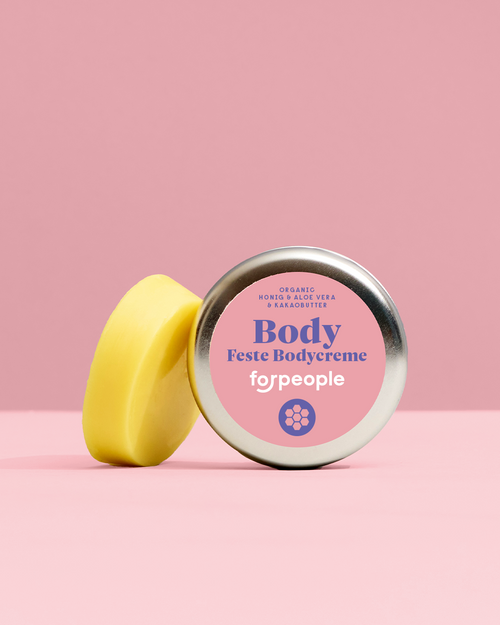
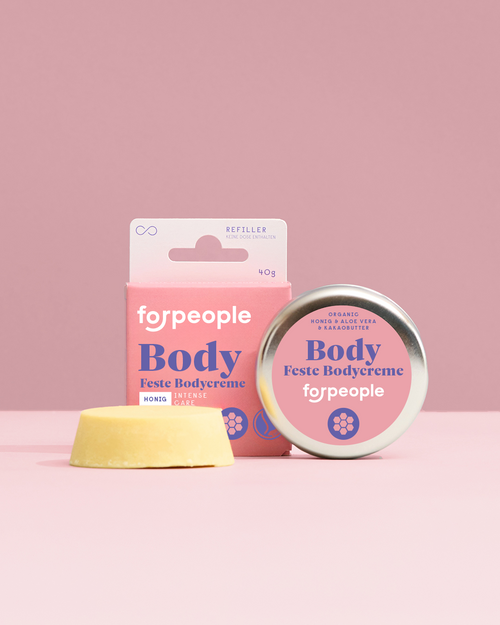
Solid Body Butter - Beeswax & Aloe Vera, 40 g, €9.90: cocoa butter, shea butter, beeswax and plant oils, after showering on damp skin.
Solid Body Butter Refill - Beeswax & Aloe Vera, 40 g, €7.90: the same butter for refilling the tin.
Body Oil - Lemongrass, 100 ml, €16.90: sesame, safflower and sea buckthorn seed oil with lemongrass oil, let it absorb before getting dressed.
Body Care Set – For Dry, Tight Skin (2× Body Butter), 80 g, €16.90: one tin and one refill.
More on this: Dry skin in autumn · Dry skin on the ears · Dry skin in winter: what helps with cold and indoor heating
From the blog: What is in the solid body butter – and why
Sources
- Garnsworthy RK, Gully RL, Kenins P, Mayfield RJ, Westerman RA (1988): Identification of the physical stimulus and the neural basis of fabric-evoked prickle. J Neurophysiol 59(4): 1083–1097. https://doi.org/10.1152/jn.1988.59.4.1083
- Zallmann M, Smith PK, Tang MLK, Spelman LJ, Cahill JL, Wortmann G et al. (2017): Debunking the Myth of Wool Allergy: Reviewing the Evidence for Immune and Non-immune Cutaneous Reactions. Acta Derm Venereol 97(8): 906–915. https://doi.org/10.2340/00015555-2655
- Wool Products Labeling Act, 15 U.S.C. § 68b (a)(5) and (a)(6). Legal Information Institute, Cornell Law School, accessed 29.10.2026. https://www.law.cornell.edu/uscode/text/15/68b
- Engebretsen KA, Johansen JD, Kezic S, Linneberg A, Thyssen JP (2016): The effect of environmental humidity and temperature on skin barrier function and dermatitis. J Eur Acad Dermatol Venereol 30(2): 223–249. https://doi.org/10.1111/jdv.13301
- DermNet: Dry skin. Oakley A (1997), updated March 2022, accessed 29.10.2026. https://dermnetnz.org/topics/dry-skin
- Malinauskiene L, Bruze M, Ryberg K, Zimerson E, Isaksson M (2013): Contact allergy from disperse dyes in textiles: a review. Contact Dermatitis 68(2): 65–75. https://doi.org/10.1111/cod.12001
- Die Bundesregierung (German Federal Government) (2016): Kleidung ohne Gift und Chemie. bundesregierung.de, 21.07.2016, accessed 29.10.2026. https://www.bundesregierung.de/breg-de/aktuelles/kleidung-ohne-gift-und-chemie-426408