A jar of pure shea butter that stood on the windowsill in winter can only be scraped out in crumbs. A body butter that lay in the car in summer feels gritty days later. A home-made cream was smooth on the first day and has grains after two weeks. All three cases have the same cause: the way fat crystallises. This page explains the mechanism, how to tell grains from spoilage and what helps. The composition and origin of shea butter are covered in Shea butter: composition, origin and refining, the comparison with cocoa and mango butter in Shea, cocoa or mango butter?
What the grains are: fat sorting itself out
Plant fats consist of triglycerides, that is, glycerol with three attached fatty acids. A natural fat is never a single substance but a mixture of many different triglycerides. Even small differences in the fatty acids change how the molecules stack in the crystal. Saturated fatty acids such as stearic acid pack tightly and melt at high temperatures; a double bond, as in oleic acid, puts a kink in the chain and lowers the melting point considerably. Different triglycerides often do not fit into the same crystal in the solid state and therefore crystallise separately (Himawan et al. 2006).
Shea butter is a textbook example. It consists mainly of stearic and oleic acid, and their shares vary widely: in 36 samples from seven African countries, stearic acid ranged from 28 to 56 % and oleic acid from 34 to 61 % (Akihisa et al. 2010). In thermal analysis, shea butter does not melt at one point but over a wide range with several melting peaks (Lawer-Yolar et al. 2019). Its hard fraction, shea stearin, which industry separates and uses as a cocoa butter alternative, only loses its solid fat above 35 °C (Macridachis et al. 2025). The skin surface is around 32 °C (Bouwstra et al. 2023).
How such mixtures turn into grains is shown by a trial with margarine containing a lot of palm oil: after three weeks alternating between 12 hours at 5 °C and 12 hours at 20 °C, granular crystals had formed. The higher-melting fatty acids were concentrated in them, the lower-melting ones in the surroundings. No change into another crystal form was needed for this; it was enough for the higher-melting triglycerides to cluster together (Tanaka et al. 2007). This is a food trial, but the principle can be transferred to water-free skincare: the grains are the hardest part of the fat, which has separated from the softer rest.
Polymorphism: why fat solidifies in several crystal forms
A second property comes on top. Triglycerides can solidify in several crystal forms, a phenomenon called polymorphism. The three main forms are called alpha, beta prime and beta. Only one of them is stable in the long run, and transformations only ever run towards the more stable form. On cooling, a less stable form usually appears first and then slowly rearranges; this can take a long time (Seilert et al. 2025).
| Crystal form | Stability | Molecular packing | What it means in the jar |
|---|---|---|---|
| Alpha (α) | least stable | loose, hexagonal | forms on rapid cooling, transforms quickly |
| Beta prime (β′) | metastable | denser, monoclinic | can persist for a long time |
| Beta (β) | stable | densest | end point of all transformations; the form with the densest packing |
Sources: crystal forms and stability (Seilert et al. 2025), densest packing of the most stable form (Himawan et al. 2006). The column “What it means in the jar” is a simplified interpretation.
Chocolate is the familiar example. Its cocoa butter is deliberately brought into a particular form during production; less stable forms change into more stable ones over time, and the most stable form is associated with fat bloom, the greyish-white film on old chocolate. If chocolate cools very quickly, unstable forms arise that transform rapidly and can also lead to bloom (Stobbs et al. 2025). White spots on a body butter containing cocoa butter and grains in shea butter are relatives of this effect. Exactly how it plays out in a particular cream cannot be said without a laboratory; even for food fats, many processes are still considered unexplained (Himawan et al. 2006).
When grains form: warmth, slow cooling, temperature changes
Three situations favour grains. This assessment follows from the mechanisms described; there are hardly any measurements for individual cosmetic products:
- Partly melted and slowly solid again: in the car, on the radiator or in the sun, part of the fat becomes liquid. If it cools slowly, the higher-melting parts have time to gather and grow into larger crystals.
- Frequent temperature changes: day and night by the window, warm bathroom and cool bedroom, a parcel in summer. Each change partly melts the smallest crystals and lets the larger ones keep growing as it cools, similar to the margarine trial with 5 °C and 20 °C (Tanaka et al. 2007).
- Home-made, not fully melted: if shea butter is only partly melted while mixing, crystal remnants remain as seeds on which grains later grow.
“Crumbly” is not always the same as “grainy”, by the way. Pure shea butter kept cold in winter is simply harder, because more of the fat is solid at low temperatures; it breaks into crumbs when scraped, but feels smooth in the hand once it warms up. It is grainy if individual hard beads can still be felt after warming.
Why does this mainly affect solid skincare? In a water-based cream, the fat is dispersed in fine droplets in the water phase. In a water-free cream, a butter or a balm, the whole product is fat and wax, and every change in the crystals shows directly on the surface and in the feel. How to get solid skincare through summer and winter is explained in Storing solid cosmetics: heat, summer and winter.
Grains or spoiled? The difference
Grains form from the same fat that is already in the tin. Nothing is added and nothing is lost. Whether the crystal form affects how the product cares for the skin has not been studied for cosmetics; in food, grains count as a texture defect (Tanaka et al. 2007), not as a sign of spoilage. Two real changes need to be kept apart from this.
| Feature | Fat crystals (grains) | Rancid (oxidation) | Microbial spoilage |
|---|---|---|---|
| Appearance | small hard beads, gritty surface, pale spots | often unchanged, sometimes darker or stickier | coloured or fluffy patches, slimy areas |
| Smell | as usual | sharp, of old fat, oil paint or modelling clay | musty, sour |
| Cause | warmth, slow cooling, temperature changes | oxygen, light and heat attack the fatty acids | water in the product, for example from wet fingers |
| What to do | warm it, rub it in, keep using it | stop using it | stop using it |
Sources: grains as above; water as a precondition for microbial growth (Halla et al. 2018); signs of rancid fat according to How to tell if a skin oil is rancid. Appearance and smell are practical experience.
Water is the most important precondition for microorganisms to grow (Halla et al. 2018). A water-free butter therefore does not go mouldy by itself; it only becomes a problem if water gets in during use. What to watch when taking product out is covered in Hygiene and water-free cosmetics. Why fats go rancid and how quickly is explained in Why does oil go rancid?
What you can do
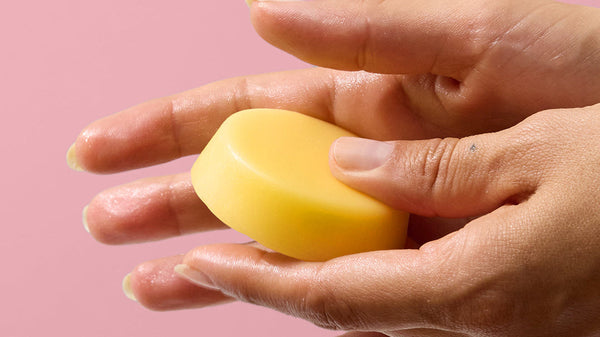
With finished products, your hands are usually enough. Take some butter or cream, rub it between your palms or fingertips until the grains soften, and then spread it. Because the hard fraction only melts above skin temperature, this can take a moment. Afterwards, store the tin at as even and cool a temperature as possible instead of letting it swing between warm and cold. Do not remelt finished products: in the microwave or a pan the heat is distributed unevenly, volatile fragrance substances are lost, water can get in, and the texture will be different afterwards. For a solid sunscreen that was completely liquid, the note in Storing solid cosmetics also applies.
With home-made products you can make corrections. This is how many people who make their own go about it; it is practical knowledge, not a tested method:
- Melt the mixture completely in a water bath, never over an open flame and never unattended. Hot fat can cause serious burns.
- Keep it liquid until no streaks or crystal remnants are visible, and a few minutes longer. Do not let any water drip in.
- Pour it into the containers and let it cool quickly and evenly, for example in the fridge, without moving the containers.
- Then store it cool and without large temperature changes.
Rapid cooling produces many small crystals instead of a few large ones. However, it initially creates less stable crystal forms that can still rearrange later (Stobbs et al. 2025). There is therefore no guarantee against grains. The more often you remelt, the longer the fat is exposed to heat and oxygen; remelting several times is not worth it. Recipes and quantities are in Making solid cream: how much wax to oil?, Making lip balm at home and Making deodorant cream at home; on shelf life see Homemade cream: how long does it last?
Shea butter in our products
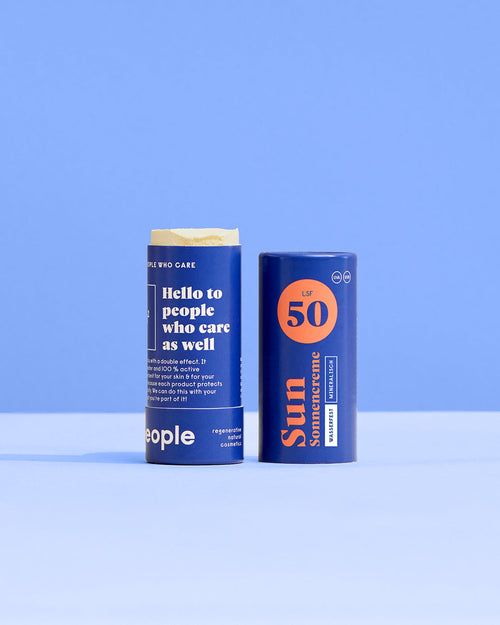
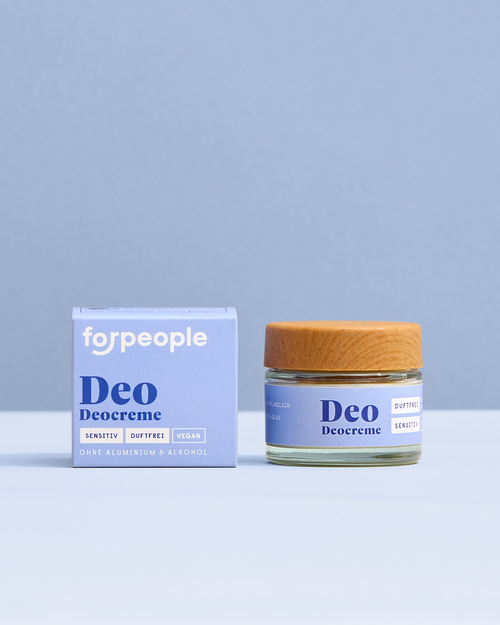
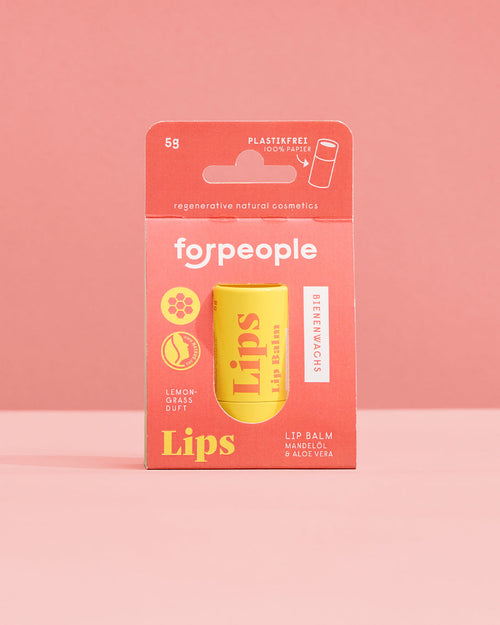
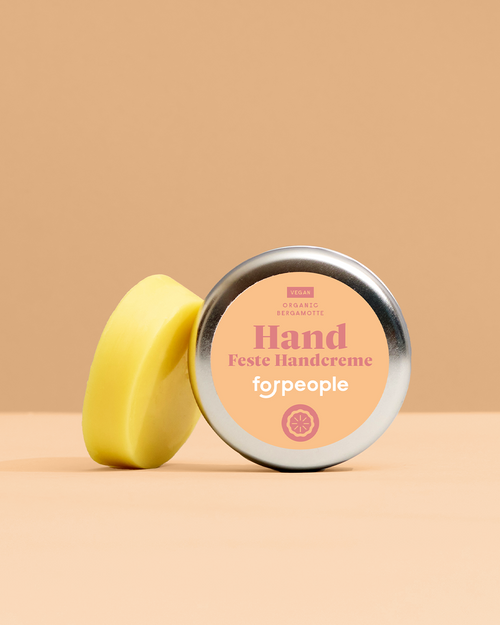
According to the ingredients list, shea butter comes first in the Solid Sunscreen SPF50, second in the Sensitive Deodorant Cream, third in the Lip Balm - Lemongrass, fourth in the Solid Vegan Hand Cream - Bergamot and the Solid Foot Cream – Rosemary & Sage, and fifth in the Solid Body Butter - Beeswax & Aloe Vera, where cocoa butter comes first. All these products are water-free and consist of fats, waxes and in some cases starch or mineral filters. They become softer when warm and firmer when cold, and after strong temperature changes grains or pale spots can form. This does not change the composition.
Frequently asked questions
Has crumbly shea butter gone off?
Usually not. Cold makes shea butter hard and crumbly; warmth followed by cooling makes it grainy. Both concern the crystals, not the composition. It has gone off if it smells rancid, or if water has got in and patches appear.
Can I still put grainy shea butter on my skin?
Yes, if it smells as usual. Rub the grains warm between your fingers until they are soft, then spread them. Gritty rubbing is unpleasant on cracked skin; there, apply only once the grains have been fully rubbed in.
Why is my shea butter crumbly in winter and soft in summer?
Because it melts over a wide temperature range. When it is cold, a large part is solid; at summer room temperature, more of it is liquid. How pronounced this is also depends on the origin, as the share of solid stearic acid varies from butter to butter.
Is it a sign of poor quality?
Not necessarily. Grains form mainly as a result of temperature history and storage. Composition plays a part: butter with a lot of stearic acid has more high-melting fractions. We have not found reliable comparisons between refined and unrefined shea butter on this.
Does it help to put shea butter in the fridge?
Storing it evenly cool helps more than constant changes. If you do keep it cool, let the closed tin reach room temperature before opening it so that no condensation forms.
Does shea butter go rancid when remelted?
Melting once, briefly, in a water bath is common practice. Heat and oxygen do speed up oxidation, though. So: no longer and hotter than necessary, and do not remelt again and again. More in Why does oil go rancid?
Why does my body butter have white spots instead of grains?
In butters with a lot of cocoa butter, fat crystals often show up as pale spots or a haze, similar to bloom on chocolate. They also melt when applied and are not mould, as long as the butter has stayed dry.
At forpeople
These water-free products contain shea butter; the full ingredients list is on each product page.
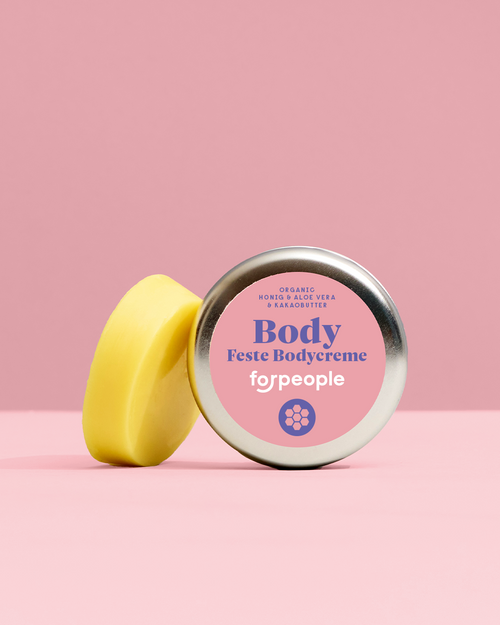
- Solid Body Butter - Beeswax & Aloe Vera, 40 g, €9.90: cocoa butter, olive oil, beeswax, sunflower oil, shea butter and aloe extract, for dry skin on the body.
- Solid Vegan Hand Cream - Bergamot, 30 g, €9.90: vegan, with candelilla wax, jojoba oil, olive oil, shea butter and hemp oil; scent from lemon and bergamot oil.
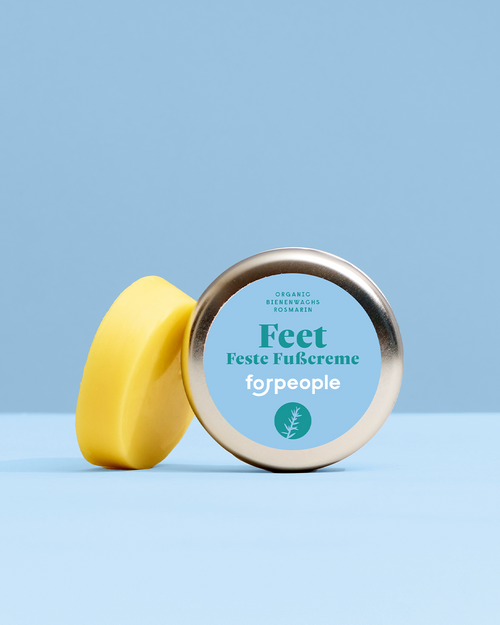
- Solid Foot Cream – Rosemary & Sage, 40 g, €9.90: sunflower oil, beeswax, olive oil and shea butter, with essential oils of rosemary, eucalyptus and sage, for dry feet.
- Lip Balm - Lemongrass, 5 g, €4.90: beeswax, sunflower oil, shea butter, almond and hemp oil, with lemongrass oil.
Store cool, dry and out of direct sunlight. Do not use on broken or irritated skin, and stop using if your skin reacts.
More on this: Water-free cosmetics · How do I apply a solid cream correctly?
From the blog: What is in the solid body butter – and why
Sources
- Himawan C, Starov VM, Stapley AGF (2006): Thermodynamic and kinetic aspects of fat crystallization. Advances in Colloid and Interface Science 122(1–3): 3–33. https://doi.org/10.1016/j.cis.2006.06.016
- Akihisa T, Kojima N, Katoh N, Ichimura Y, Suzuki H, Fukatsu M et al. (2010): Triterpene alcohol and fatty acid composition of shea nuts from seven African countries. Journal of Oleo Science 59(7): 351–360. https://doi.org/10.5650/jos.59.351
- Lawer-Yolar G, Dawson-Andoh B, Atta-Obeng E (2019): Novel phase change materials for thermal energy storage: Evaluation of tropical tree fruit oils. Biotechnology Reports 24: e00359. https://doi.org/10.1016/j.btre.2019.e00359
- Macridachis J, Bayés-García L, Calvet T (2025): Temperature-Driven Changes in the Polymorphism, Microstructure and Thermal Properties of Cocoa Butter/Shea Butter Stearin Blends. Food Biophysics 20(4). https://doi.org/10.1007/s11483-025-10030-7
- Bouwstra JA, Nădăban A, Bras W, McCabe C, Bunge A, Gooris GS (2023): The skin barrier: An extraordinary interface with an exceptional lipid organization. Progress in Lipid Research 92: 101252. https://doi.org/10.1016/j.plipres.2023.101252
- Tanaka L, Miura S, Yoshioka T (2007): Formation of Granular Crystals in Margarine with Excess Amount of Palm Oil. Journal of the American Oil Chemists’ Society 84(5): 421–426. https://doi.org/10.1007/s11746-007-1064-2
- Seilert J, Holdstock M, Pratama Y, Sadeghpour A, Flöter E, Rappolt M (2025): Polymorphic Structures and Transitions of Triglycerides and Complex Fats: A Guide to X-Ray Scattering Approaches. Comprehensive Reviews in Food Science and Food Safety 24(6): e70271. https://doi.org/10.1111/1541-4337.70271
- Stobbs JA, Ghazani SM, Donnelly ME, Marangoni AG (2025): Chocolate Tempering: A Perspective. Crystal Growth & Design 25(9): 2764–2783. https://doi.org/10.1021/acs.cgd.5c00269
- Halla N, Fernandes IP, Heleno SA, Costa P, Boucherit-Otmani Z, Boucherit K et al. (2018): Cosmetics Preservation: A Review on Present Strategies. Molecules 23(7): 1571. https://doi.org/10.3390/molecules23071571