An oil that was opened in spring and suddenly smells different in autumn did not go off overnight. The change was happening the whole time, just below the threshold your nose notices for a long while. This page explains what happens chemically, which measured values exist and what they mean in everyday life. How to recognise rancid oil at home and store it properly is summarised in How to tell if a skin oil is rancid.
Two ways an oil goes rancid
Oxidative: oxygen reacts with the double bonds of the unsaturated fatty acids. This is accelerated by light, heat, oxygen, pigments that capture light, and traces of metals such as iron and copper (Shahidi & Hossain 2022). This is the most common route for care oils.
Hydrolytic: enzymes known as lipases split fatty acids off the glycerol; this splitting requires water. The result is free fatty acids, which can then oxidise further (Shahidi & Hossain 2022). This is measured as the acid value. In pure oils without water, this route plays a smaller role in our assessment; one more reason not to let water get into the bottle.
Which fatty acids are particularly vulnerable depends on the number of double bonds: for oleic, linoleic and linolenic acid, oxidation rates in a ratio of 1 to 12 to 25 are given (Lužaić et al. 2023). Which of our oils contain a lot of them is shown in Linoleic or oleic acid? Fatty acids in plant oils explained.
What happens during oxidation: three phases
Autoxidation runs in three phases: initiation, propagation and termination. In the initiation phase the first radicals form. In propagation, reactive compounds multiply; at the end of this phase there are hydroperoxides and conjugated dienes. These break down into aldehydes, ketones, alcohols and volatile acids (Shahidi & Hossain 2022). Light speeds up the process considerably: excited singlet oxygen reacts with linoleic acid about 1500 times faster than normal atmospheric oxygen (Shahidi & Hossain 2022).
| Phase | What happens chemically | What you notice | What laboratories measure |
|---|---|---|---|
| Initiation | first radicals on the fatty acids | nothing | induction time in accelerated tests |
| Propagation | hydroperoxides and conjugated dienes accumulate | usually nothing, or only a slightly changed smell | peroxide value, conjugated dienes |
| Breakdown | hydroperoxides break down into aldehydes and other volatile substances | sharp, musty smell of paint, old nuts or cardboard; thicker oil | anisidine value, volatile substances such as hexanal |
Basis: Shahidi & Hossain 2022; on the key values Caño-Ochoa et al. 2022. The column “What you notice” describes typical experience, not a measurement.
Why do you smell it so late? Linoleic acid produces, among others, 2,4-decadienal, 2-octenal and hexanal, oleic acid produces octanal, heptanal and also hexanal. Their smells are described as painty, metallic, green, beany and rancid, and some can be detected in traces: for diunsaturated aldehydes, the odour threshold is 0.002 to 0.6 milligrams per kilogram (Shahidi & Hossain 2022). So your nose is sensitive, but it only reacts to the breakdown products, not to the early phase.
Peroxide value, anisidine value, acid value: what the laboratory values mean
Producers test oils using standardised methods. The most important key values and the limits that the international food standard Codex Alimentarius sets for edible oils:
| Key value | What it measures | cold-pressed and virgin oils | refined oils |
|---|---|---|---|
| Peroxide value | amount of hydroperoxides, the first oxidation products | no more than 15 mEq O₂/kg | no more than 10 mEq O₂/kg |
| Acid value | free fatty acids, a measure of splitting by water and enzymes | no more than 4.0 mg KOH/g | no more than 0.6 mg KOH/g |
| Anisidine value | aldehydes, that is, later breakdown products | not limited in the Codex | not limited in the Codex |
| Virgin olive oil | peroxide value; free acidity as oleic acid | below 20 mEq O₂/kg; “extra virgin” no more than 0.8 g per 100 g | refined olive oil: below 5 mEq O₂/kg |
Sources: Codex Alimentarius, Standard 210 for named vegetable oils; olive oil according to Standard 33. These values apply to food. We are not aware of specific peroxide value limits for cosmetic oils in cosmetics law; the values for edible oils offer a point of reference. The peroxide value alone does not tell the whole story: it captures the first stage, the anisidine value the breakdown products of the hydroperoxides. Only both together give a picture of how rancid an oil is (Prescha et al. 2014).
Evidence that these values are not just theory: in a sample of oils from cosmetics shops in Warsaw, peroxide values ranged from 0.82 to 232 milliequivalents per kilogram; two oils, perilla and raspberry seed oil, exceeded 200 (Bialek et al. 2016). For an edible oil, that would be many times the limit.
How quickly cold-pressed oils actually age
A storage study followed cold-pressed oils in their original bottles at 20 °C, alternating twelve hours of light and twelve hours of darkness, over the shelf life stated by the producer (Prescha et al. 2014). Four of the oils studied are also used in our products:
| Oil | Shelf life according to producer | Peroxide value fresh → end | Anisidine value fresh → end |
|---|---|---|---|
| Sesame oil | 12 months | 1.4 → 4.1 | 0.25 → 0.37 |
| Safflower oil | 12 months | 4.2 → 9.7 | 2.8 → 2.7 |
| Hemp oil | 6 months | 3.2 → 8.7 | 2.7 → 3.7 |
| Rosehip oil | 6 months | 3.0 → 4.5 | 8.6 → 14.4 |
Means of three to five brands per oil; peroxide value in mEq O₂/kg (Prescha et al. 2014). The fatty acid composition stayed practically the same over this period, while the oxidation values rose. The mean peroxide values stayed below the Codex limit of 15; one brand of hemp oil was above it at the end, at 16.0. Rosehip oil stands out: its peroxide value rose only slightly, its anisidine value, the later breakdown products, clearly. The authors write that the shelf life of cold-pressed oils is usually set at 6 or 12 months, limited mainly by the content of polyunsaturated fatty acids, especially alpha-linolenic acid, and of antioxidants.
Accompanying substances shift the picture. In one study, cold-pressed rosehip oils contained up to 1124.7 milligrams of tocopherols and 107.7 milligrams of carotenoids per kilogram and were therefore comparatively well protected despite their many double bonds (Grajzer et al. 2015). For argan oil, the edible oil from roasted kernels lasted an average of 31 hours in an accelerated test at 110 °C, cosmetic argan oil from unroasted kernels 13 hours (Gharby & Charrouf 2022). Such accelerated tests work with temperatures of 100 °C and more that do not occur in normal storage (Prescha et al. 2014); their results therefore cannot be converted directly into months.
Vitamin E: what tocopherol can and cannot do
Tocopherols occur naturally in plant oils and capture radicals. Many producers add them as well. More does not necessarily help more: in older experiments with pure linoleic acid, alpha-tocopherol promoted oxidation at 3.8 percent and protected at smaller amounts; in soybean oil the most favourable amount was 0.01 percent. In walnut oil with 2 percent added alpha-tocopherol, the initial phase of oxidation was almost entirely absent at 40 °C (Caño-Ochoa et al. 2022, citing earlier work). How vitamin E is used in cosmetics and which forms exist is explained in Vitamin E (tocopherol) in cosmetics.
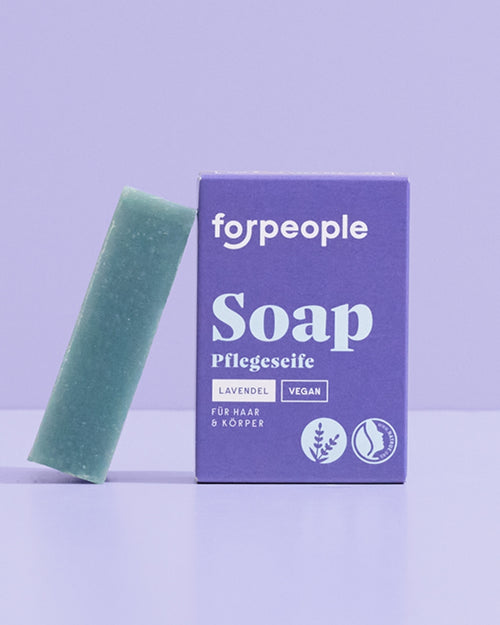
According to the ingredient list, our pure oils consist only of the respective oil, without added tocopherol; they contain only their own tocopherols. Added tocopherol appears, for example, in the INCI list of the Lip Balm - SPF15 Almond & Vanilla and of the bar soaps such as the Aloe Vera Soap – Lavender.
Is rancid oil bad for your skin?
The honest answer: for plant oils on human skin this has hardly been studied; we did not find a study on it in the PubMed literature database (search in October 2026). There are, however, indications from animal studies. In the rabbit ear, oleic acid and its peroxides caused blackheads, and the blackheads were larger the more peroxides the sample contained; oxidised squalene had a much stronger effect than fresh squalene (Motoyoshi 1983). With oils containing essential oils, there is the added factor that oxidised fragrance components trigger contact allergies more often; more on this in Essential Oils and Fragrance Allergens. Our recommendation follows cautiously from this: do not put rancid oil on your skin any more. What oxidised fats can mean for blackheads is covered in Comedogenic oils: where the scale comes from and what it is worth.
Shelf-life information and the test at home
Cosmetics carry either a best-before date or the symbol with the open jar, which states the months after opening; the rules are explained in Cosmetics Shelf Life: Hourglass Symbol and PAO After Opening. Both assume normal storage. This is how to check an oil if you are unsure:
- Create a reference: when you open a new bottle, smell it consciously once and remember the smell.
- Warm a drop: rub it in your palm; warmth makes volatile substances more noticeable.
- Look out for typical notes: paint, modelling clay, old nuts, cardboard or a metallic tone are warning signs. A weaker scent in oils with essential oils, on the other hand, is not on its own a sign of rancidity.
- Check the consistency: if the oil seems thicker or stickier than before, it is usually already well oxidised.
- If in doubt, throw it out: an oil you no longer like the smell of does not belong on your skin.
These steps are practical knowledge; they do not replace a measurement. The same principle applies to solid products made of oils and waxes, see Storing solid cosmetics: heat, summer and winter.
When to seek medical advice?
If you have applied a rancid oil, wash it off with water and a little soap. If your skin then turns red, burns or itches, or if blisters or wheals develop, have the reaction checked by a doctor, especially if it does not subside after a day or spreads. If you already know that you react allergically to fragrances or resins, discuss care oils with essential oils with your dermatologist first.
Frequently asked questions
Can an oil be rancid even though it still smells normal?
Yes, at an early stage. The first oxidation products, the hydroperoxides, are measured by the peroxide value; only their breakdown products can be smelled. An oil that smells normal and is still within the stated period can be used.
What is a good peroxide value?
For cold-pressed edible oils the limit is 15 milliequivalents of oxygen per kilogram, for refined oils 10 (Codex 210). In a storage study, the means for fresh cold-pressed oils ranged from 0.6 to 9.6, most between 1 and 5 (Prescha et al. 2014).
Does oil not go rancid in the fridge?
More slowly, but it still does. Cold slows the reaction down, while light and air in the bottle keep working. The fridge makes most sense for oils rich in linolenic acid such as rosehip oil.
Does added vitamin E make an oil last indefinitely?
No. Tocopherol slows oxidation down in small amounts and can promote it in large amounts (Caño-Ochoa et al. 2022). Storage and time remain decisive.
Do solid creams and butters go rancid too?
Yes, because they consist of oils and fats. Saturated fats such as shea and cocoa butter oxidise more slowly, but the liquid oils they contain behave no differently than in the bottle.
Why does rosehip oil have a shorter shelf life than almond oil?
Because it contains a lot of linoleic and linolenic acid, whereas almond oil consists mainly of oleic acid. In the storage study, producers gave cold-pressed rosehip oil 6 months (Prescha et al. 2014).
Is cloudy or flaky oil rancid?
Not necessarily. Cold can make waxes and solid fat fractions separate out; at room temperature this usually clears again. The smell is what counts.
At forpeople
Our pure oils are cold-pressed and come in dark glass bottles. They differ clearly in how sensitive they are:
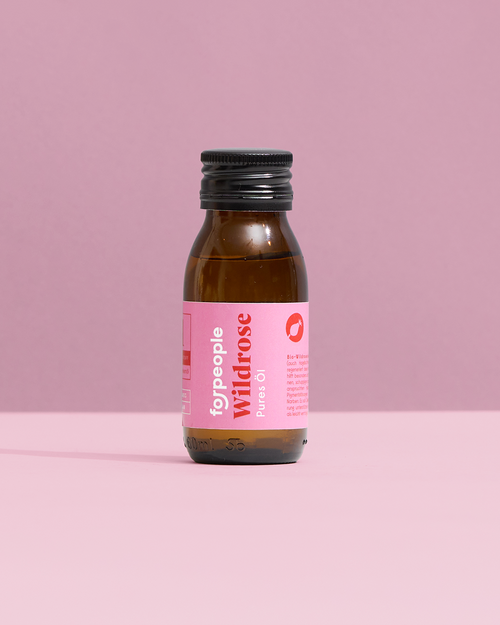
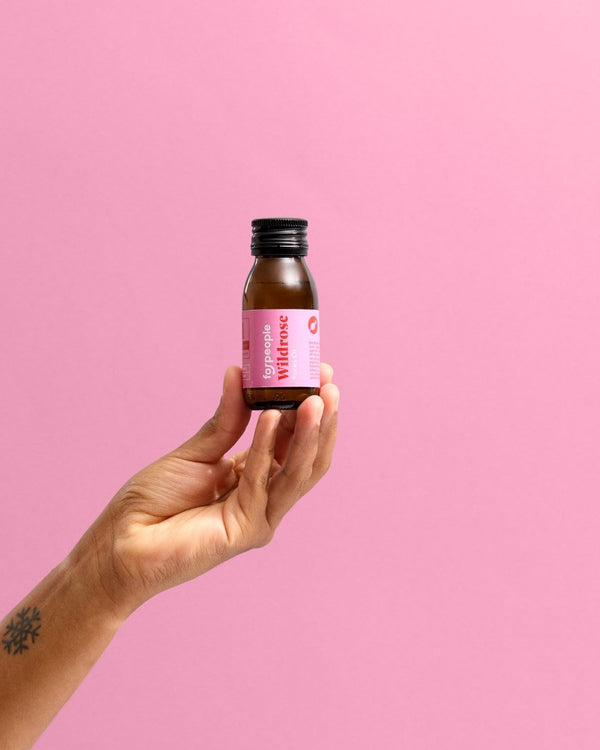
- Wild Rose Seed Oil - pure, 50 ml, €19.90: rich in linoleic and linolenic acid; after opening, store cool and dark and use up quickly, ideally in the fridge.
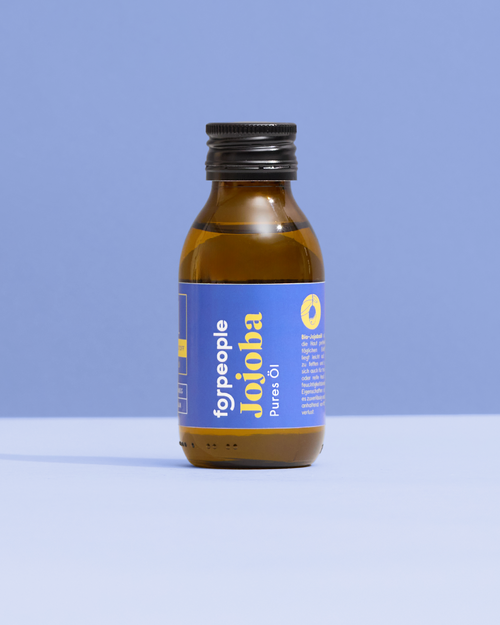
- Jojoba Oil - pure, 100 ml, €16.90: chemically a liquid wax and much more stable; more in Can jojoba oil go off? Shelf life and structure.
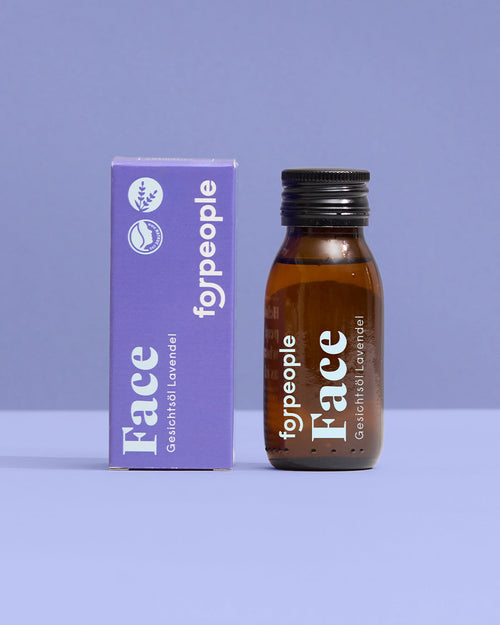
- Face Oil - Lavender, 50 ml, €21.90: with rosehip, borage and hemp oil it contains several sensitive oils as well as lavender oil; close tightly and keep out of the sun.
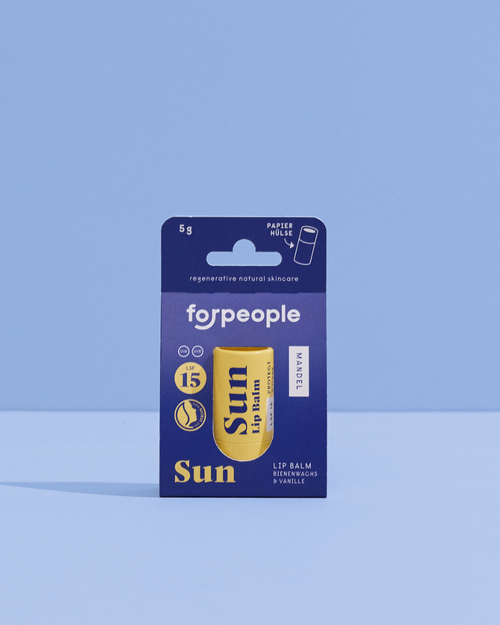
- Lip Balm - SPF15 Almond & Vanilla, 5 g, €7.90: with tocopherol in the formula; do not leave it in the heat.
The shelf life after opening is stated on each pack.
More on this: Cold-pressed or refined: what the difference means for oils · Argan, jojoba, almond or rosehip oil: how do they differ? · Blending your own face oil: ratios, scent, shelf life
From the blog: Rosehip seed oil: what it contains, effects on skin, storage
Sources
- Shahidi F, Hossain A (2022): Role of Lipids in Food Flavor Generation. Molecules 27(15): 5014. https://doi.org/10.3390/molecules27155014
- Lužaić T, Kravić S, Stojanović Z, Grahovac N, Jocić S, Cvejić S et al. (2023): Investigation of oxidative characteristics, fatty acid composition and bioactive compounds content in cold pressed oils of sunflower grown in Serbia and Argentina. Heliyon 9(7): e18201. https://doi.org/10.1016/j.heliyon.2023.e18201
- Codex Alimentarius Commission (2015): Standard for Named Vegetable Oils, CODEX STAN 210-1999, Fassung mit Änderungen bis 2015, Abschnitt 2.2 und Anhang (Qualitätsmerkmale). fao.org
- Prescha A, Grajzer M, Dedyk M, Grajeta H (2014): The Antioxidant Activity and Oxidative Stability of Cold-Pressed Oils. Journal of the American Oil Chemists' Society 91(8): 1291–1301. https://doi.org/10.1007/s11746-014-2479-1
- Bialek A, Bialek M, Jelinska M, Tokarz A (2016): Fatty acid profile of new promising unconventional plant oils for cosmetic use. International Journal of Cosmetic Science 38(4): 382–388. https://doi.org/10.1111/ics.12301
- Gharby S, Charrouf Z (2022): Argan Oil: Chemical Composition, Extraction Process, and Quality Control. Frontiers in Nutrition 8: 804587. https://doi.org/10.3389/fnut.2021.804587
- Grajzer M, Prescha A, Korzonek K, Wojakowska A, Dziadas M, Kulma A et al. (2015): Characteristics of rose hip (Rosa canina L.) cold-pressed oil and its oxidative stability studied by the differential scanning calorimetry method. Food Chemistry 188: 459–466. https://doi.org/10.1016/j.foodchem.2015.05.034
- Caño-Ochoa SD, Ruiz-Aracama A, Guillén MD (2022): Alpha-Tocopherol, a Powerful Molecule, Leads to the Formation of Oxylipins in Polyunsaturated Oils Differently to the Temperature Increase: A Detailed Study by Proton Nuclear Magnetic Resonance of Walnut Oil Oxidation. Antioxidants 11(4): 604. https://doi.org/10.3390/antiox11040604
- Motoyoshi K (1983): Enhanced comedo formation in rabbit ear skin by squalene and oleic acid peroxides. British Journal of Dermatology 109(2): 191–198. https://doi.org/10.1111/j.1365-2133.1983.tb07080.x
- Codex Alimentarius Commission (2015): Standard for Olive Oils and Olive Pomace Oils, CODEX STAN 33-1981, Revision 2015, Abschnitte 3 und 8 (Qualitätskriterien). fao.org