


The building kit: three roles
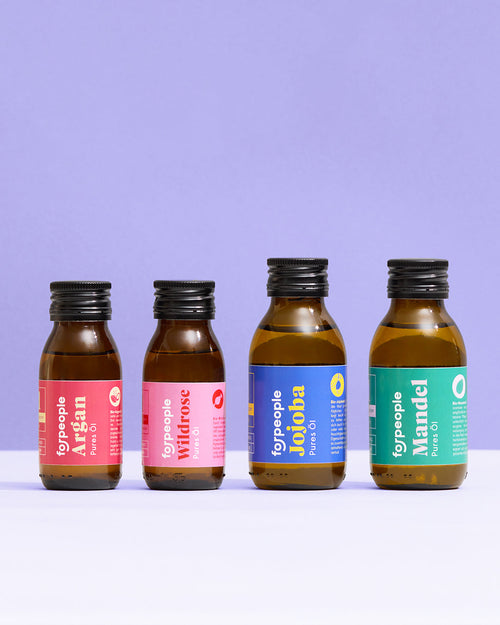
A face oil consists of oils only, with no water and no emulsifier. What matters is how the oils age: oxidation starts at the unsaturated fatty acids, and the more double bonds an oil has, the lower its stability towards oxygen (Gharby & Charrouf 2022). That gives three roles.
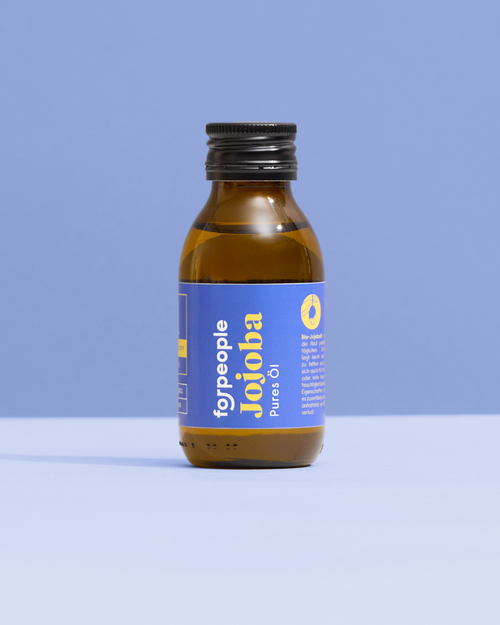
- The stable base: Jojoba Oil - pure. Jojoba oil consists of about 98 percent waxes, mainly wax esters. Left unrefined, it is very resistant to turning rancid (Gad et al. 2021). More on this: Jojoba oil: why it is a liquid wax.
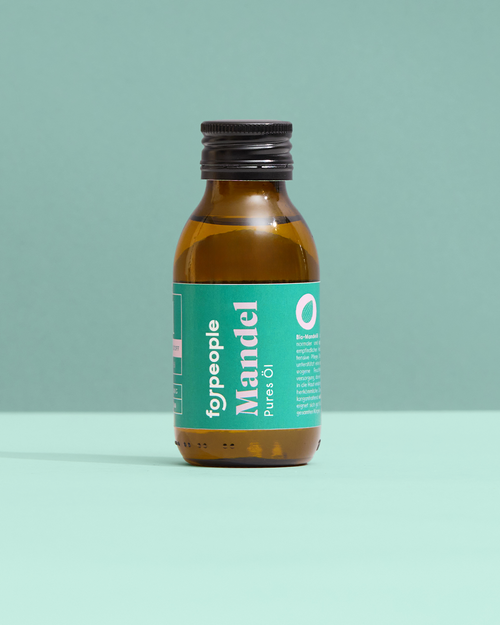
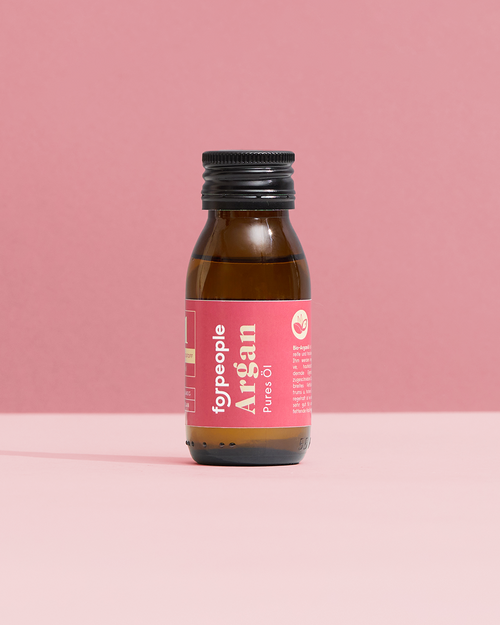
- The richer oil: Almond Oil - pure or Argan Oil - pure. Both feel a little fuller than jojoba oil. Argan oil contains mainly oleic acid and linoleic acid, fatty acids with one and with two double bonds (Gharby & Charrouf 2022).
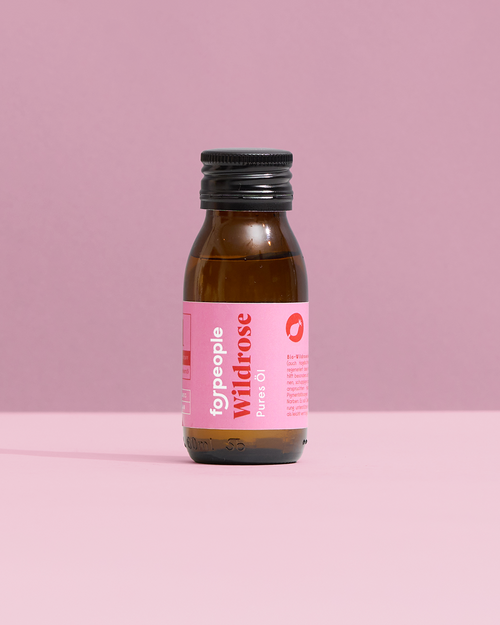
- The delicate oil in a small share: rosehip seed oil, also called wild rose seed oil. Cold-pressed rosehip seed oils are rich in linolenic acid (Grajzer et al. 2015), a fatty acid with three double bonds.
Which fatty acids are in which oil is set out under Argan, jojoba, almond or rosehip oil: how do they differ? How an oil feels on the skin is a matter of experience; which blend suits you, only trying will show.
Three example blends for 30 ml
The ratios are given in parts. With a 5 ml measuring spoon, one part is one spoonful; six parts make 30 ml. The blends are a guide, not a promise of any effect.
| Blend | Ratio | For 30 ml | What it is like |
|---|---|---|---|
| Light | 4 parts jojoba oil, 2 parts argan oil | 20 ml jojoba oil, 10 ml argan oil | thin and runny; a good start |
| Richer | 3 parts almond oil, 2 parts jojoba oil, 1 part rosehip seed oil | 15 ml almond oil, 10 ml jojoba oil, 5 ml rosehip seed oil | fuller feel, slightly yellow-orange; contains the most delicate oil and is the one to use up first |
| Little smell of its own | 5 parts jojoba oil, 1 part almond oil | 25 ml jojoba oil, 5 ml almond oil | the highest share of stable jojoba oil; for anyone who does not want scent |
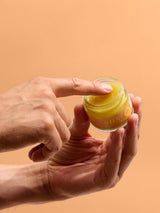
To try a blend out, mix it in the palm of your hand first: two drops of one oil, one drop of the other.
How to blend
- Prepare the bottle: Take a small bottle made of dark glass. It must be clean and completely dry.
- Check the oils: Smell each oil. If one smells sharp, musty or of old nuts, it does not belong in the blend; see How to tell if a skin oil is rancid.
- Measure and mix: Pour the oils into the bottle using a clean, dry measuring spoon and a small funnel, close it and swirl it a few times. The oils dissolve in one another and do not separate again.
- Label: Write the oils, the shares and the date on a label.
- Test: Try the blend on a small area first: Trying a new product: how do I test it on a small area?
- Use: Rub two to three drops between your palms and press them onto skin that is still slightly damp.
How long does the blend keep?
There is no tested figure in months for a blend you make yourself. Three things help you judge.
- The most delicate oil sets the pace. You use up a blend with rosehip seed oil sooner than one made of jojoba and almond oil. That is a classification by fatty acids, not a measured value. In one study, cold-pressed rosehip seed oils were comparatively well protected by their own antioxidants (Grajzer et al. 2015).
- The oldest bottle counts. Blending does not restart the clock; what matters is the oil that has been open the longest. What the information on the bottle means is explained under Cosmetics Shelf Life and the PAO Symbol.
- Your nose decides. If the blend smells clearly different from the first day, stop using it.
Store the bottle closed, cool and in the dark. The emptier it gets, the more air sits above the oil; that is another reason why small amounts make sense.
Scent: easiest to leave out
A face oil does not need scent. Essential oils are mixtures of many fragrance substances, and some of these can trigger contact allergies. The EU's Scientific Committee on Consumer Safety estimates that 1 to 3 percent of the population in Europe have a contact allergy to fragrance ingredients (SCCS 2012). This applies to natural fragrance materials too: the committee lists lavender oil among the natural extracts with established contact allergies in humans.
If you want scent anyway, dose very low. A point of reference is what is usual in finished cosmetics: outside perfume, deodorant and aftershave, cosmetic products contain 0.1 to 1 percent fragrance compound according to the SCCS (SCCS 2012). That describes usual amounts in products whose safety is assessed individually, and it is not a limit for your own blend.
For 30 ml that would be 0.03 to 0.3 ml. Depending on the oil and the dropper, one drop is roughly 0.02 to 0.05 ml; that figure comes from experience. With one to three drops for the whole bottle you are at about 0.5 percent at most. Recipes that give as many drops of essential oil as of plant oil come to around 50 percent, many times more. We advise against that.
We do not sell essential oils on their own. If you react to fragrances, or do not know whether you do, blend without. Background: Essential Oils and Fragrance Allergens.
For comparison: a finished blend
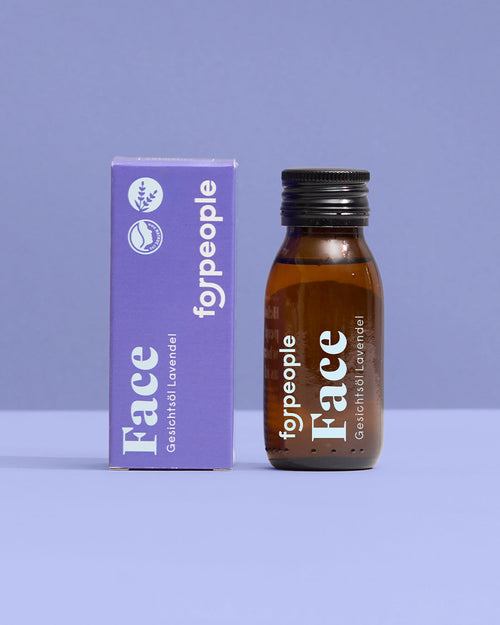
The ingredient list of our Face Oil - Lavender names five plant oils: argan, rosehip, jojoba, borage and hemp oil. These are followed by essential lavender oil and its constituents linalool and limonene. In the EU the list is given in descending order of weight; anything that makes up less than 1 percent may come at the end in any order. The lavender oil comes after all five plant oils. Unlike a blend of your own, a product on sale has gone through a safety assessment beforehand (Regulation (EC) No 1223/2009, Articles 10 and 19).
When to seek medical advice?
An oil you have blended yourself is care, not treatment. If your skin turns red, burns or develops hives after you apply it, wash the oil off and stop using it. If the reaction persists or returns, have it checked by a doctor. If you are allergic to almonds or other nuts, ask a doctor before using almond or argan oil. If you have a known fragrance allergy, blend without essential oils. Do not apply oils to injured or irritated skin, and keep them out of your eyes.
Frequently asked questions
Which ratio is good to start with?
Jojoba oil and argan or almond oil in a ratio of 2 to 1. The blend is thin and contains no particularly delicate oil.
How many drops of essential oil go into 30 ml?
The easiest answer is none. If you want scent, use one to three drops for the whole bottle, not for each use.
How long does a home-blended face oil keep?
That depends on the most delicate oil, the age of the bottles you started from and how you store it. Blend small amounts and note the date.
Can I add aloe vera serum or water to the bottle?
No. Water and oil separate again, and a blend containing water without tested preservation can spoil. Mix the two only in the palm of your hand. More on this: How long does homemade cream last?
May I give away or sell the oil I have blended?
For yourself you are free to blend. The EU Cosmetics Regulation applies as soon as a cosmetic product is supplied in the course of a commercial activity, whether for payment or free of charge. It then needs, among other things, a responsible person and a safety assessment (Regulation (EC) No 1223/2009, Articles 2, 4 and 10). If you pass a bottle on, write all the oils and the date on it.
At forpeople
We offer the raw materials as pure, cold-pressed oils from certified organic farming. According to the ingredient list, each consists only of the oil itself.
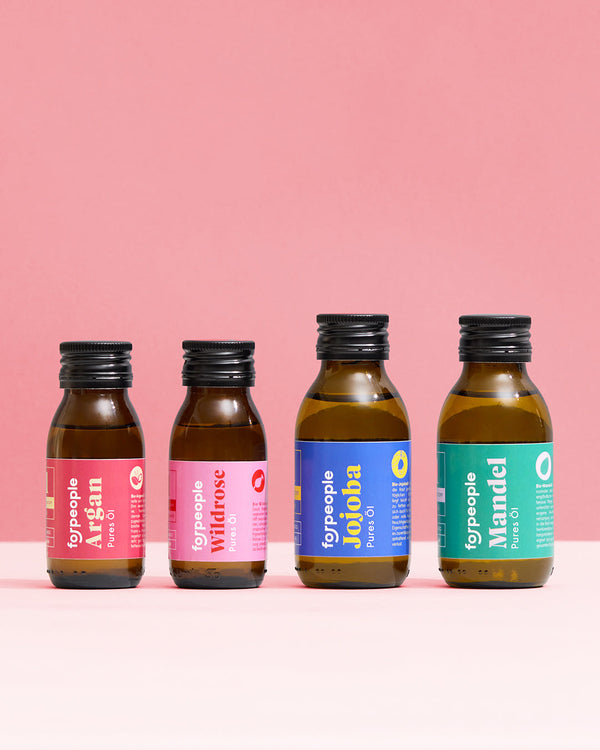
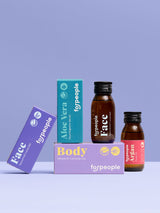
- Care Oil Set – 4 Organic Oils for Face, Body & Hair, €69.90: argan, jojoba, almond and rosehip seed oil, one bottle of each. According to the product page, to be used singly or as a blend.
- Jojoba Oil - pure, 100 ml, €16.90: the stable base.
- Wild Rose Seed Oil - pure, 50 ml, €19.90: the most delicate of the four oils; store cool and in the dark.
- Face Oil - Lavender, 50 ml, €21.90: the finished blend with essential lavender oil.
For all of them, the product pages say: avoid contact with the eyes and do not use on injured or irritated skin. If you notice a skin reaction, stop using the product.
More on this: Making solid cream: how much wax to oil? · Mixing your own massage oil: how much essential oil per 100 ml? · Citrus oils in cosmetics and the sun: what does phototoxic mean?
From the blog: Face & Body Oils: Which Oil Suits Which Skin Type?
Sources
- Gharby S, Charrouf Z (2022): Argan Oil: Chemical Composition, Extraction Process, and Quality Control. Frontiers in Nutrition 8: 804587. https://doi.org/10.3389/fnut.2021.804587
- Gad HA, Roberts A, Hamzi SH, Gad HA, Touiss I, Altyar AE et al. (2021): Jojoba Oil: An Updated Comprehensive Review on Chemistry, Pharmaceutical Uses, and Toxicity. Polymers (Basel) 13(11): 1711. https://doi.org/10.3390/polym13111711
- Grajzer M, Prescha A, Korzonek K, Wojakowska A, Dziadas M, Kulma A et al. (2015): Characteristics of rose hip (Rosa canina L.) cold-pressed oil and its oxidative stability studied by the differential scanning calorimetry method. Food Chemistry 188: 459–466. https://doi.org/10.1016/j.foodchem.2015.05.034
- Scientific Committee on Consumer Safety (SCCS) (2012): Opinion on fragrance allergens in cosmetic products. SCCS/1459/11, angenommen am 26.–27. Juni 2012. https://ec.europa.eu/health/scientific_committees/consumer_safety/docs/sccs_o_102.pdf
- Europäisches Parlament und Rat (2009): Verordnung (EG) Nr. 1223/2009 über kosmetische Mittel, Artikel 2, 4, 10 und 19. ABl. L 342: 59. https://eur-lex.europa.eu/eli/reg/2009/1223/oj