




Three triglyceride oils and one wax
Like most plant oils, argan, almond and rosehip oil consist of triglycerides: three fatty acids are bound to one glycerol. Three fatty acids are in the foreground here:
- Oleic acid: one double bond.
- Linoleic acid: two double bonds.
- Alpha-linolenic acid: three double bonds.
Jojoba oil is built differently. Around 98 per cent of it is waxes, mainly wax esters: one long fatty acid and one long fatty alcohol each, mostly with 20 or 22 carbon atoms and one double bond apiece (Gad et al. 2021). The details are under Jojoba oil: why it is a liquid wax.
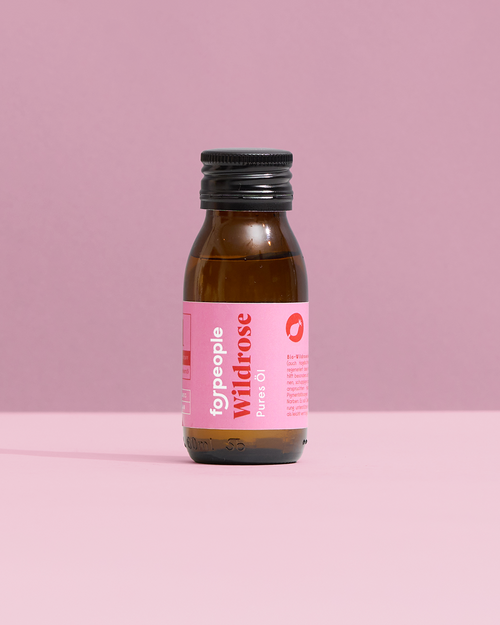
“Rosehip oil” here means the oil pressed from the seeds of the rosehip, sold by us as Wild Rose Seed Oil, not the essential oil from rose petals.
The four oils compared
| Feature | Argan oil | Jojoba oil | Almond oil | Rosehip oil |
|---|---|---|---|---|
| INCI name on our bottles | Argania Spinosa Kernel Oil | Simmondsia Chinensis Seed Oil | Prunus Amygdalus Dulcis Oil | Rosa Canina Fruit Oil |
| Structure | triglycerides | around 98% waxes, mainly wax esters | triglycerides | triglycerides |
| Oleic acid | 43–49% | not applicable | 63–78% | 14.7–22.1% |
| Linoleic acid | 29–36% | not applicable | 12–27% | 35.9–54.8% |
| Alpha-linolenic acid | at most 0.3% | not applicable | not a major fatty acid | 16.6–26.5% |
| Colour, unrefined | gold-coloured | golden to light yellow | light yellow | yellow-orange to reddish |
| Stability against rancidity | medium | high | medium | lowest |
| Absorption in our reviews (praised / criticised) | 1 / 2 | 9 / 1 | 11 / 1 | 4 / 1 |
| Often used for | face, hair ends | face, cuticles, hair, your own blends | body, massage, large areas | face in the evening, small areas |
| Storage | cool and dark | cool and dark; turns solid below about 7 °C | cool and dark | cool and dark, in the fridge once opened if you like |
Sources of the figures: argan oil according to Gharby & Charrouf 2022; jojoba oil according to Gad et al. 2021; almond oil according to Kodad & Socias i Company 2008, measured in 55 cultivars and breeding lines; rosehip oil according to Lin et al. 2018. The shares vary with variety, cultivation and pressing. Stability is a qualitative rating. “Absorption” comes from our analysis of the reviews from September 2026; the numbers are small. The uses and the colours of almond and rosehip oil are based on experience.
What the fatty acids say about shelf life
Oils go rancid when oxygen attacks the double bonds. The more double bonds an oil has, the lower its stability; linolenic acid is regarded as particularly easy to oxidise (Gharby & Charrouf 2022).
- Jojoba oil: Its stability is high, thanks in part to natural tocopherols. If it is bleached, they are lost and stability drops (Gad et al. 2021).
- Argan oil: Cosmetic argan oil is pressed from unroasted kernels; for argan oil the review gives 60 to 90 milligrams of tocopherols per 100 grams (Gharby & Charrouf 2022). In a one-year storage trial it quickly lost quality at 40 °C. At 25 °C and protected from light it was still satisfactory after twelve months; for stricter industry standards the authors give six months at most (Gharby et al. 2014).
- Almond oil: With a lot of oleic acid and a smaller share of linoleic acid, it sits in the middle.
- Rosehip oil: Going by its fatty acid profile, it is the most sensitive. Cold-pressed rosehip seed oils do bring their own antioxidants, though: two oils that were analysed contained up to 1,124.7 milligrams of tocopherols and up to 107.7 milligrams of carotenoids per kilogram, which protected them comparatively well (Grajzer et al. 2015).
For all four: close them tightly, keep them away from sun and heat, and check the smell. The open-jar symbol gives the months after opening; see Cosmetics Shelf Life and the PAO Symbol. How to recognise spoiled oil is explained under How to tell if a skin oil is rancid.
What the fatty acids mean for the skin
Oils sit on the stratum corneum and slow the evaporation of water, jojoba oil less so than other plant oils in one measurement. They do not bring any water of their own. That is why you apply them to slightly damp skin, for example after washing or over a water-based serum. More on this under Combining aloe vera serum with oil or solid cream.
Whether an oil with a lot of oleic acid or a lot of linoleic acid agrees better with the skin has mainly been studied with olive and sunflower oil. The findings are under Olive oil and sunflower oil on the skin. They concern pure olive oil applied over weeks. Whether they can be transferred to almond or argan oil has, to our knowledge, not been studied; we do not derive a ranking from them.
In the literature, jojoba oil is described as having good slip without the oily, greasy feel of other fats (Gad et al. 2021). For the other three, we only have experience to go on; how quickly an oil absorbs depends mainly on the amount.
Which oil for what?
- Face: A few drops are enough. Jojoba oil is thin; rosehip oil briefly tints the skin orange and is therefore better for the evening. Shiny skin has its own rules: Face oil on oily skin: does that work?
- Body: For large areas after showering, many people use almond oil. Comparison with solid care: Body Oil or Body Butter – Which One When?
- Hair: One or two drops in the ends add shine and make hair easier to comb. More under Oil for hair ends: which one, how much?
- Cuticles: One drop per nail, massaged in in the evening. More under Dry, torn cuticles: how to care for them.
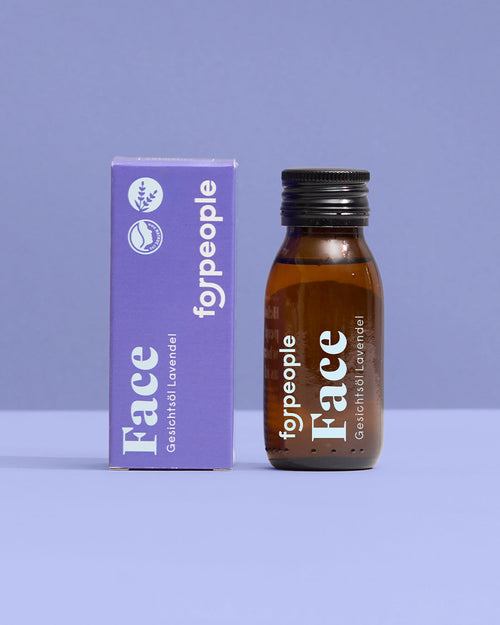
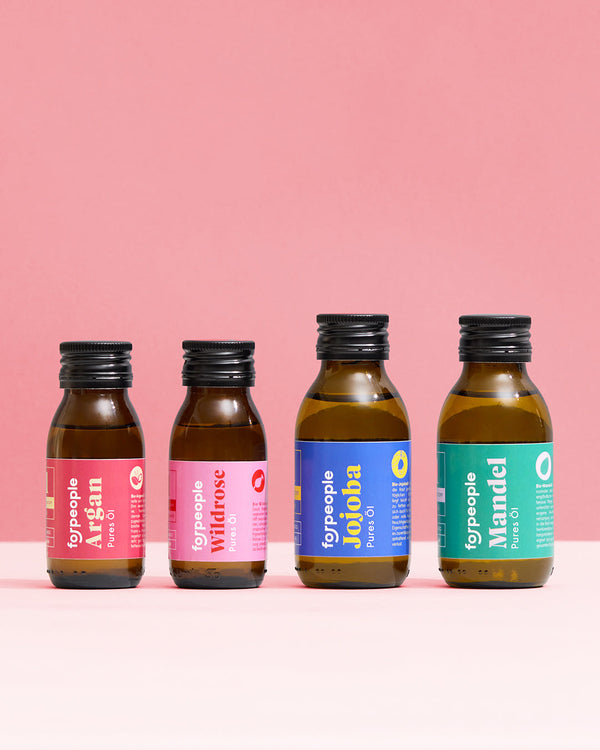
If you would rather not choose, you will find all four in the Care Oil Set – 4 Organic Oils for Face, Body & Hair. A ready-made blend is the Face Oil - Lavender: argan, rosehip and jojoba oil, plus borage and hemp oil and lavender essential oil; it smells of lavender.
When should you seek medical advice?
Plant oils are care, not treatment. If your skin turns red, burns or develops hives after an oil, stop using it. If the reaction persists or comes back, have it checked by a doctor. If you are allergic to almonds or other nuts, ask a doctor before using almond or argan oil. Do not apply oils to broken skin, and make sure nothing gets into your eyes. Try a new oil on a small area first: Trying a new product: how do I test it on a small area?
What customers say
A selection of verified reviews from our shop (collected via Judge.me), translated from German and partly shortened.
“I bought the oil for the first time and I am delighted. It took some getting used to in the first few days, but now everything is fine.”
Customer review of Wild Rose Seed Oil - pure, 5 out of 5 stars, February 2026, verified purchase
Frequently asked questions
Which of the four oils keeps the longest?
Jojoba oil; it is a liquid wax with high stability against oxidation. Rosehip oil is the one to use up fastest. Storage and smell remain decisive.
Why is rosehip oil orange, and why does it not smell of roses?
It is pressed from the seeds of the rosehip, not from petals. Cold-pressed rosehip seed oils contain carotenoids (Grajzer et al. 2015), natural yellow-orange colourants. The colour is briefly visible on the skin and disappears as you massage the oil in; on light-coloured clothing it can leave marks.
How do I dose with the cork dispenser?
Tip the bottle only briefly and let the oil drip into your palm, not straight onto your face. Thin oils such as jojoba oil come out faster than expected.
Do the pure oils smell of anything?
According to their ingredient lists they contain no added fragrance, but they do have a smell of their own. In reviews it is described as slightly nutty for almond oil and barely noticeable for jojoba oil. For argan oil the descriptions range from slightly nutty to almost neutral: cosmetic argan oil comes from unroasted kernels, and the nutty aroma of the culinary oil only develops during roasting (Gharby & Charrouf 2022).
Can I mix the oils with each other?
Yes, most easily in your palm. For a blend made in advance, use fresh oils and small amounts and note the date; the most sensitive oil determines how long it stays fresh.
At forpeople
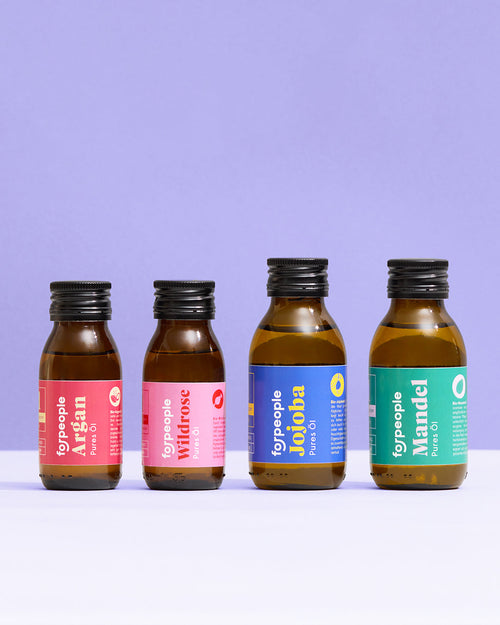
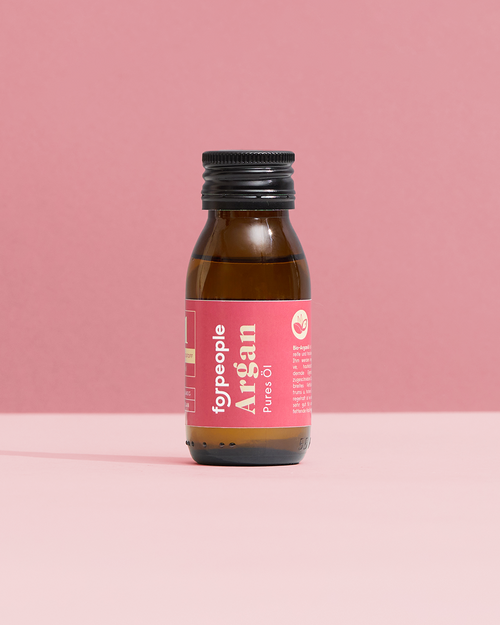
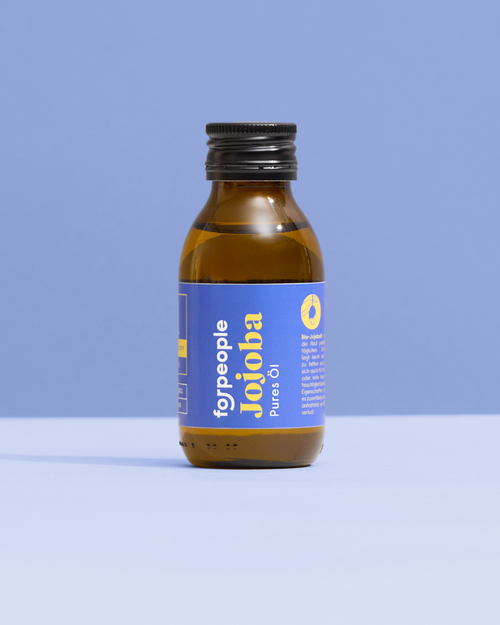
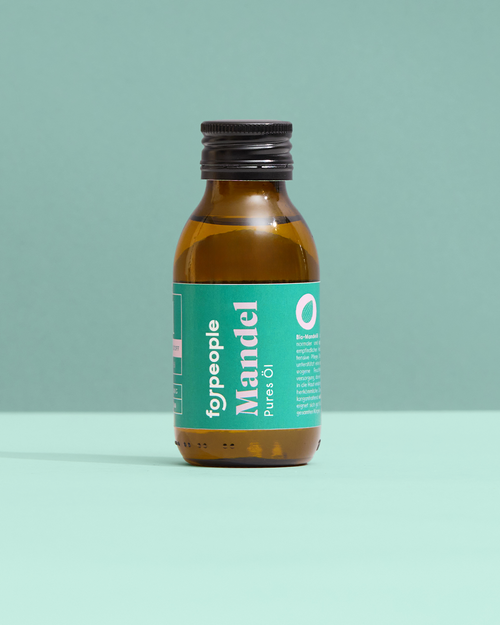
According to their ingredient lists, the four pure oils each consist of a single ingredient, cold-pressed and from certified organic farming: Argan Oil - pure (50 ml, €19.90), Jojoba Oil - pure (100 ml, €16.90), Almond Oil - pure (100 ml, €14.90) and Wild Rose Seed Oil - pure (50 ml, €19.90). They come in dark glass bottles with a cork dispenser.
More on this: Jojoba oil: why it is a liquid wax · Olive oil and sunflower oil on the skin · How to tell if a skin oil is rancid
From the blog: Face & Body Oils: Which Oil Suits Which Skin Type?
Sources
- Gharby S, Charrouf Z (2022): Argan Oil: Chemical Composition, Extraction Process, and Quality Control. Front Nutr 8: 804587. https://doi.org/10.3389/fnut.2021.804587
- Gad HA, Roberts A, Hamzi SH, Gad HA, Touiss I, Altyar AE et al. (2021): Jojoba Oil: An Updated Comprehensive Review on Chemistry, Pharmaceutical Uses, and Toxicity. Polymers (Basel) 13(11): 1711. https://doi.org/10.3390/polym13111711
- Kodad O, Socias i Company R (2008): Variability of oil content and of major fatty acid composition in almond (Prunus amygdalus Batsch) and its relationship with kernel quality. J Agric Food Chem 56(11): 4096–4101. https://doi.org/10.1021/jf8001679
- Lin TK, Zhong L, Santiago JL (2018): Anti-Inflammatory and Skin Barrier Repair Effects of Topical Application of Some Plant Oils. Int J Mol Sci 19(1): 70. https://doi.org/10.3390/ijms19010070
- Grajzer M, Prescha A, Korzonek K, Wojakowska A, Dziadas M, Kulma A et al. (2015): Characteristics of rose hip (Rosa canina L.) cold-pressed oil and its oxidative stability studied by the differential scanning calorimetry method. Food Chem 188: 459–466. https://doi.org/10.1016/j.foodchem.2015.05.034
- Gharby S, Harhar H, Kartah B, Guillaume D, Chafchaouni-Moussaoui I, Bouzoubaa Z et al. (2014): Oxidative stability of cosmetic argan oil: a one-year study. J Cosmet Sci 65(2): 81–87. https://pubmed.ncbi.nlm.nih.gov/24797024/