



What oil can do for hair
On the outside, a hair consists of the cuticle, flat horny cells that overlap like roof tiles, and on the inside of the fibre shaft (cortex). The shape and orientation of the cuticle cells determine how much hairs rub against each other (Gavazzoni Dias 2015). Oil acts mainly on this surface:
- Shine and less friction: A film of oil settles on the cuticle. This increases shine and reduces friction (Gavazzoni Dias 2015).
- Combability: In tests on hair tresses, the force needed to comb wet hair dropped after an oil treatment (Gavazzoni Dias 2015).
- Less swelling: Hair takes up water during washing and swells. Some oils penetrate the hair, reduce the amount of water taken up and with it the swelling (Gavazzoni Dias 2015).
- Slower exchange of moisture: In measurements, oil-treated hair took up less water vapour and released moisture more slowly (Keis et al. 2007).
How deeply an oil penetrates has been studied to very different degrees. In an older laboratory study, coconut oil was the only one of three oils tested that reduced protein loss from hair; sunflower oil and mineral oil did not. The authors attribute this to coconut oil penetrating the hair shaft (Rele & Mohile 2003). With coconut, olive and sunflower oil, the oil film became thinner over time, presumably because the hair absorbs part of the oil (Keis et al. 2005). A more recent study found that many plant oils penetrate hair, those with shorter and with unsaturated fatty acid chains more so (Marsh et al. 2024). Most of these studies come from manufacturers' laboratories or were carried out together with them, and they do not agree on every point.
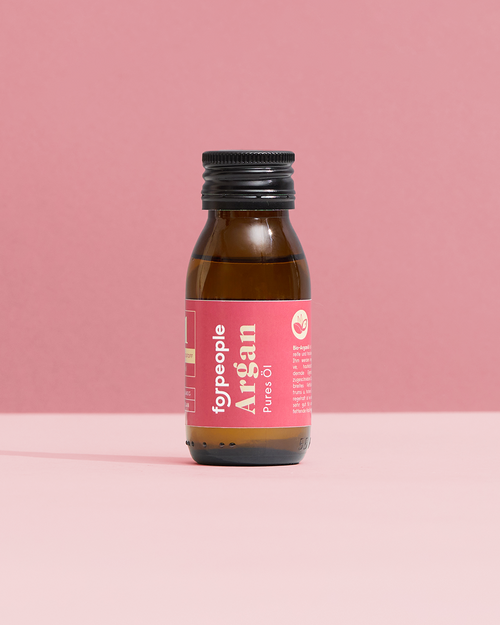
Coconut oil is the best-studied hair oil, and it is not in our range. For argan oil, a systematic review found no significant evidence that it improves hair quality (Phong et al. 2022). For jojoba, almond and wild rose seed oil, we know of no comparable measurements on hair. What is established is the film on the surface: shine, combability, less friction.
What oil cannot do
Split ends form when the cuticle has been worn away and cracks continue lengthwise through the fibre. This is more likely in weathered and oxidatively damaged hair and through friction from combing and styling (Gavazzoni Dias 2015). Hair outside the scalp is keratinised material without living cells. A split end therefore does not grow back together. Oil can smooth the ends and lay them together until the next wash. Split ends can only be removed by cutting.
It has not been shown that oil makes hair grow faster or thicker: the review mentioned found only limited evidence for coconut oil and no robust evidence for castor and argan oil (Phong et al. 2022). We make no statements about the scalp here.
Which oil from our range?
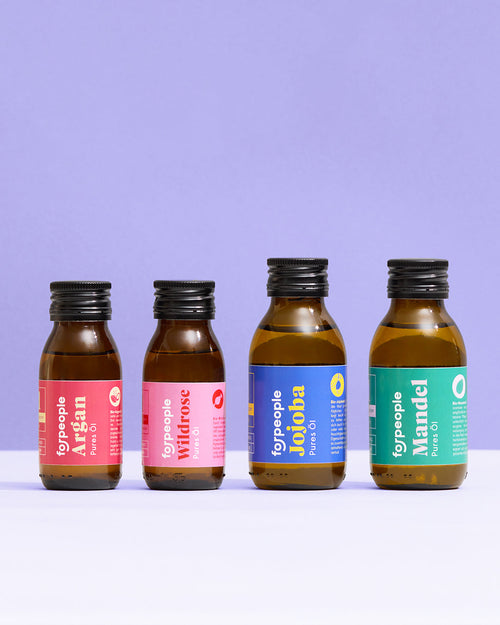
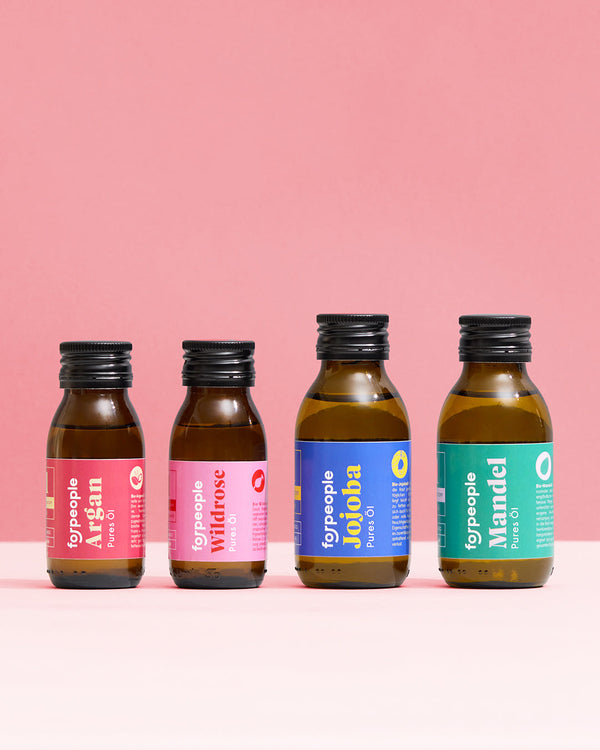
According to their ingredient lists, the four pure oils from forpeople each consist of a single cold-pressed oil. The product information in the shop mentions hair for all four (as of 3 October 2026).
| Oil | Composition | What the product information says about hair | For which hair (based on experience) |
|---|---|---|---|
| Argan Oil - pure | plant oil made of triglycerides | for face, body and hair; on the oil set's page it is named for face and hair ends | normal to thick hair, dry ends |
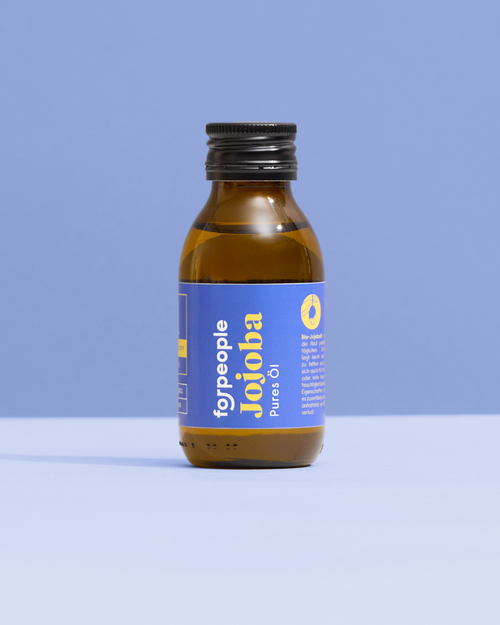
| Jojoba Oil - pure | liquid wax made of wax esters, more stable against oxidation than most plant oils; see Jojoba oil: why it is a liquid wax | for face, body and hair | fine to normal hair, because it feels light |
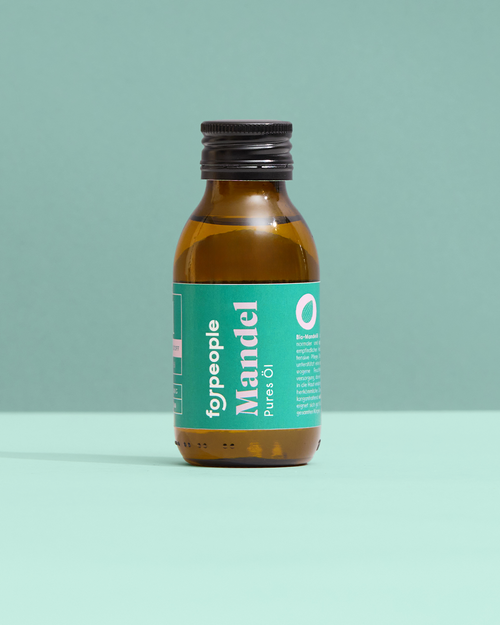
| Almond Oil - pure | plant oil made of triglycerides | for skin, hair and lips | normal to thick hair; also for the treatment before washing |
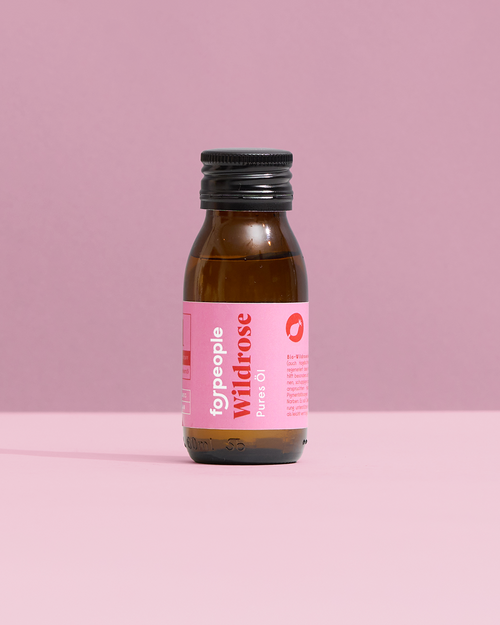
| Wild Rose Seed Oil - pure | plant oil made of triglycerides, rich in polyunsaturated fatty acids; ages faster, see How to tell if a skin oil is rancid | mainly for the face; also mentioned as a hair oil for dry ends | possible; because it ages faster, it is mostly used on the face |
All four together come in the Care Oil Set – 4 Organic Oils for Face, Body & Hair. How the oils differ in fatty acids, shelf life and skin feel is covered in Argan, jojoba, almond or rosehip oil: how do they differ?
How much, and how to apply it?
The product page of the oil set gives one to two drops for the hair ends. Start with one drop.
- Rub between your palms: Spread the oil between your palms until they only shine slightly.
- Apply to the lower part only: Draw the ends and lower lengths through your hands or scrunch the oil in. Leave the roots out; oil quickly looks greasy there.
- Check: If the hair looks stringy after a few minutes, it was too much.
Thick oil films do cover raised cuticle cells, but they leave the hair looking oily and heavy. A thin film that is renewed when needed works better (Gavazzoni Dias 2015). The following amounts are guide values from practice, not measured values:
| Hair | Amount to start with | Note |
|---|---|---|
| Fine, up to shoulder length | 1 drop | in towel-dried hair, ends only |
| Normal, shoulder length | 1–2 drops | dry or towel-dried |
| Thick, curly or very long | 2–4 drops | in portions, strand by strand |
| As a treatment before washing | enough for the lengths to shine slightly | is washed out again |
Dry or damp? Both work. In towel-dried hair, oil spreads more evenly; combing becomes easier through the interplay of water and oil (Gavazzoni Dias 2015). In dry hair you see straight away how much shine you get.
As a treatment before washing
Oil in the hair limits how much water it takes up during washing (Gavazzoni Dias 2015). Use before washing has been studied for coconut oil (Rele & Mohile 2003), not for our four oils. The following steps are common practice:
- Apply: Spread oil through the dry lengths and ends until the hair shines slightly but does not drip.
- Leave on: 30 minutes to a few hours is usual. There is no evidence-based minimum time.
- Protect fabrics: Put an old towel over your shoulders. What helps against grease stains is explained in Does deodorant cream stain? Prevent and remove.
- Wash out: Wash with shampoo and rinse thoroughly, twice if you used a lot of oil.
How washing with soap instead of shampoo works is explained in Washing hair with soap: hard water, acid rinse and the switch.
When to seek medical advice
Dry ends and split ends are a cosmetic matter. See a doctor about hair that falls out noticeably more than usual or breaks off close to the roots, bald patches, and a scalp that persistently itches, burns, flakes heavily, weeps or is red. The same applies to redness or burning after applying an oil; stop using it in that case. How to try out a new product beforehand is described in Trying a new product: how do I test it on a small area?
Frequently asked questions
Can oil seal split ends again?
No. A split hair end does not grow back together. Oil lays the ends together for a while and makes them look smoother. The only lasting solution is a trim.
My fine hair looks greasy after oil. What can I change?
Use just one drop, rub it between your palms thoroughly and apply it to towel-dried hair, to the ends only. If that is still too much, use the oil only as a treatment before washing.
How long should I leave an oil treatment on?
30 minutes to a few hours before washing is usual; we know of no evidence-based minimum time. What matters more is washing the oil out thoroughly afterwards.
Does oil make hair grow faster?
There is no robust evidence for that. Oil cares for the surface of the hair, that is, the lengths and ends.
Are the oils also suitable for a beard?
Yes, the same oils are used as beard oil. The difference from a solid balm is explained in Beard balm or beard oil: what is the difference?
At forpeople
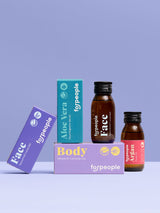
Four pure, cold-pressed oils, each without additives according to the ingredient list: Argan Oil - pure (50 ml, €19.90), Jojoba Oil - pure (100 ml, €16.90), Almond Oil - pure (100 ml, €14.90) and Wild Rose Seed Oil - pure (50 ml, €19.90). The glass bottles have a cork dispenser. We do not have a pure coconut oil, a shampoo or a ready-made hair treatment in our range.
More on this: Argan, jojoba, almond or rosehip oil: how do they differ? · Washing hair with soap: hard water, acid rinse and the switch · Jojoba oil: why it is a liquid wax
From the blog: Face Oil for Dry Skin: Choosing the Right Oil
Sources
- Gavazzoni Dias MF (2015): Hair cosmetics: an overview. Int J Trichology 7(1): 2–15. https://doi.org/10.4103/0974-7753.153450
- Keis K, Huemmer CL, Kamath YK (2007): Effect of oil films on moisture vapor absorption on human hair. J Cosmet Sci 58(2): 135–145. https://pubmed.ncbi.nlm.nih.gov/17520153/
- Rele AS, Mohile RB (2003): Effect of mineral oil, sunflower oil, and coconut oil on prevention of hair damage. J Cosmet Sci 54(2): 175–192. https://pubmed.ncbi.nlm.nih.gov/12715094/
- Keis K, Persaud D, Kamath YK, Rele AS (2005): Investigation of penetration abilities of various oils into human hair fibers. J Cosmet Sci 56(5): 283–295. https://pubmed.ncbi.nlm.nih.gov/16258695/
- Marsh JM, Whitaker S, Felts T, Cowans C, Gupta S, Masirevic S et al. (2024): Penetration of oils into hair. Int J Cosmet Sci 46(6): 905–917. https://doi.org/10.1111/ics.12978
- Phong C, Lee V, Yale K, Sung C, Mesinkovska N (2022): Coconut, Castor, and Argan Oil for Hair in Skin of Color Patients: A Systematic Review. J Drugs Dermatol 21(7): 751–757. https://pubmed.ncbi.nlm.nih.gov/35816075/