










Rosehip seed oil, also called wild rose seed oil, is pressed from the seeds of rose hips. A large part of it consists of the polyunsaturated fatty acids linoleic acid and alpha-linolenic acid, and it contains tocopherols and carotenoids; the carotenoids give cold-pressed oil its orange colour. On the skin it is a light care oil that makes the skin supple; further effects on healthy skin have not been studied in people. Because its fatty acids oxidise easily, store it somewhere cool and dark and use it up quickly.
Where rosehip seed oil comes from and what it contains
Rose hips are the fruit of wild roses. Most research is on oil from the dog rose (Rosa canina); there are also oils from other species, such as the sweet briar (Rosa rubiginosa), also known as Rosa mosqueta (Mármol et al. 2017). The small, hard seeds inside the hip are pressed. Depending on the species, they contain 5 to 18% oil (Mármol et al. 2017).
Rosehip seed oil is a fixed oil like olive or almond oil, not an essential rose oil made from rose petals. In the ingredient list of cosmetics, the INCI, the Latin name of the rose is given; for our oil it is Rosa Canina Fruit Oil.
Most of the oil is made up of fatty acids with several double bonds, known as polyunsaturated fatty acids:
| Component | Share | What it means |
|---|---|---|
| Linoleic acid (omega-6) | 35.9–54.8% | two double bonds |
| Alpha-linolenic acid (omega-3) | 16.6–26.5% | three double bonds |
| Oleic acid | 14.7–22.1% | one double bond |
| Tocopherols (vitamin E) | up to 1,124.7 mg/kg | antioxidants |
| Carotenoids | up to 107.7 mg/kg | pigments that give the orange colour |
| Phytosterols | up to 6,485.4 mg/kg | accompanying plant substances |
The fatty acid ranges come from a review (Lin et al. 2018), the accompanying substances from measurements on two cold-pressed oils (Grajzer et al. 2015). The exact amounts vary with origin, harvest and pressing.
Vitamin C and vitamin A: Rose hips are known for their vitamin C content (Mármol et al. 2017). But vitamin C sits in the flesh of the fruit and is water-soluble; an oil pressed from the seeds is not a source of vitamin C. Vitamin A (retinol) is also not among the substances measured in the oil (Grajzer et al. 2015). The oil does contain carotenoids, some of which are a precursor of vitamin A in the diet (Mármol et al. 2017). That does not make rosehip seed oil a vitamin A product.
Cold-pressed or refined, and how to store it
An oil is cold-pressed when it is obtained by mechanical means only, such as pressing, without adding heat. Afterwards it may only be purified by washing with water, settling, filtering and centrifuging. This is how the Codex Alimentarius, the international food standard for edible oils, defines it (Codex Alimentarius 2015).
Refined oils go through further steps involving heat or chemicals, such as neutralising, bleaching and deodorising. This can change their composition (Lin et al. 2018); they become lighter in colour and more neutral in smell. You can recognise cold-pressed rosehip seed oil by its yellow-orange to reddish colour. The INCI name is the same for both; whether an oil is cold-pressed, if stated at all, is shown separately on the pack.
The more double bonds a fatty acid has, the more easily oxygen attacks it. That makes rosehip seed oil one of the most sensitive care oils. This keeps it fresh for longer:
- Close the bottle straight after use and store it somewhere cool and dark; once opened, it can go in the fridge.
- Do not let water get into the bottle, and do not touch the dispenser with wet fingers.
- Check the smell: if the oil smells sharp, musty or like old nuts, it is rancid. There is more on this in How to tell if a skin oil is rancid; what the open-jar symbol means is explained in Cosmetics shelf life.
What is proven on the skin, and what is not
Care oil: Like other plant oils, rosehip seed oil forms a thin film on the skin. Such a film reduces the evaporation of water from the outer skin layer (Lin et al. 2018) and makes the skin supple. The oil brings no water of its own, so it works best on slightly damp skin, for example after washing or over a watery serum.
Linoleic acid: Linoleic acid is the most common polyunsaturated fatty acid in the outer skin layer, and the body cannot make it itself. According to a review, it plays a direct role in keeping the skin's water barrier intact; the evidence comes from studies of linoleic acid deficiency (Lin et al. 2018). Whether rosehip seed oil applied to healthy skin changes anything here has not been studied. How the barrier is built is explained in The skin barrier explained simply.
Antioxidants: Tocopherols and carotenoids mainly protect the oil itself. Despite their many double bonds, the cold-pressed oils studied were relatively well protected against oxidation (Grajzer et al. 2015). Whether these substances have an effect on the skin is not proven.
Studies in people: The studies we found on rosehip seed oil on the skin deal with medical questions, which are not the subject here. We found none on healthy skin, for example on skin moisture (PubMed search, October 2026). Further promises about rosehip seed oil cannot be backed up by them.
How to use it, and rosehip seed oil at forpeople
Two to four drops are enough for the face, ideally in the evening, as the oil can leave a brief orange sheen. Use one or two drops on the ends of your hair; there is more in Oil for hair ends: which one, how much? Try a new oil on a small area first, see Trying a new product: how do I test it on a small area?, and do not apply it to broken skin.
At forpeople, rosehip seed oil is listed in the ingredients of these products:
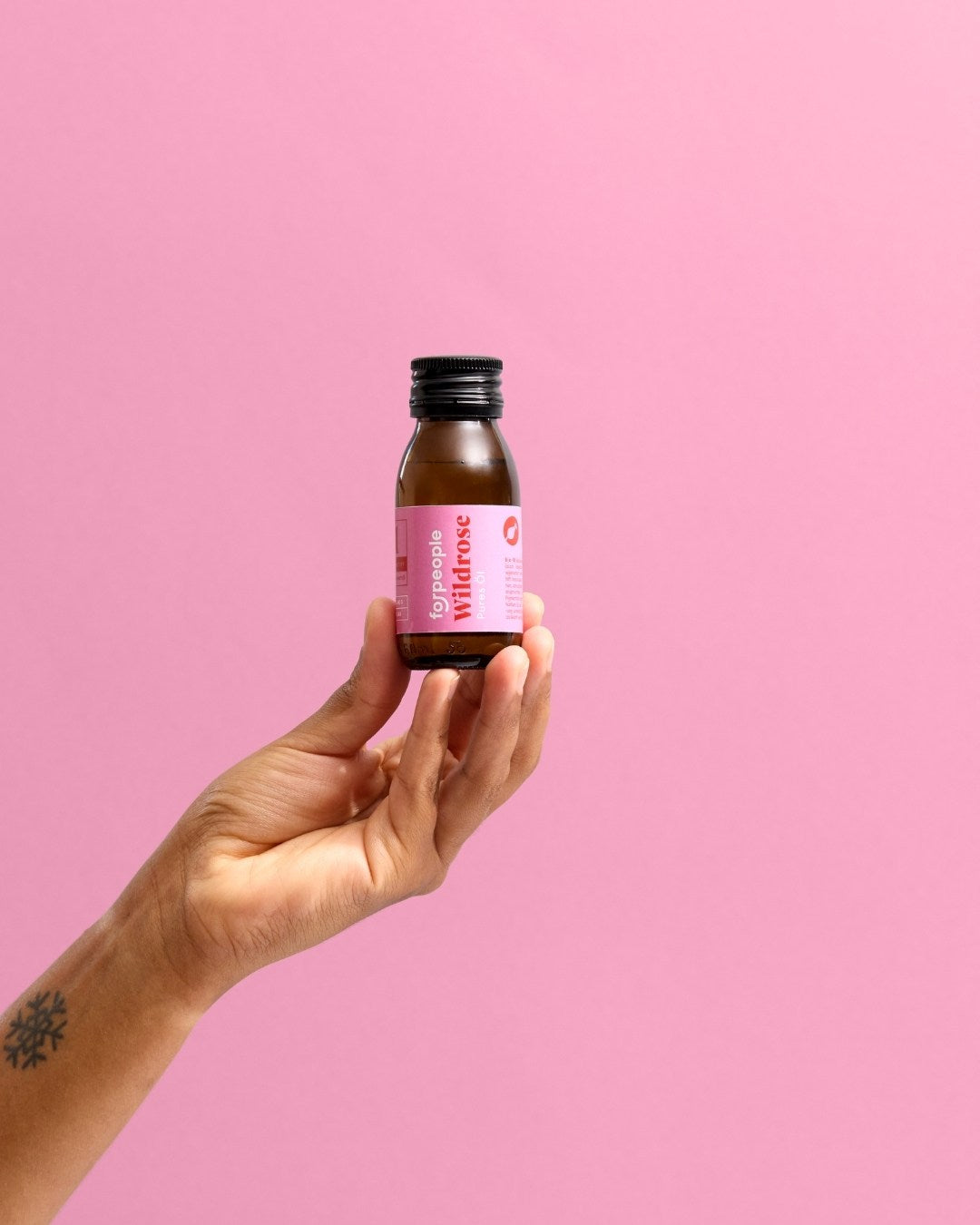
- Wild Rose Seed Oil - pure, 50 ml, €19.90: only Rosa Canina Fruit Oil from certified organic farming, gently cold-pressed, in a dark glass bottle.
- Face Oil - Lavender, 50 ml, €21.90: rosehip oil together with argan, jojoba, borage and hemp seed oil plus lavender essential oil, which gives it its scent.
- Care Oil Set – 4 Organic Oils for Face, Body & Hair, €69.90: rosehip seed oil, argan oil, jojoba oil and almond oil in separate bottles.
How the oils differ is explained in Argan, jojoba, almond or rosehip oil: how do they differ?, and there is more about the raw material in Rosehip seed oil: fatty acids, shelf life, use.
Frequently asked questions
Is rosehip oil the same as rosehip seed oil?
Yes. Both names refer to the fixed oil from the seeds of rose hips. Essential rose oil from rose petals is something else.
Is rosehip seed oil good for the face?
It is a light oil, a few drops are enough, and it makes the skin supple. Any effect beyond that has not been proven on healthy skin.
How long does rosehip seed oil keep after opening?
Less long than most care oils. Go by the information on the label and by your nose, and keep it cool, ideally in the fridge.
Does rosehip seed oil contain vitamin A or vitamin C?
Not vitamin C, which is water-soluble and found in the flesh of the fruit. Vitamin A was not measured in the oil; it contains carotenoids, some of which are a precursor of vitamin A in the diet.
Why is rosehip seed oil orange?
Because of the carotenoids. Cold-pressed oil is yellow-orange to reddish, refined oil is lighter. On the skin the colour shows briefly and disappears as you massage it in.
Sources
- Lin TK, Zhong L, Santiago JL (2018): Anti-Inflammatory and Skin Barrier Repair Effects of Topical Application of Some Plant Oils. International Journal of Molecular Sciences 19(1): 70. doi:10.3390/ijms19010070
- Grajzer M, Prescha A, Korzonek K, Wojakowska A, Dziadas M, Kulma A, Grajeta H (2015): Characteristics of rose hip (Rosa canina L.) cold-pressed oil and its oxidative stability studied by the differential scanning calorimetry method. Food Chemistry 188: 459–466. doi:10.1016/j.foodchem.2015.05.034
- Mármol I, Sánchez-de-Diego C, Jiménez-Moreno N, Ancín-Azpilicueta C, Rodríguez-Yoldi MJ (2017): Therapeutic Applications of Rose Hips from Different Rosa Species. International Journal of Molecular Sciences 18(6): 1137. doi:10.3390/ijms18061137
- Codex Alimentarius Commission (2015): Standard for Named Vegetable Oils, CODEX STAN 210-1999, adopted 1999, last amended 2015. fao.org


Leave a comment
This site is protected by hCaptcha and the hCaptcha Privacy Policy and Terms of Service apply.