







The problem: dry feet and legs with diabetes
Your heels get hard and crack, your soles feel rough, the skin on your shins flakes and sometimes itches. Many people notice this first in autumn, when the heating is on and the feet spend all day in warm socks and winter boots. On its own, this is dry skin like anyone else's. With diabetes, though, it matters more.
The reason is the feet themselves. The German Diabetes Society estimates the lifetime likelihood of developing diabetic foot syndrome at 19 to 34 per cent. Ulcers usually develop when pressure, friction or small injuries are not felt because nerve damage has reduced the sense of pain (Morbach et al. 2025). A crack in dry heel skin, a blister from new winter boots or a burn from a hot-water bottle can then easily go unnoticed. Care can keep dry skin supple; spotting cracks and wounds and having them treated is the more important part.
Why the skin dries out with diabetes, and why winter makes it worse
Less sweat. Diabetes can also damage the nerves that control organs and glands (autonomic neuropathy). If this affects the sweat glands, the feet and lower legs produce less sweat. An international consensus paper states that impaired sweating causes dry skin and is associated with foot ulcers (Kempler et al. 2011). For this reason, sweating is part of the skin findings in a medical foot examination (Morbach et al. 2025).
Blood sugar. In a Japanese study of 49 people with diabetes, the outer layer of the skin on the lower leg and forearm held less moisture when fasting blood sugar was higher, and there was less skin oil on the forehead; the barrier itself, measured as water loss through the skin, was no worse (Sakai et al. 2005). An Iranian study of 38 people with diabetes and 40 controls, on the other hand, found no difference in skin moisture, but did find less skin oil on the forehead (Seirafi et al. 2009). The studies are small, and their results partly contradict each other.
Less sensation. If diabetes damages the nerves that report touch, pressure, pain and temperature, the warning signal is missing. The guideline speaks of the loss of protective pain perception (NVL Typ-2-Diabetes 2023). You then also cannot tell whether a foot bath is too hot.
Itching. A review found itching in 18.4 to 27.5 per cent of people with diabetes in the studies it included; it names dry skin and nerve damage as the main causes (Stefaniak et al. 2021). Scratching can injure dry skin further.
Winter. Cold outdoor air and heated indoor air draw extra water from the skin, in lined boots it alternates between damp and dry, and cold feet tempt you towards hot-water bottles and hot foot baths. How this works on the feet is explained in Dry feet in winter: what causes it, what helps?; for the shins, see Why are shins dry and flaky in winter? If you also take water tablets, they may play a part too; more in Dry skin from medication.
The solution step by step
In its 2023 guidelines, the International Working Group on the Diabetic Foot (IWGDF) sets out what people with diabetes should do for their feet (Schaper et al. 2024), (Bus et al. 2024). The table summarises this for dry skin.
| Step | What you do | Why |
|---|---|---|
| Every day: look | look at both feet completely, including soles, heels and the spaces between the toes; use a mirror or ask a relative for help if your eyesight is poor or bending is difficult | otherwise, cracks, blisters and pressure marks are noticed late when sensation is reduced |
| Every day: wash | wash your feet in water below 37 °C; check the temperature with a thermometer, not with your foot | the IWGDF gives 37 °C as the limit; temperature sensation may be impaired |
| Every day: dry | pat dry thoroughly, especially between the toes | damp spaces between the toes become soggy |
| Every day: apply care | apply care to dry skin on heels, soles, the tops of the feet and the lower legs, not between the toes | the IWGDF recommends emollients for dry skin, explicitly not between the toes |
| Keeping warm | warm socks that do not constrict; no hot-water bottle, no heating pad, no feet against the radiator | burns go unnoticed when sensation is reduced |
| Calluses and nails | cut nails straight across; do not treat calluses, corns and ingrown nails with blades, acids or plasters, but at a podiatrist | the IWGDF advises against chemical agents and plasters for removing calluses |
| Regularly | have your feet examined by a doctor: at least once a year without nerve damage or circulation problems, every three to six months with these findings | this is what the German national care guideline for type 2 diabetes states |
| Prevention | do not walk barefoot, not even at home; feel inside your shoes before putting them on | otherwise, foreign objects and pressure points are not felt |
Sources for the table: Schaper et al. 2024, Bus et al. 2024, NVL Typ-2-Diabetes 2023. The thermometer is common practice. The IWGDF rates the recommendation on washing, applying emollients and cutting nails as strong, but the certainty of the evidence as low (Bus et al. 2024).
Which care? For very dry, flaky skin, urea is by far the most thoroughly studied ingredient, according to a position paper by German dermatologists (Augustin et al. 2019). Foot creams with urea are available from pharmacies; which one suits your feet is something to discuss with your doctor or podiatrist. Our products contain no urea; they provide the fat-based side of care. The difference is explained in Urea or water-free cream? Rough heels and dry hands.
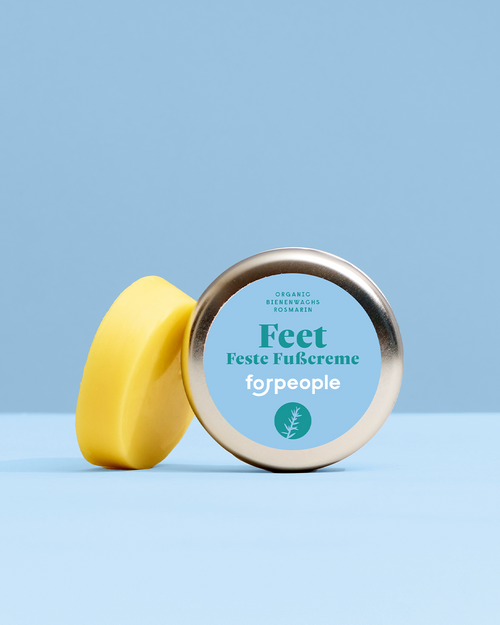
For shins and calves, the Solid Body Butter - Beeswax & Aloe Vera without essential oils is a good fit, or, for larger areas, the Almond Oil - pure. The Solid Foot Cream – Rosemary & Sage is meant for dry, rough feet and heels. Its product page itself says that with diabetes or reduced sensation in the feet, skin changes should be checked by a professional early on, and that it should not be applied to injured skin. It contains essential oils of rosemary, eucalyptus and clary sage. Check with your doctor or podiatrist beforehand whether it is an option for your feet.
What helps, and what tends not to
| Measure | Assessment |
|---|---|
| Applying care to dry skin every day | fits; recommended by the IWGDF, not between the toes |
| Care with urea | well studied for dry skin; discuss the choice with your doctor or podiatrist |
| Cream between the toes | tends not to help: the skin there stays damp and becomes soggy; for telling it apart from athlete's foot, see Dry feet or athlete's foot? Signs and when to see a doctor |
| Long, hot foot bath | tends not to help: water below 37 °C, measure the temperature; whether and how long a foot bath makes sense is explained in Foot soak before moisturising: how long, how warm, is it worth it? |
| Callus planes, blades, corn plasters, acids | tends not to help: risk of injury; this belongs with a podiatrist |
| Home remedies such as vinegar or baking soda baths for calluses | tends not to help; why is explained in Vinegar, baking soda, lemon: home remedies for calluses |
| Hot-water bottle or heating pad for cold feet | tends not to help: risk of burns with reduced sensation; warm socks are the better choice |
| Socks overnight after applying cream | possible if they sit loosely and do not constrict; more in Foot cream overnight with socks: does it help? |
Common mistakes
- Only applying cream, not looking. Care does not replace the daily look at soles, heels and the spaces between the toes.
- Testing the water temperature with your foot. With reduced sensation this is misleading; a thermometer is not.
- Cutting or planing off calluses yourself. Small injuries only become apparent once they are inflamed.
- Rubbing cream between the toes. The skin there should stay dry.
- Putting cream on a crack and waiting. Open areas do not belong under a care product but at the doctor's.
- Skipping the yearly foot examination because your feet do not hurt. That is exactly when it matters.
When to get medical advice
Cosmetics care for dry, unbroken skin. Everything else belongs with a doctor or podiatrist.
See a doctor or a diabetic foot clinic on the same day if
- you find a blister, cut, scratch, crack or open area on your foot, even if it does not hurt,
- a foot is red, swollen and warmer than the other; this can indicate an acute Charcot foot, in which the foot has to be offloaded immediately (Morbach et al. 2025),
- an area produces pus, weeps, changes colour or you develop a fever.
The IWGDF advises contacting a trained professional promptly if blisters, cuts, scratches or ulcers develop (Schaper et al. 2024).
Mention it at your next appointment if
- your feet tingle, burn, sting or feel numb; this is part of checking for nerve damage (Morbach et al. 2025),
- the skin stays cracked despite daily care or thick calluses form,
- you itch all over, especially for weeks,
- your last foot examination was more than a year ago.
To find experienced centres, the practice recommendation of the German Diabetes Society refers to foot treatment facilities certified by its diabetic foot working group (Morbach et al. 2025). How podiatrists and doctors share the work and when podiatry can be prescribed in Germany is explained in Cracked heels: when to see a podiatrist or doctor.
Frequently asked questions
Why do people with diabetes often have dry skin?
Nerve damage can reduce sweating on the feet and legs, and in one study higher blood sugar levels were associated with less moisture in the outer skin layer. In winter, heated air and warm shoes are added.
Can I use foot cream if I have diabetes?
Yes. The international guidelines recommend applying care to dry skin, but not between the toes and not on wounds or cracks. Discuss which product suits you with your doctor or podiatrist.
Why should no cream go between the toes?
The skin there lies close together and easily stays damp. Cream holds the moisture in even more, and the skin becomes soggy. Between the toes, drying thoroughly matters more.
Which cream is suitable with diabetes?
Fat-based care for dry skin; for very dry, flaky skin, products with urea have been studied most thoroughly. Discuss the choice with your doctor or podiatrist, especially if sensation is reduced.
Can I remove calluses myself if I have diabetes?
Not with blades, planes, acids or callus plasters. That belongs with a podiatrist. You can apply care to unbroken skin yourself.
How warm can a foot bath be with diabetes?
The IWGDF says below 37 °C. Measure the temperature with a thermometer, because temperature sensation in the feet may be impaired.
Does the skin itch more often with diabetes?
In studies, 18 to 28 per cent of people with diabetes had itching; important causes are dry skin and nerve damage. If it itches for weeks, have it checked by a doctor.
At forpeople
None of our products was developed for the diabetic foot, and none contains urea. They care for dry, unbroken skin. With diabetes, wounds, cracks, calluses and nails belong with a podiatrist or doctor.
Solid Foot Cream – Rosemary & Sage, 40 g, €9.90: water-free, made from sunflower oil, beeswax, olive oil and shea butter, with essential oils; for dry, rough feet. According to the product page, with diabetes have skin changes checked by a professional early on; not on injured skin, not for children under 7.
Solid Body Butter - Beeswax & Aloe Vera, 40 g, €9.90: water-free, without essential oils; for dry areas such as the shins.
Almond Oil - pure, 100 ml, €14.90: pure almond oil for larger areas on the legs and body.
More on this: Why do feet get drier with age? · Why heel skin gets so thick and cracks · Dry skin under compression stockings: causes and what helps
Sources
- Bundesärztekammer (BÄK), Kassenärztliche Bundesvereinigung (KBV), Arbeitsgemeinschaft der Wissenschaftlichen Medizinischen Fachgesellschaften (AWMF) (2023): Nationale VersorgungsLeitlinie Typ-2-Diabetes – Langfassung, Version 3.0, Kapitel 4.4. https://doi.org/10.6101/AZQ/000503
- Morbach S, Eckhard M, Koller A, Lobmann R, Müller E, Reike H et al. (2025): Diabetisches Fußsyndrom. DDG-Praxisempfehlung. Diabetol Stoffwechs 20(Suppl 2): S347–S359. https://doi.org/10.1055/a-2592-8610
- Schaper NC, van Netten JJ, Apelqvist J, Bus SA, Fitridge R, Game F et al. (2024): Practical guidelines on the prevention and management of diabetes-related foot disease (IWGDF 2023 update). Diabetes Metab Res Rev 40(3): e3657. https://doi.org/10.1002/dmrr.3657
- Bus SA, Sacco ICN, Monteiro-Soares M, Raspovic A, Paton J, Rasmussen A et al. (2024): Guidelines on the prevention of foot ulcers in persons with diabetes (IWGDF 2023 update). Diabetes Metab Res Rev 40(3): e3651. https://doi.org/10.1002/dmrr.3651
- Kempler P, Amarenco G, Freeman R, Frontoni S, Horowitz M, Stevens M et al. (2011): Management strategies for gastrointestinal, erectile, bladder, and sudomotor dysfunction in patients with diabetes. Diabetes Metab Res Rev 27(7): 665–677. https://doi.org/10.1002/dmrr.1223
- Sakai S, Kikuchi K, Satoh J, Tagami H, Inoue S (2005): Functional properties of the stratum corneum in patients with diabetes mellitus: similarities to senile xerosis. Br J Dermatol 153(2): 319–323. https://doi.org/10.1111/j.1365-2133.2005.06756.x
- Seirafi H, Farsinejad K, Firooz A, Davoudi SM, Robati RM, Hoseini MS et al. (2009): Biophysical characteristics of skin in diabetes: a controlled study. J Eur Acad Dermatol Venereol 23(2): 146–149. https://doi.org/10.1111/j.1468-3083.2008.02950.x
- Stefaniak AA, Chlebicka I, Szepietowski JC (2021): Itch in diabetes: a common underestimated problem. Postepy Dermatol Alergol 38(2): 177–183. https://doi.org/10.5114/ada.2019.89712
- Augustin M, Wilsmann-Theis D, Körber A, Kerscher M, Itschert G, Dippel M, Staubach P (2019): Diagnosis and treatment of xerosis cutis – a position paper. J Dtsch Dermatol Ges 17(Suppl 7): 3–33. https://doi.org/10.1111/ddg.13906