A clear day in January: the sun is low, shines through the office window and dazzles you on the way home. The sunscreen from the summer is still in the bathroom. Should it go on your face every morning now, or does it hold back the vitamin D that runs low in winter anyway? Mountains and skiing have a page of their own: Sun protection in the mountains and on snow.
How strong UV radiation is in winter in Germany
The UV index is an internationally standardised measure of the UV radiation that causes sunburn. It depends mainly on the position of the sun and therefore changes most with the season, the time of day and the latitude. According to the BfS, at 1 and 2 no protective measures are normally needed, from 3 to 7 protection is required, and from 8 it is essential (BfS, UV index).
For Berlin, the BfS has calculated typical values for the 21st of each month, and also for Paris at 49 degrees north, roughly the latitude of Karlsruhe or Regensburg (BfS, UV index worldwide):
| Month | Berlin (52° north) | Paris (49° north) | BfS range |
|---|---|---|---|
| January | 1 | 1 | low |
| February | 1 | 1 | low |
| March | 2 | 3 | low to moderate |
| April | 4 | 4 | moderate |
| May | 5 | 6 | moderate to high |
| June | 7 | 7 | high |
| July | 7 | 7 | high |
| August | 5 | 6 | moderate to high |
| September | 3 | 4 | moderate |
| October | 1 | 2 | low |
| November | 1 | 1 | low |
| December | 0 | 0 | low |
These are guide values for typical weather; individual days can be higher. In summer the UV index in Germany reaches 8 to 9, and up to 11 in the high altitudes of the southern German mountains. Snow, water and bright surfaces reflect UV radiation, so the exposure can then be higher than stated (BfS, UV index). Temperature tells you nothing: according to the table, a cool, clear day in April has a higher UV index than a mild day at the end of October.
When sunscreen makes sense in winter
- Everyday life in the lowlands, November to February: with a UV index of 0 to 1, sunscreen is normally not needed according to the BfS scheme. Your skin needs care against cold and indoor heating instead, see Dry skin in winter: what helps with cold and indoor heating.
- Clear days from the end of March: at the latitude of southern Germany the UV index then typically reaches 3, and from April in the north too. If you are outdoors for a long time, for example on the bike or in the garden, put sunscreen on your face, ears, neck and the backs of your hands.
- Snow in the lowlands: with a UV index of 0 or 1 in December, exposure stays low despite reflection. Towards the end of winter, when the sun is higher, sunscreen on your face is worth it if you are out for a long time. This is an assessment based on the BfS values, not a measurement of our own.
- Mountains and winter sports: altitude and snow increase radiation considerably, see Sun protection in the mountains and on snow.
- Winter holidays in the south: for January the BfS gives typical values of 2 in Mallorca, 3 on Crete, 6 in Havana, 8 in Bangkok and 9 in Cape Town (BfS, UV index worldwide). From a value of 3, protection as in summer applies there. On airport security: Does Cream Count as a Liquid in Hand Luggage?
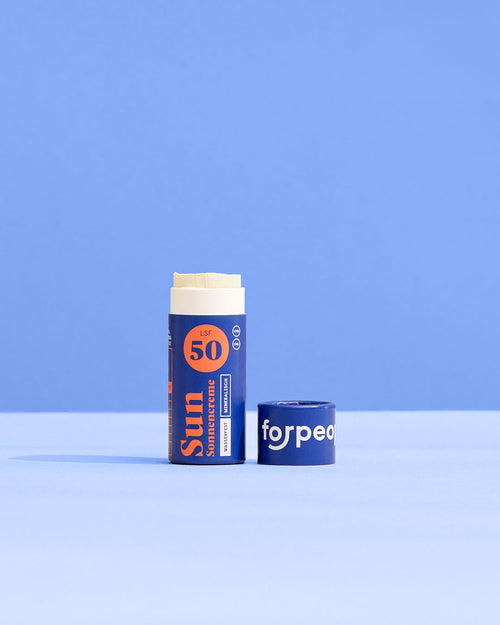
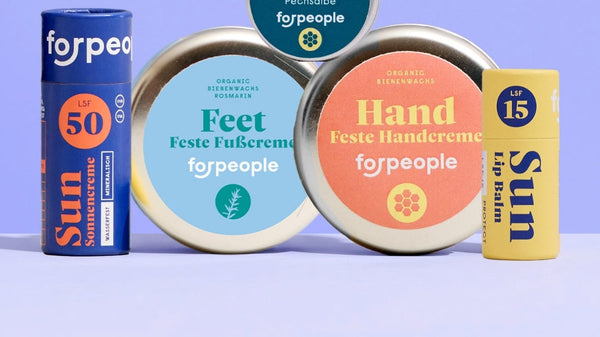
For days like these, a small stick in your jacket pocket is enough. The Solid Sunscreen SPF50 Mini weighs 20 g, protects with the mineral filters zinc oxide and titanium dioxide and contains no water. In the cold it gets firmer; carried close to your body and warmed briefly between your fingers, it spreads. On the amount: How much solid sunscreen do I need?
| Protection | Composition | Form | In winter |
|---|---|---|---|
| Solid Sunscreen SPF50 (40 g) or Mini (20 g) | shea butter, plant-based fatty acid blend, beeswax, silica, zinc oxide, titanium dioxide; no water | solid stick in a paper tube | gets firmer in the cold; a light film on the skin is possible |
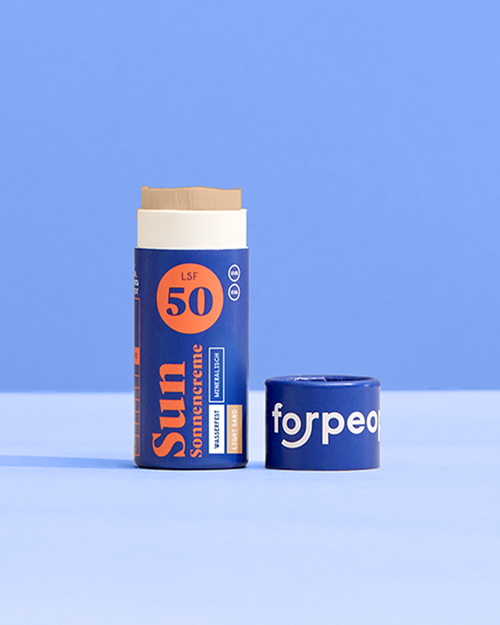
| Solid Sunscreen SPF50 Mini - Shade LIGHT SAND | as above, plus iron oxides | beige-tinted stick, 20 g | for the face; the tint evens out the light film |
| Sunscreen lotion | usually an emulsion of water, oils and emulsifiers with organic or mineral filters | liquid, from a tube or bottle | for large areas; counts as a liquid in hand luggage |
| Day cream with SPF | care cream with UV filters | cream | for short trips; the protection only applies with a sufficient amount, see SPF, UVA and water resistance: what the labels mean |
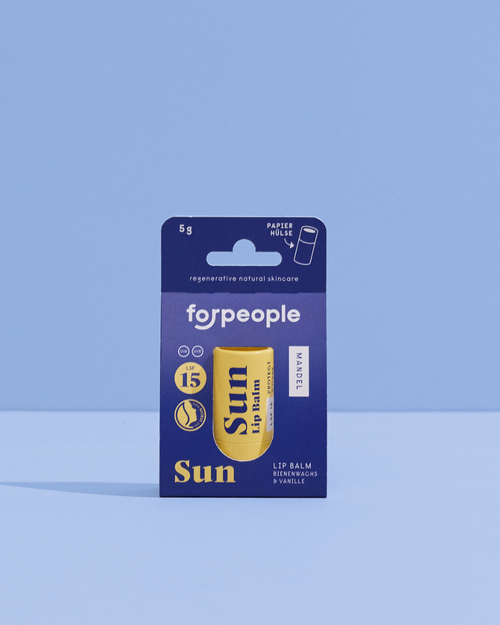
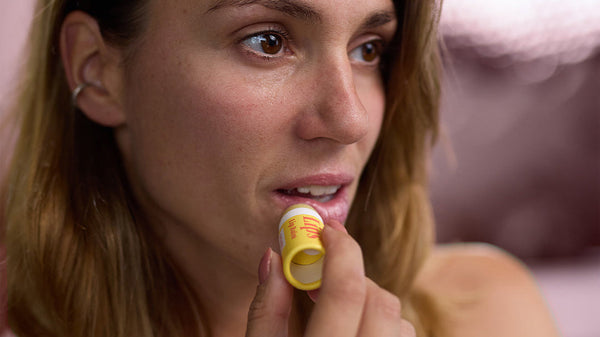
| Lip Balm - SPF15 Almond & Vanilla | beeswax, plant oils, shea butter, zinc oxide, titanium dioxide, vanilla extract | stick, 5 g | for the lips on sunny days and on snow; more on Do I need lip balm with SPF? |
| Hat, scarf, gloves | textile | clothing | cover most of you; the face and often the hands stay exposed |
Behind glass: windows, office and car
Ordinary window glass filters out UVB radiation but lets UVA radiation and visible light through. How much UVA gets through depends on the type of glass, its tint, interlayers and coatings; there is also glass that offers broad UV protection (Tuchinda et al. 2006). You cannot tell by looking at a window.
In a car, every window blocks UVB, and the windscreen also blocks UVA; the side windows let UVA through to a greater or lesser extent. The BfS considers protection advisable when, on sunny summer days and long journeys, the sun shines through a window onto you for a long time, especially for children, and names sun visors, blinds and UV protection films for this (BfS, UV protection in the car). Measurements on side windows are on Sun protection for the backs of your hands.
For winter this means: behind glass no UVB arrives, and outside the UV index is low. At a desk by the window, sunscreen is not needed in midwinter on this basis.
Sunscreen and vitamin D in winter
Vitamin D is formed in the skin only under UVB radiation. If it is too weak, production stops, and in Germany that is the case in winter (BfS, vitamin D). BfR and DGE name the months from October to March for this. The body then draws on stores in fat and muscle tissue that it built up in summer (BfR 2025), (DGE 2025).
Sunscreen changes little about this in winter: where hardly any vitamin D is formed, it can hardly hold anything back. In principle, sunscreens reduce production in the skin, as BfR and DGE state. A systematic review shows the extent: in experiments with artificial UV radiation, sunscreen clearly reduced vitamin D production. In two randomised field trials with daily use of a product of around SPF 16, no effect was found, and most observational studies found no association. Such studies are lacking for the high sun protection factors recommended today (Neale et al. 2019).
For the sunnier months, the BfS together with other expert bodies recommends exposing your face, hands and arms uncovered and without sun protection two to three times a week for half the time in which you would otherwise get sunburnt. For skin type II and a UV index of 7, that works out at around 12 minutes; longer does not produce more vitamin D, according to the BfS (BfS, vitamin D). If you stay outdoors longer, the BfR advises sunscreen and covering clothing (BfR 2025).
Whether you should take vitamin D is something to clarify with your doctor. The DGE gives an estimated value of 20 micrograms a day if the body forms no vitamin D itself, and recommends supplements only if intake cannot be improved through diet or the sun, especially in risk groups (DGE 2025).
When to seek medical advice
Sunscreen is a cosmetic. Seek medical advice if:
- a spot or mole is new or changing. It should be looked at by a dermatologist, in winter as in summer.
- your skin reacts to even a little sun, for example since you started a new medication. Some medicines make the skin more sensitive to light; ask your doctor or pharmacist. If you have been advised by a doctor to protect yourself from light consistently, that applies in winter too.
- your skin turns red, stings or blisters after a sunscreen and this does not go away after washing it off.
- you suspect a vitamin D deficiency or belong to a risk group. The BfS lists, among others, people with chronic diseases of the liver, kidneys or digestive tract, older people who rarely get outdoors, and people with dark skin. Only a doctor can determine a deficiency; the BfS strongly advises against trying to correct it with sun or a solarium (BfS, vitamin D).
- it concerns a baby. According to the BfS, babies should not be exposed to direct sun; vitamin D tablets are recommended for them until their second early summer. Discuss this with your paediatrician.
Frequently asked questions
Do I need to wear sunscreen every day in winter?
In lowland Germany from November to February normally not, because the UV index is 0 to 1. It is different on snow, in the mountains, on holiday in the south and on clear days from the end of March.
Do I need sunscreen by the office window?
Not in winter. Window glass holds back UVB, UVA partly gets through depending on the glass, and outside the radiation is low. If you sit in the sun by a window for long periods in summer, a blind or sunscreen helps.
Does sunscreen block vitamin D production?
Clearly in the lab; in everyday life, studies mostly found no effect, and data are lacking for very high sun protection factors. In winter the skin in Germany hardly forms any vitamin D anyway.
How do I get vitamin D in winter?
Mainly from the stores built up in summer, which according to the BfR exercise can also tap into. The DGE advises getting fresh air often and eating oily fish once or twice a week. Whether you need a supplement is something to clarify with your doctor.
Can I keep the summer's sunscreen until spring?
Yes, if the best-before date has not been reached and it was stored cool and dry. Our solid sunscreens have a minimum durability of 30 months from production; what counts is the date on the tube. More on Can I still use last year's sunscreen?
Does solid sunscreen get too hard in the cold?
It gets firmer; in an inside pocket close to your body it stays spreadable. More on Storing solid cosmetics: heat, summer and winter.
Do children need sunscreen in winter?
The same UV values apply: in everyday winter life in the lowlands usually not, on snow, in the mountains and on holiday in the south yes. More on Mineral sunscreen for children: what to look for.
At forpeople
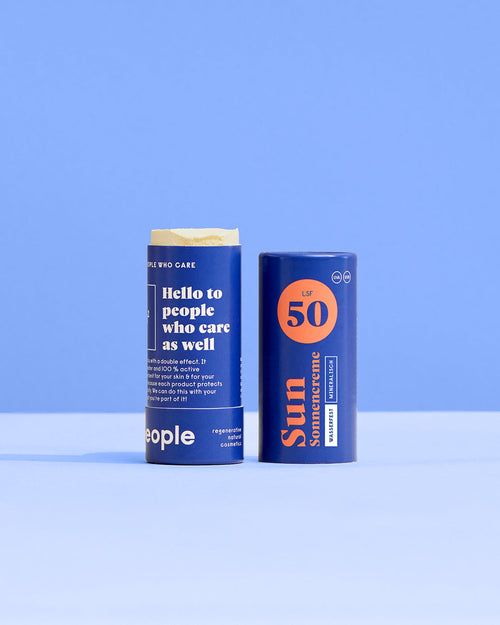
Our solid sunscreens have SPF 50, protect with zinc oxide and titanium dioxide, non-nano according to the product information, have been tested as water resistant and come in a paper tube without plastic coating. According to the INCI list, the base formula contains no water and no fragrance.
- Solid Sunscreen SPF50 Mini, 20 g, €9.90: for your jacket pocket and winter holidays.
- Solid Sunscreen SPF50, 40 g, €17.90: for ski holidays, travel and the summer.
- Solid Sunscreen SPF50 Mini - Shade LIGHT SAND, 20 g, €9.90: tinted beige with iron oxides, for the face.
- Lip Balm - SPF15 Almond & Vanilla, 5 g, €7.90: zinc oxide and titanium dioxide for the lips.
According to the product pages, the following applies to all four: avoid contact with the eyes, do not use on broken or irritated skin, stop using if skin irritation occurs. Care helps against the cold, not sun protection, see Cold cream: water-free, but no protection from frost.
Read more: SPF, UVA and water resistance: what the labels mean · Can I still use last year's sunscreen? · Fragrance-free sunscreen: how to recognise it
From the blog: Skincare for days in the snow: hands, lips, face · Face and lips through winter: a routine for every day
Sources
- Bundesamt für Strahlenschutz (BfS): Was ist der UV-Index? Stand 4. August 2026. https://www.bfs.de/DE/themen/opt/uv/uv-index/einfuehrung/einfuehrung_node.html
- Bundesamt für Strahlenschutz (BfS): UV-Index weltweit. Typische UV-Index-Werte verschiedener Städte für den 21. des jeweiligen Monats. Stand 4. August 2026. https://www.bfs.de/DE/themen/opt/uv/uv-index/weltweit/weltweit_node.html
- Bundesamt für Strahlenschutz (BfS): UV-Schutz im Auto? Stand 4. August 2026. https://www.bfs.de/DE/themen/opt/uv/schutz/auto/auto_node.html
- Tuchinda C, Srivannaboon S, Lim HW (2006): Photoprotection by window glass, automobile glass, and sunglasses. Journal of the American Academy of Dermatology 54(5): 845–854. https://doi.org/10.1016/j.jaad.2005.11.1082
- Bundesamt für Strahlenschutz (BfS): Bildung des körpereigenen Vitamin D. Stand 4. August 2026. https://www.bfs.de/DE/themen/opt/uv/wirkung/akut/vitamin-d.html
- Bundesinstitut für Risikobewertung (BfR) (2025): Vitamin D – Sonne und Bewegung fördern eine gute Versorgung. FAQ vom 30. Dezember 2025. https://www.bfr.bund.de/cm/343/ausgewaehlte-fragen-und-antworten-zu-vitamin-d.pdf
- Deutsche Gesellschaft für Ernährung (DGE) (2025): FAQ Vitamin D. Letzte Änderung 30. September 2025. https://www.dge.de/gesunde-ernaehrung/faq/vitamin-d/
- Neale RE, Khan SR, Lucas RM, Waterhouse M, Whiteman DC, Olsen CM (2019): The effect of sunscreen on vitamin D: a review. British Journal of Dermatology 181(5): 907–915. https://doi.org/10.1111/bjd.17980