








What is different in summer
In winter the heel sits in socks and closed shoes. In summer it is exposed, and the shoe no longer holds it at the sides.
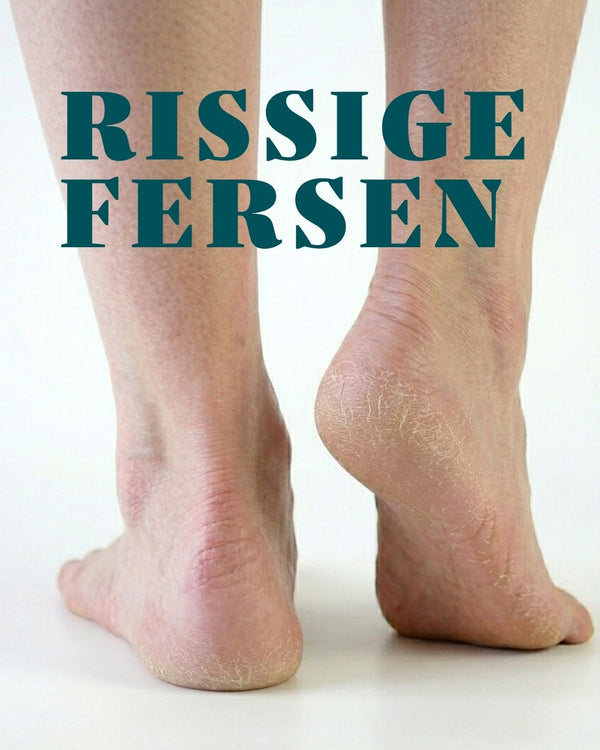
A study of 93 people shows how dry cracked heels are: calluses, dry heel skin and fissured heels held clearly less moisture and were less elastic than unaffected skin on the sole (Hashmi et al. 2015). A study of 150 women found that the drier the heel was graded, the lower skin hydration tended to be and the higher the water loss through the skin (Choi et al. 2018). Why the sole is so prone to this in the first place is explained under Why heel skin gets so thick and cracks.
Open shoes: the heel spreads sideways
Under the heel bone lies a pad of fat that cushions the impact when you step. In a closed shoe the heel counter holds this pad in place. One study compared shoes with a full and a shortened heel counter: with the counter, shock absorption was 8.8% higher on average (range 5.8 to 15.5%). The authors attribute this to the confined heel pad (Jørgensen & Ekstrand 1988).
Sandals, clogs and mules lack this support. The pad can spread sideways when you step, and the skin at the edge of the heel has to stretch with every stride. Thick, dry hard skin cracks where the stretch is greatest. This is the usual professional explanation; the study cited measured shock absorption, not the skin.
For choosing shoes this means: sandals with a heel strap, or with a footbed that cups the heel, give more hold than flat flip-flops.
Barefoot, sand and hard ground
If you walk barefoot a lot, you get more hard skin. This is a normal adaptation: in a study of people from Kenya and the United States, those who often walk barefoot had thicker and harder calluses than people who usually wear shoes (Holowka et al. 2019). The hard skin protects the sole. It only becomes a problem when it dries out and turns rigid. Sand, stones and patio slabs are additional mechanical stimuli. More under Does walking barefoot give me more calluses?
Chlorinated water, salt water and frequent showers
Skin often feels tight after the swimming pool. Measurements fit this: nine women swam for one hour in a public pool. Afterwards the skin surface was less hydrated, carried less sebum, and its pH was higher. The next day the values were back to baseline (Gardinier et al. 2009). The measurements were taken on the face and body, not on the feet.
For salt water there is a laboratory finding: isolated stratum corneum treated with saline was stiffer on drying and built up higher stresses than stratum corneum that had only been in contact with pure water (Moogan & German 2025). This was an experiment on skin samples, not a measurement on heels.
Then there is showering, often several times a day in summer. What water and warmth do to hard skin is covered under A foot bath before applying cream: useful or not?
Causes at a glance
| Cause | What is behind it | What you can do |
|---|---|---|
| Sandals without a heel counter | The heel pad spreads, the edge of the heel is stretched | Choose a heel strap or heel cup, alternate shoes |
| Walking barefoot, sand, hard ground | More pressure and friction, the skin forms more hard skin | Smooth hard skin once a week |
| Exposed heel | The hard skin gives off water to the air | Apply a rich cream in the evening, socks on top |
| Swimming pool | The skin surface is temporarily drier and carries less sebum afterwards | Rinse, dry, apply cream |
| Sea water | Salt makes the stratum corneum stiffer as it dries | Rinse off the salt with fresh water |
| Sun | The tops of the feet and the toes are often forgotten when applying sunscreen | Include them, reapply after swimming |
A routine for summer
- Start early. The stratum corneum renews itself continuously, but slowly. Begin a few weeks before sandal season or your holiday.
- Wash in the evening and dry well. Lukewarm and brief, between the toes too.
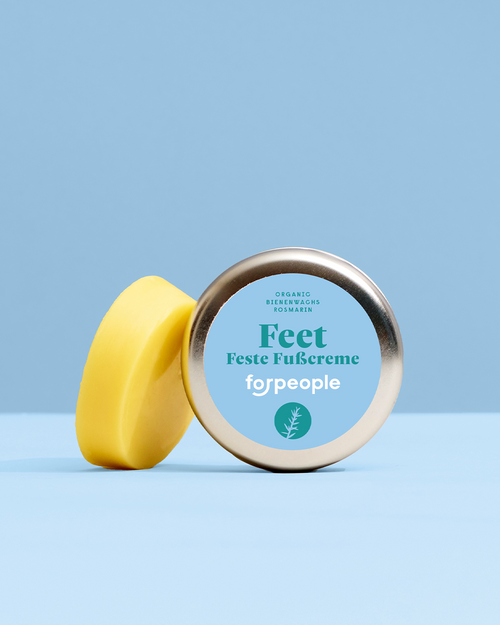
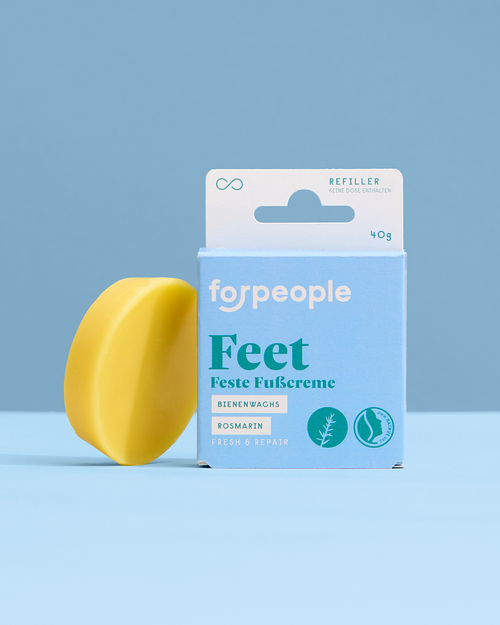
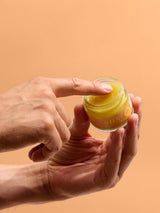
- Apply cream to the heels. A rich cream lays a film on the skin that reduces evaporation. Apply it to the heel, the edge of the heel and the ball of the foot, not between the toes. The authors of the heel study consider daily, repeated application helpful (Choi et al. 2018). A water-free cream such as the Solid Foot Cream – Rosemary & Sage is rubbed directly over the heel and then spread with your hands. When the tin is empty, you insert the refill.
- Socks on top. Thin cotton socks keep the cream on the heel overnight. In detail: Foot cream overnight with socks: what does it do?
- Smooth hard skin once a week. Only the top layer. Do not remove everything before your holiday: hard skin is protection, especially when you walk barefoot. Which tool is suitable is covered under Pumice stone, file or callus shaver: how do I remove calluses?
- After the beach and the pool. Rinse your feet with fresh water and dry them.
For very thick hard skin, many people use a cream with urea. How urea and water-free care complement each other is explained under Urea or water-free cream?
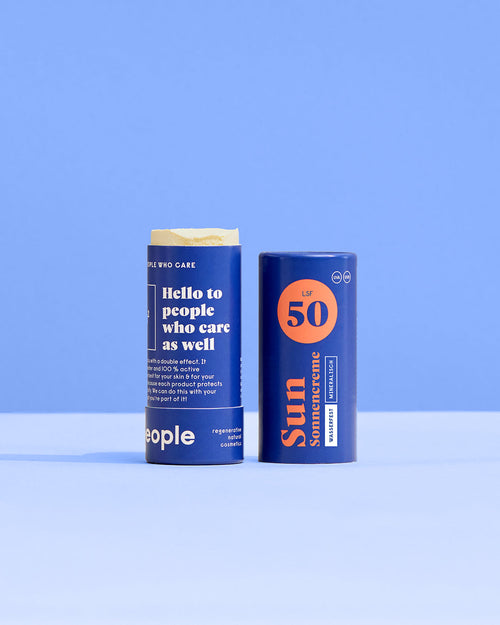
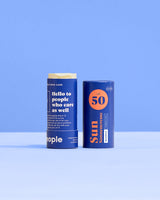
In sandals the tops of your feet and your toes are exposed too. Include them when you apply sunscreen. At forpeople there is the mineral Solid Sunscreen SPF50 for this.
When to see a podiatrist or doctor?
Cosmetics care for the skin; they do not treat medical conditions. Have your feet looked at by a podiatrist or doctor if cracks are deep, bleed or hurt when you walk, if the skin around a crack is red, swollen or warm or weeps, or if nothing improves after a few weeks of regular care. Do not put cream into open cracks. If you have diabetes, circulation problems or reduced sensation in your feet, do not remove hard skin yourself and have changes checked early. More: Cracked heels: when to see a podiatrist or a doctor?
What customers say
A selection of verified reviews from our shop (collected via Judge.me), translated from German and partly shortened.
“This solid foot cream is the absolute highlight for my feet! Space-saving when travelling, pleasant scent, easy to apply, great care.”
Customer review of Solid Foot Cream Refill - Rosemary & Sage, 5 out of 5 stars, May 2026, verified purchase
Frequently asked questions
Why do my heels crack in summer of all times?
Because the heel is exposed and has no hold at the sides in open shoes. The hard skin gets thicker, dries out and is stretched at the edge of the heel with every step.
Should I remove the hard skin before my holiday?
Smooth it, yes; remove it completely, no. A thin layer of hard skin protects the sole on sand and stones. Smooth it carefully a few days beforehand and apply cream daily afterwards.
Does the solid foot cream go soft in summer?
Yes, in warm conditions it becomes softer and is easier to apply; reviews describe this too. In direct sun or in a parked car it can become very soft; in a cool place it firms up again. More under Storing solid cosmetics: heat, summer and winter.
Can I take the solid foot cream on holiday?
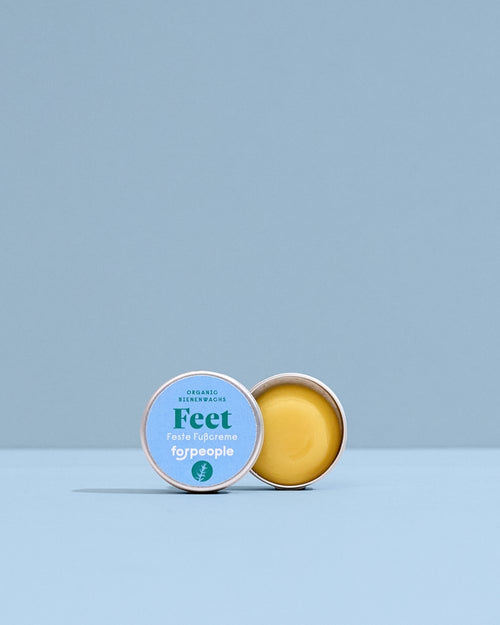
Yes. It is solid and comes in a closable metal tin; for short trips there is the travel size with 8 g. In hand luggage, solid creams can also count as a liquid at security. The rules are explained under Solid cream in hand luggage: liquid or not?
Does the cream sink in before I put my sandals on?
A water-free cream leaves a thin film; that is its purpose. A freshly creamed sole slips in a sandal and on smooth floors. Use only a little in the morning and wait a few minutes; the richer portion belongs in the evening.
At forpeople
- Solid Foot Cream – Rosemary & Sage, 40 g, €9.90: water-free; according to the INCI made from sunflower oil, beeswax, olive oil and shea butter, with essential oils of rosemary, eucalyptus and clary sage; in a metal tin.
- Solid Foot Cream Refill - Rosemary & Sage, 40 g, €7.90: the refill for the tin, same formula.
- Solid Foot Cream Travel Size – Rosemary & Sage in a Tin, 8 g, €5.90.
- Solid Sunscreen SPF50, 40 g, €17.90: mineral UV filters zinc oxide and titanium dioxide in non-nano form, in a paper tube.
The foot cream contains essential oils. Do not use it on injured skin.
More: Dry feet in winter: what causes it, what helps? · Foot care before and after hiking · Why heel skin gets so thick and cracks
From the blog: Cracked heels, dry feet: what really helps – and what doesn't · Well-cared-for feet for spring: care tips
Sources
- Hashmi F, Nester C, Wright C, Newton V, Lam S (2015): Characterising the biophysical properties of normal and hyperkeratotic foot skin. J Foot Ankle Res 8: 35. https://doi.org/10.1186/s13047-015-0092-7
- Choi JY, Kim EJ, Jang SI, Kim AR, Lee TJ, Lee HK (2018): A new technique for evaluating heel xerosis grade and the effects of moisturizer on heel skin dryness. Skin Res Technol 24(4): 557–561. https://doi.org/10.1111/srt.12466
- Jørgensen U, Ekstrand J (1988): Significance of heel pad confinement for the shock absorption at heel strike. Int J Sports Med 9(6): 468–473. https://doi.org/10.1055/s-2007-1025053
- Holowka NB, Wynands B, Drechsel TJ et al. (2019): Foot callus thickness does not trade off protection for tactile sensitivity during walking. Nature 571(7764): 261–264. https://doi.org/10.1038/s41586-019-1345-6
- Gardinier S, Guéhenneux S, Latreille J, Guinot C, Tschachler E (2009): Variations of skin biophysical properties after recreational swimming. Skin Res Technol 15(4): 427–432. https://doi.org/10.1111/j.1600-0846.2009.00382.x
- Moogan L, German GK (2025): Quantification of the mechanical effects of saline on human ex vivo stratum corneum. J Mech Behav Biomed Mater 168: 107016. https://doi.org/10.1016/j.jmbbm.2025.107016