








At a glance: before, during and after the hike
| When | What you do | Why |
|---|---|---|
| A few days before | cut nails straight, smooth thick callus edges moderately, break in your boots | very thick callus is considered a risk factor for blisters; broken-in boots rub less |
| On the evenings before | wash, dry and moisturise your feet | dry callus is less elastic |
| On the morning of the hike | do not apply cream freshly, put on dry socks without creases | damp, softened skin rubs more |
| On the trail | air your feet during breaks, change wet socks, tape pressure points immediately | moisture increases friction |
| After the hike | wash, dry thoroughly, look at your feet, moisturise in the evening | spot pressure points early; a film of fat and wax slows evaporation |
The days before the hike
Nails: Cut them straight and not too short a few days beforehand, so they do not hit the front of the boot on descents.
Calluses: A moderately thickened outer skin layer protects. If it turns into a thick callus, however, it is considered a risk factor for blisters (Rushton & Richie 2024). So smooth thick edges moderately a few days beforehand rather than removing a lot the evening before. Which tool to use is covered in Pumice stone, file or callus shaver: how do I remove calluses?.
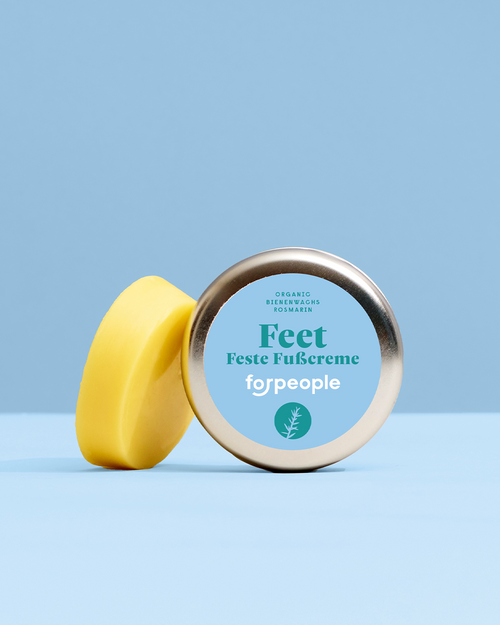
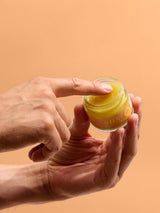
Moisturising: On the evenings before, apply cream to the heel and ball of the foot after washing. A water-free cream such as the Solid Foot Cream – Rosemary & Sage leaves a film of oil and wax on the skin. It is intended for care in the evening, not as a lubricant in the boot. More in Foot cream overnight with socks.
Getting boots and skin used to it: Repeated, low-level friction makes the epidermis thicker, which may make blisters less likely (Knapik et al. 1995). Among 2,617 cadets, those who had worn their boots for more than 20 hours a week in the two weeks before training developed blisters less often (29.70% versus 44.41%) (cited in Rushton & Richie 2024). Before a long tour, walk several shorter routes in the same boots and socks.
How blisters form: friction and moisture
When you walk, the bones in your foot move while sock and boot hold the skin surface in place. With every step the skin in between is sheared, until a split forms in the epidermis and fills with fluid (Rushton & Richie 2024). The higher the friction force, the fewer repetitions it takes; more vigorous activity and heavy loads increase the risk (Knapik et al. 1995).
Moisture adds to this: moist skin increases friction (Knapik et al. 1995). In one experiment, on heels that had been soaked in water beforehand, skin temperature rose faster under load than on the dry comparison heel; the researchers interpret this as a higher blister risk (Kirkham et al. 2014). More in Preventing chafing when running and cycling.
On the morning of the hike: cream or no cream?
A film of fat in the boot sounds like less friction. There is little evidence for it:
- In measurements on forearm and abdominal skin, water and lightly to moderately greasy moisturisers increased friction. Only viscous lubricants such as petroleum jelly, mineral oil and glycerin reduced it, for about 90 minutes. After three hours, friction was 35% above the starting value (cited in Rushton & Richie 2024).
- This was not measured on foot skin. Whether lubricants prevent blisters on the feet is not known (Rushton & Richie 2024).
- Antiperspirants with emollients and drying powders do not appear to reduce the likelihood of blisters (Knapik et al. 1995).
So moisturise your feet in the evening, not right before setting off. By the morning the cream has had time to absorb. Then pull dry socks over dry feet. Do not apply cream between your toes. The same goes for hands when climbing: Moisturise before or after climbing?.
Socks and boots
- Material: Cotton takes up sweat and stays wet for a long time. Among 35 long-distance runners, the group with densely padded cotton socks developed twice as many blisters as the group with identically constructed acrylic socks. With less padded socks, a follow-up study found no difference (cited in Rushton & Richie 2024).
- Two layers: Of 357 recruits, 40% had blisters when they wore a thin polyester liner sock under a thick, dense wool-polypropylene sock, compared with 69% with the standard sock (Knapik et al. 1996). Overall, however, a systematic review found little high-quality evidence for particular socks (Worthing et al. 2017).
- In practice: Pack a dry spare pair and change wet socks. The boot should hold the heel firmly and leave room for the toes on descents.
On the trail: tape pressure points early
If you feel a warm, rubbing spot, stop: boot off, smooth the sock, remove any grit, dry the spot and tape it.
Some people tape vulnerable areas before they start. In a randomised trial with 128 ultramarathon runners, thin paper tape reduced blisters by 40% (Lipman et al. 2016). An earlier study found no protection; the evidence is considered inconsistent (Worthing et al. 2017; Rushton & Richie 2024).
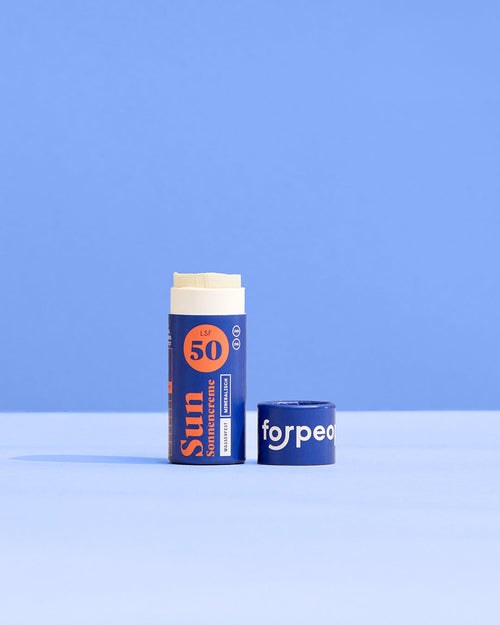
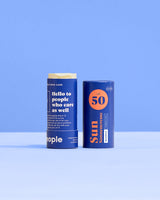
During breaks, let your feet dry in the air. If you sit barefoot in the sun while doing so, the top of the foot needs sun protection, for example with the Solid Sunscreen SPF50 Mini. If a blister has formed, that is not a case for a care cream. Ask a pharmacist or doctor how to look after it.
After the hike
- Wash: lukewarm and brief.
- Dry: thoroughly, including between the toes.
- Look: Check for redness, pressure points and your nails.
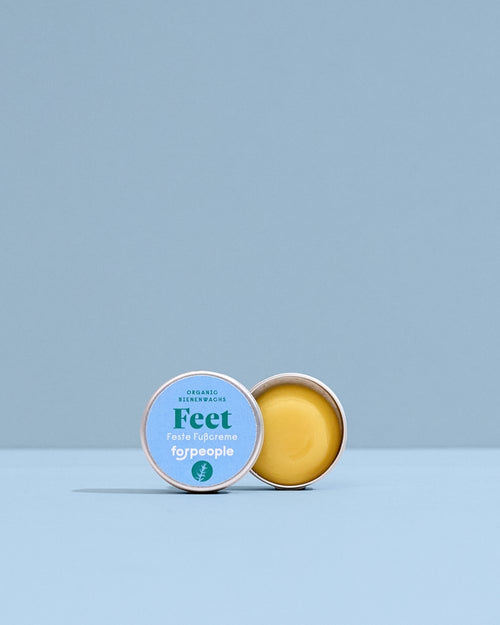
- Moisturise: heel and ball of the foot, only on uninjured skin. For multi-day tours there is the Solid Foot Cream Travel Size – Rosemary & Sage in a Tin with 8 g.
- Boots: Take out the insoles and let them dry in the air, not right next to a stove or radiator.
When to see a podiatrist or doctor
Cosmetics care for uninjured skin; they do not treat blisters or injuries. Get advice from a pharmacist or doctor if a blister is large, very painful or filled with blood, if the area turns red, warm, swollen or produces pus, or if a nail turns dark and hurts after the hike. If you have diabetes, loss of sensation or circulation problems in your feet, discuss long tours with a doctor or podiatrist beforehand. More in Cracked heels: when to see a podiatrist or doctor.
Frequently asked questions
Does a film of petroleum jelly or deer tallow help against blisters?
That has not been shown. In measurements on forearm skin, viscous lubricants reduced friction for about 90 minutes; after that it rose above the starting value. This has not been studied on feet.
Should I remove calluses before a hike?
Not completely, and not the evening before. A thin outer layer protects; very thick callus is considered a risk factor for blisters. Smooth thick edges a few days beforehand.
Can I take the solid foot cream on a multi-day tour?
Yes. It is solid and comes in a closable tin; customers describe it as easy to take along when travelling. In a warm rucksack it can become softer. More in Storing solid cosmetics: heat, summer and winter.
Does the solid foot cream absorb quickly enough in the evening?
Applied thinly, the oils absorb and the wax stays on the skin as a film. Put socks on afterwards, then the cream stays on your heel and not in your sleeping bag.
Does the solid foot cream contain fragrance?
Yes. It contains essential oils of rosemary, eucalyptus and clary sage with the declared components Linalool, Limonene and Geraniol. If you want to avoid essential oils, you can use the Solid Hand Cream - Beeswax on your feet; its ingredient list contains none. More in Can I use hand cream on my feet?.
At forpeople
- Solid Foot Cream – Rosemary & Sage, 40 g, €9.90: water-free, made from sunflower oil, beeswax, olive oil and shea butter.
- Solid Foot Cream Travel Size – Rosemary & Sage in a Tin, 8 g, €5.90: the same formula in the small tin.
- Solid Sunscreen SPF50 Mini, 20 g, €9.90: mineral filters zinc oxide and titanium dioxide, water-resistant.
The foot cream is care for the evening, not blister protection. Do not apply it to open or injured skin, and stop using it if your skin reacts.
More on this: Why heel skin gets so thick and cracks · Calluses keep coming back · Sun protection in the mountains and on snow
From the blog: Well-cared-for feet for spring: care tips · Cracked Heels, Dry Feet: What Really Helps – and What Doesn't
Sources
- Knapik JJ, Reynolds KL, Duplantis KL, Jones BH (1995): Friction blisters. Pathophysiology, prevention and treatment. Sports Med 20(3): 136–147. https://doi.org/10.2165/00007256-199520030-00002
- Rushton R, Richie D (2024): Friction Blisters of the Feet: A Critical Assessment of Current Prevention Strategies. J Athl Train 59(1): 8–21. https://doi.org/10.4085/1062-6050-0341.22
- Kirkham S, Lam S, Nester C, Hashmi F (2014): The effect of hydration on the risk of friction blister formation on the heel of the foot. Skin Res Technol 20(2): 246–253. https://doi.org/10.1111/srt.12136
- Knapik JJ, Hamlet MP, Thompson KJ, Jones BH (1996): Influence of boot-sock systems on frequency and severity of foot blisters. Mil Med 161(10): 594–598. https://pubmed.ncbi.nlm.nih.gov/8918120/
- Worthing RM, Percy RL, Joslin JD (2017): Prevention of Friction Blisters in Outdoor Pursuits: A Systematic Review. Wilderness Environ Med 28(2): 139–149. https://doi.org/10.1016/j.wem.2017.03.007
- Lipman GS, Sharp LJ, Christensen M, Phillips C, DiTullio A, Dalton A, Ng P, Shangkuan J, Shea K, Krabak BJ (2016): Paper Tape Prevents Foot Blisters: A Randomized Prevention Trial Assessing Paper Tape in Endurance Distances II (Pre-TAPED II). Clin J Sport Med 26(5): 362–368. https://doi.org/10.1097/JSM.0000000000000319