







How the skin on hands and feet differs
The stratum corneum is the outermost layer of the skin. How thick it is depends on the part of the body. In a study of 301 people, researchers counted its cell layers: on average 9 on the face, 15 on the arms and legs, 47 on the palms and soles, and 86 on the heel (Ya-Xian et al. 1999). A second paper estimated the thickness in living subjects and arrived at around 29 micrometres on the back of the hand and 173 micrometres on the palm (Egawa et al. 2007).
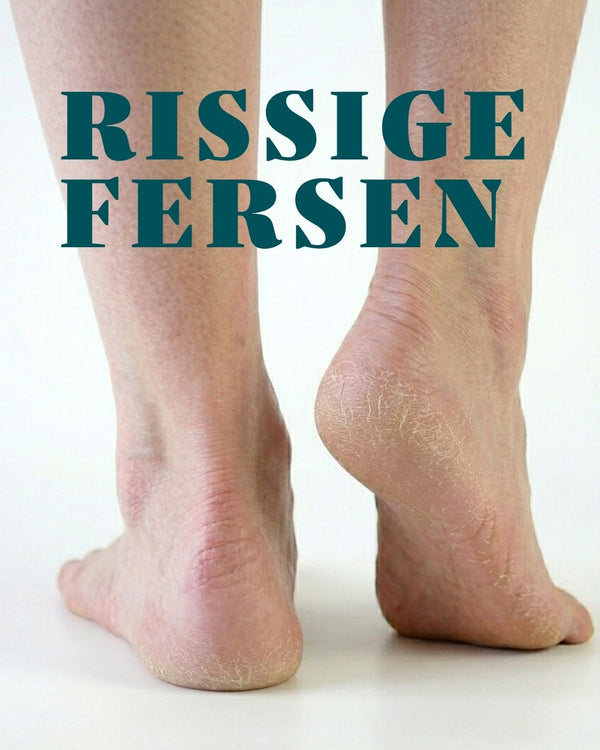
Then there is the question of fat. Sebaceous (oil) glands are found almost everywhere on the body, except on the palms and the soles of the feet (Smith & Thiboutot 2008). The back of the hand therefore has its own film of oil; the sole of the foot does not. The sole also carries your body weight with every step and forms extra callus under pressure. In a study of 93 people, callused and dry areas of the foot contained less moisture and were less elastic than unaffected skin (Hashmi et al. 2015). What this means for the heel is explained in Why heel skin gets so thick and cracks.
How hand creams and foot creams usually differ
There is no fixed rule for what counts as a hand cream and what counts as a foot cream. The manufacturer decides what a product is intended for. The table describes tendencies: there are also rich hand creams and light foot creams.
| Feature | Typical hand cream | Typical foot cream |
|---|---|---|
| Structure | often an emulsion with water listed first that absorbs quickly, so your hands can grip again straight away | often richer in fat; the film may stay on the skin for longer |
| Additive for thick calluses | rare | often urea |
| Scent | from unscented to perfumed | often herbal, for example with essential oils |
Urea is the most noticeable difference. At low concentrations it binds water in the stratum corneum; at higher concentrations of 20 to 30% it loosens callused skin (Sethi et al. 2016). More on this in Urea or water-free cream?.
The ingredient list shows what makes up the largest share: ingredients are listed in descending order of weight, and only below 1% is the order free (Regulation (EC) No 1223/2009, Art. 19). How to read the list is explained in How to Read an INCI List.
Where hand cream is enough on the foot, and where it is not
- Top of the foot, ankles, tops of the toes: The skin here is thin and resembles the back of the hand. A hand cream is usually enough.
- Heel, ball of the foot, outer edge: This is thick callus without its own film of oil. With a water-rich cream, the water evaporates first and the smaller share of fat stays on the skin. On the heel, that does not last long.
- Between the toes: do not apply cream here; dry well after washing instead.
What the heel needs most is a film of fat and wax that slows evaporation. It has the most pronounced effect on slightly damp skin (Sethi et al. 2016). If hand cream is all you have at home, this is how to get more out of it:
- Wash and dry your feet, including between the toes.
- Apply more generously than on your hands and massage it into the heel and the ball of the foot.
- Pull on cotton socks in the evening, see Foot cream overnight with socks.
- File thick calluses moderately about once a week.
Formula comparison: our solid hand cream and our solid foot cream
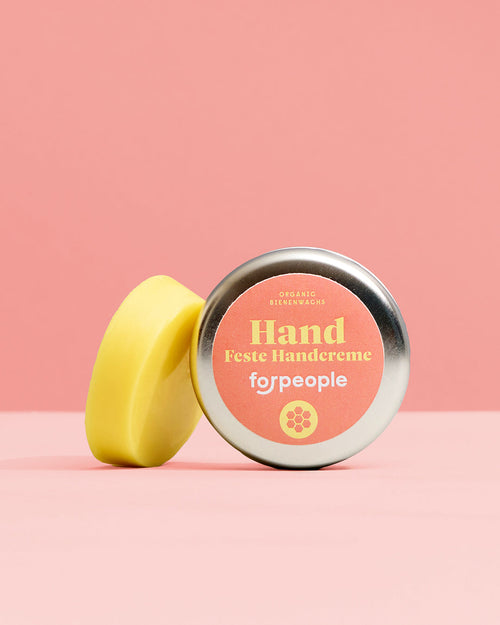
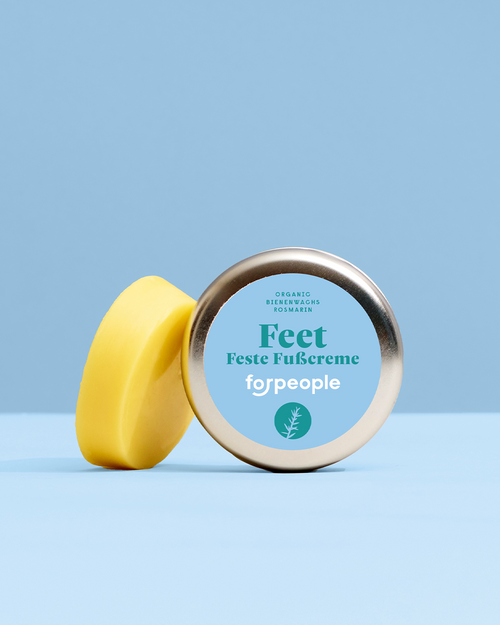
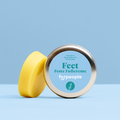
Two ingredient lists show how close a hand cream and a foot cream can be. The Solid Hand Cream - Beeswax and the Solid Foot Cream – Rosemary & Sage are both water-free. The information comes from their ingredient lists (INCI), as of October 2026.
| Feature | Solid Hand Cream - Beeswax | Solid Foot Cream – Rosemary & Sage |
|---|---|---|
| First ingredient | beeswax (Cera Alba) | sunflower oil (Helianthus Annuus Seed Oil) |
| Other oils, waxes, butters | olive oil, sunflower oil | beeswax, olive oil, shea butter |
| Plant extracts | St. John's wort, aloe vera | St. John's wort, aloe vera |
| Essential oils | none | rosemary, eucalyptus, clary sage |
| Declared fragrance components | none | Linalool, Limonene, Geraniol |
| Water, emulsifier, preservative | not included | not included |
| Ingredients according to INCI | 5 | 12 |
Beeswax, olive oil, sunflower oil and extracts of St. John's wort and aloe vera are in both. Three things differ:
- Order: In the hand cream the wax comes first, in the foot cream the sunflower oil. More wax generally makes a water-free cream firmer; how large the difference is here cannot be read from the list.
- Shea butter: It is only in the foot cream.
- Scent: Only the foot cream contains essential oils, and with them fragrance components that have to be named individually. More in Without fragrance and essential oils: ingredients at a glance.
So our hand cream is not a light, water-rich hand cream. On the heel it leaves the same kind of film of wax and oil as the foot cream. If you already have it, you can use it on your feet. If you want to avoid essential oils, stay with it on your feet as well; if you want the herbal scent and shea butter, choose the foot cream. The ingredient lists do not allow the conclusion that one of the two cares “more strongly” for the feet.
The other way round: foot cream on your hands
That works too. Three points to keep in mind:
- Urea: Foot creams with a lot of urea are made for thick calluses. On thin or cracked skin on the back of the hand, urea can sting.
- Film: Rich foot creams absorb more slowly. That gets in the way at the keyboard, on your phone or at the steering wheel, but not in the evening.
- Scent: A strong herbal scent on your hands is a matter of taste. In reviews, a few customers write that they also use our solid foot cream on their hands.
When to see a podiatrist or doctor
Cosmetics care for the skin; they do not treat medical conditions. Have your feet looked at by a podiatrist or doctor if cracks are deep, bleed or hurt when you walk, if the skin turns red, weeps or feels warm, or if it does not improve despite a few weeks of regular care. If you have diabetes, loss of sensation or circulation problems in your feet, get professional advice on foot care first. More in Cracked heels: when to see a podiatrist or doctor.
What customers say
A selection of verified reviews from our shop (collected via Judge.me), translated from German and partly shortened.
“I have been using this solid foot cream for quite a while now and I am still delighted. I have never had such soft feet.”
Customer review of Foot Care Set – For Dry, Rough Feet (2× Rosemary Cream), 5 out of 5 stars, December 2025, verified purchase
Frequently asked questions
Is hand cream enough for rough heels that look cracked?
A rich hand cream keeps the callus supple if you apply it generously in the evening and pull socks over it. A light cream is usually not enough on the heel. Deep or painful cracks belong in professional hands.
Why does the solid foot cream smell of herbs, but the solid hand cream does not?
The foot cream contains essential oils of rosemary, eucalyptus and clary sage. The ingredient list of the hand cream with beeswax contains no essential oils and no fragrance components that require declaration.
Is the solid foot cream firmer or softer than the solid hand cream?
Both are solid and soften at the surface with the warmth of your skin. In the hand cream, beeswax comes first; in the foot cream, sunflower oil. A few customers describe the foot cream in reviews as turning creamy more quickly; we have no measurements on this.
Does a solid cream absorb on the feet, or do I need socks?
The oils absorb, the wax stays on the skin as a thin film. Several customers write in reviews that the foot cream absorbs quickly; a few put socks on afterwards because they can feel the film. Do not walk barefoot on smooth floors after applying it.
Can I refill the hand cream tin with the foot cream refill?
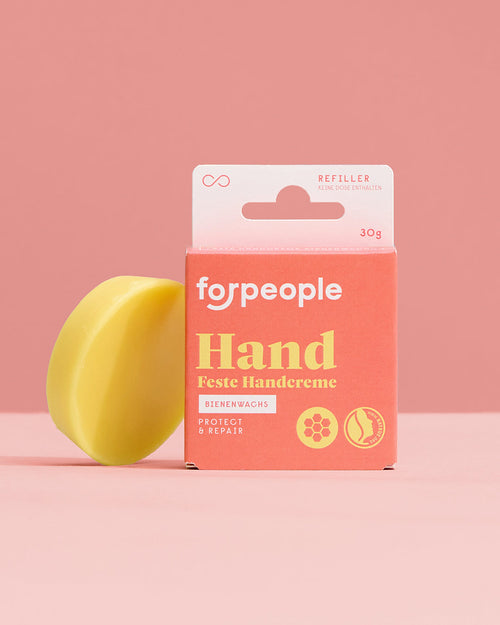
The refills are intended for the tin of the respective cream: the Solid Foot Cream Refill - Rosemary & Sage for the foot cream tin, the Solid Hand Cream Refill - Beeswax for the hand cream tin. More in Refillable Hand Cream: How the Refill Works.
At forpeople
- Solid Hand Cream - Beeswax, 30 g, €9.90: water-free, no essential oils according to the ingredient list.
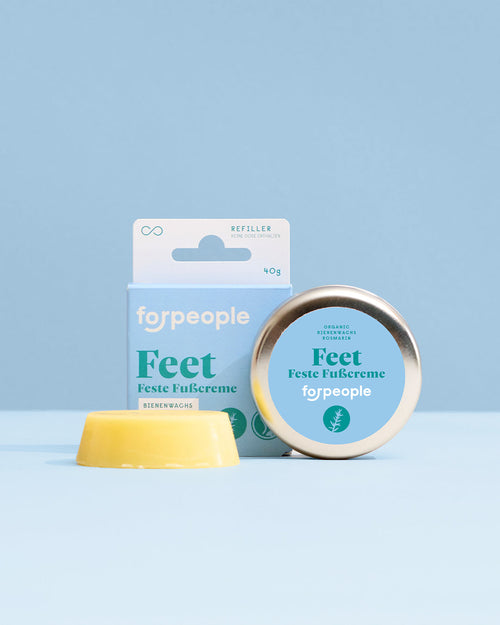
- Solid Foot Cream – Rosemary & Sage, 40 g, €9.90: water-free, with shea butter and essential oils of rosemary, eucalyptus and clary sage.
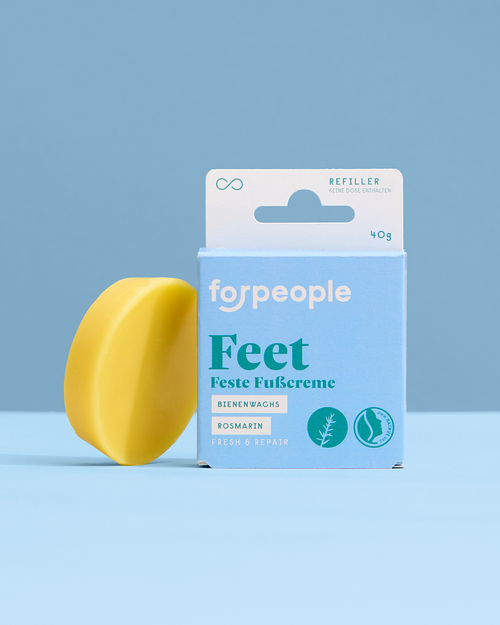
- Solid Foot Cream Refill - Rosemary & Sage, 40 g, €7.90: the refill for the foot cream tin.
Do not apply the creams to open or injured skin, and stop using them if your skin reacts.
More on this: Calluses keep coming back · Solid hand cream: how to recognise a good one · How do I apply a solid cream correctly?
From the blog: Cracked Heels, Dry Feet: What Really Helps – and What Doesn't · Well-cared-for feet for spring: care tips
Sources
- Ya-Xian Z, Suetake T, Tagami H (1999): Number of cell layers of the stratum corneum in normal skin – relationship to the anatomical location on the body, age, sex and physical parameters. Arch Dermatol Res 291(10): 555–559. https://doi.org/10.1007/s004030050453
- Egawa M, Hirao T, Takahashi M (2007): In vivo estimation of stratum corneum thickness from water concentration profiles obtained with Raman spectroscopy. Acta Derm Venereol 87(1): 4–8. https://doi.org/10.2340/00015555-0183
- Smith KR, Thiboutot DM (2008): Thematic review series: skin lipids. Sebaceous gland lipids: friend or foe? J Lipid Res 49(2): 271–281. https://doi.org/10.1194/jlr.R700015-JLR200
- Hashmi F, Nester C, Wright C, Newton V, Lam S (2015): Characterising the biophysical properties of normal and hyperkeratotic foot skin. J Foot Ankle Res 8: 35. https://doi.org/10.1186/s13047-015-0092-7
- Sethi A, Kaur T, Malhotra SK, Gambhir ML (2016): Moisturizers: The Slippery Road. Indian J Dermatol 61(3): 279–287. https://doi.org/10.4103/0019-5154.182427
- Europäisches Parlament und Rat (2009): Verordnung (EG) Nr. 1223/2009 über kosmetische Mittel, Art. 19 Abs. 1 Buchst. g. ABl. L 342: 59. https://eur-lex.europa.eu/eli/reg/2009/1223/oj