


What a loofah sponge is
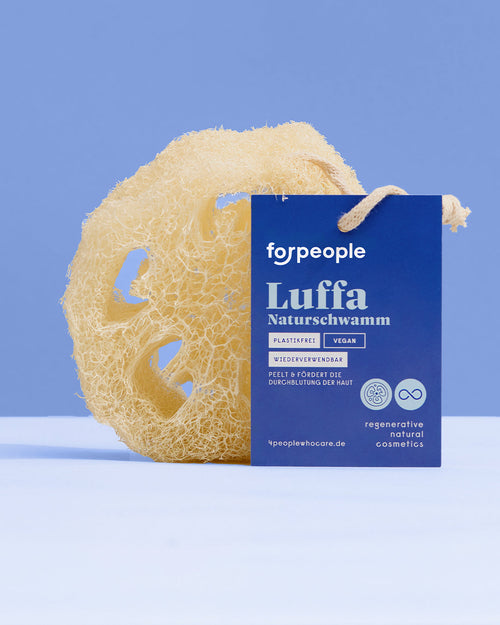
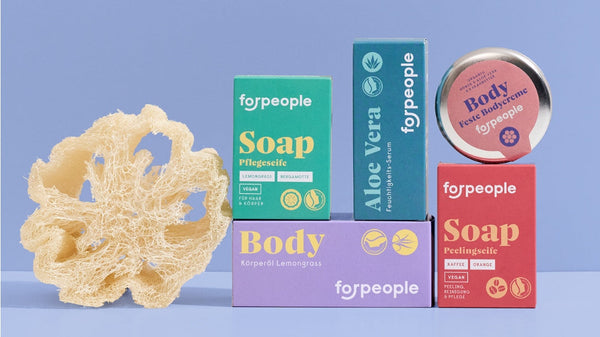
A loofah is not a sea sponge but the fibre skeleton of a fruit from the gourd family; in the scientific literature the plant is mostly called Luffa cylindrica. The ripe fruits are soaked in water for several days until skin and seeds come away, and the skeleton is then dried (Bottone et al. 1994). The individual fibre consists mainly of cellulose embedded in lignin and hemicellulose, and is itself porous (Chen et al. 2014).
In the shower the sponge works as a mechanical scrub: the fibres take loose skin cells with them. Some of these stay caught in the sponge.
Why a wet natural sponge offers germs good conditions
Bacteria need water and nutrients. A used loofah sponge provides both. This was studied by a hospital laboratory in New York (Bottone et al. 1994):
- The sponge itself is enough as a growth medium. In distilled water containing nothing but a sterile piece of loofah, several bacterial species from the environment multiplied. For Pseudomonas aeruginosa, the count rose within 24 hours at 35 °C from between 1,000 and 10,000 to between 100 million and 1 billion colony-forming units per millilitre. Typical skin residents such as Staphylococcus epidermidis did not multiply in this way.
- Skin flakes add to it. According to the researchers, skin cells caught in the fibre mesh can further promote growth.
Bacteria are part of every skin and every bathroom. The findings do not mean that a loofah sponge makes you ill; how often sponges lead to skin problems is not known, according to the same research group (Bottone & Perez 1993). They do show, however, why the sponge should not stay wet all the time.
After every shower: rinse, squeeze out, hang up
- Rinse: under running water until no more lather comes out. Soap residue and skin flakes should be washed out.
- Squeeze out: press firmly and shake out.
- Hang up: in an airy place outside the shower cubicle, for example on a hook next to the window. The sponge should dry completely before it is used again; airing the bathroom is part of that.
- Do not share: Everyone has their own sponge.
Why the place matters is shown by the single case that prompted the studies: the sponge hung on the tap in the shower cubicle, the cubicle was used several times a day, and there was too little time for it to dry. By contrast, Pseudomonas aeruginosa was not found on ten dry sponges in private use by laboratory staff (Bottone & Perez 1993).
Drying has its limits, though. In the experiment, the bacterial count on dried sponges fell only slowly; it took more than two weeks for a clear decline, and after one night in water the earlier level was reached again (Bottone et al. 1994). Drying is therefore the basis, but not decontamination.
Cleaning more thoroughly: what has been tested and what is household practice
| Method | What is known | Assessment |
|---|---|---|
| Diluted chlorine bleach: one part bleach to nine parts water, soak for one minute, rinse thoroughly | In the experiment, no bacteria could be detected on the sponge pieces afterwards. The researchers recommend this at regular intervals (Bottone et al. 1994). | the only method tested on loofah |
| Hot water, boiling, washing machine, vinegar water | We know of no study on loofah sponges. | household practice |
| Replacing | New, dry sponges carried only few germs in the experiment (Bottone et al. 1994). | the most reliable solution |
Chlorine-based cleaners do not all have the same concentration; the mixing ratio from the US study therefore cannot simply be carried over. If you use chlorine bleach, follow the label, wear gloves, ventilate the room and never mix it with vinegar or other cleaners.
A study on kitchen sponges calls for caution: sponges that, according to their users, were cleaned regularly did not contain fewer bacteria than uncleaned ones. The authors therefore recommend replacing them regularly, about weekly in that case (Cardinale et al. 2017). Kitchen sponges are made of a different material. Only the general direction carries over: cleaning is no substitute for a new sponge.
How often to replace it, and how to tell it has to go
There is no interval that has been tested in studies. A common rule of thumb is to replace a natural sponge used daily after about three to four weeks; with less frequent use and good drying it lasts longer. Replace it sooner if you notice one of these signs:
- The sponge smells musty or mouldy, even after it has dried.
- Dark dots or spots appear that cannot be rinsed out.
- The surface feels slimy.
- The fibres break, the sponge loses its shape or falls apart.
If in doubt, replace it. A worn-out sponge goes into household waste; what may go into the organic waste bin is decided by your local authority.
Which skin not to use it on
- Freshly shaved skin: The blade also removes part of the top horny layer, see Deodorant after shaving: why does it sting, and what helps? In the case described, small shaving nicks probably served as a point of entry for germs from the sponge (Bottone & Perez 1993). Leave out the sponge on shaved areas on the same day.
- Injured, irritated or reddened skin: leave it out until the skin is intact again.
- Face and intimate area: A loofah sponge is too coarse for these. How to cleanse your face is described in Can I use bar soap on my face?
- Very dry skin: A scrub removes loose skin cells; the dryness remains. Applying cream afterwards helps more here than frequent scrubbing; more on this under Why are elbows and knees so dry? and Why are shins dry and flaky in winter?
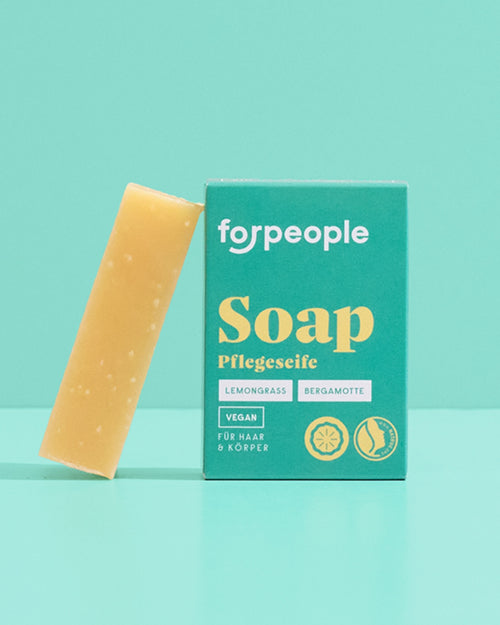
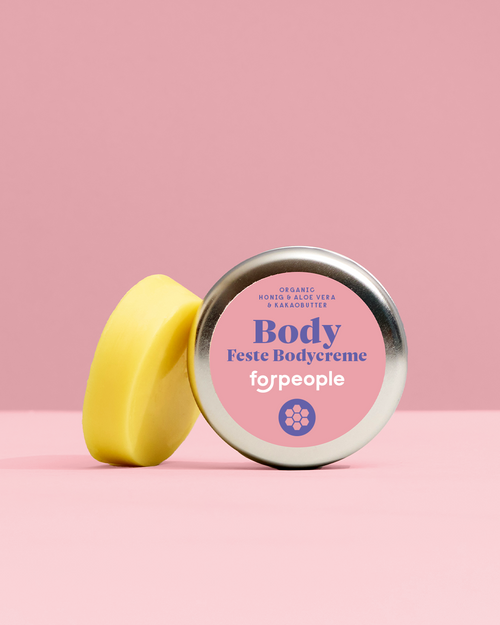
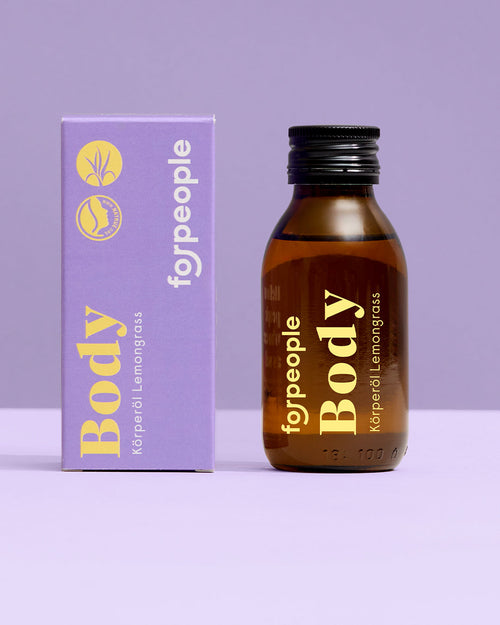
A scrub once or twice a week is usual, with little pressure on wet, lathered skin, for example with the Luffa Shower Sponge - Cleansing & Exfoliation and a bar of Aloe Vera Soap - Lemongrass. If the skin reddens, it was too much. After drying off, apply cream or oil, for instance the Solid Body Butter - Beeswax & Aloe Vera or the Body Oil - Lemongrass; you will find the comparison under Body Oil or Body Butter – Which One When?
When to seek medical advice
The studies cited were prompted by a single case: in one woman, an inflammation of the hair follicles caused by Pseudomonas aeruginosa was traced back to her heavily colonised loofah sponge (Bottone & Perez 1993). If red, itchy or pus-filled spots appear after showering or scrubbing, especially on shaved areas, dispose of the sponge and have your skin looked at by a doctor. This applies all the more if you have a fever, swollen lymph nodes or if the spots spread. If you have a weakened immune system, diabetes or a chronic skin condition, check with your doctor beforehand whether scrubbing with the sponge is right for you.
Frequently asked questions
How often do I need to replace a loofah sponge?
There is no interval tested in studies. The rule of thumb is three to four weeks with daily use. If it smells musty, develops spots or falls apart, replace it straight away.
Can I boil the loofah sponge or put it in the washing machine?
Both are common household practice. Whether this reliably reduces the germs in the loofah has, to our knowledge, not been studied. It is no substitute for replacing the sponge regularly.
Why is the new sponge hard and flat?
Dry loofah fibres are stiff, and the sponges are often delivered pressed flat. In water the sponge swells and becomes soft.
Can I use the loofah sponge with bar soap?
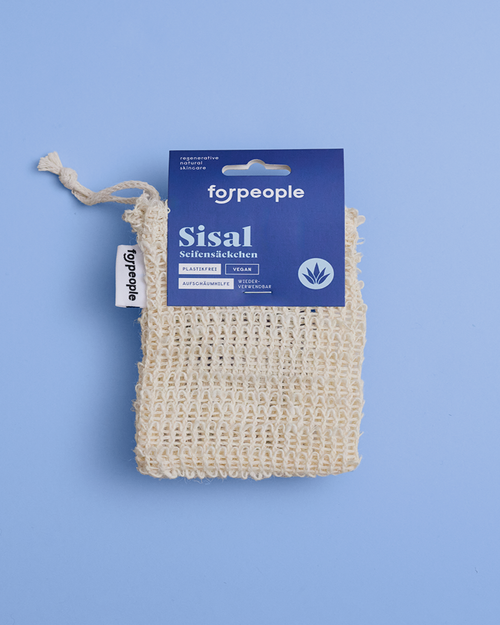
Yes. Rub the soap briefly over the wet sponge and work up a lather. Afterwards, let both dry separately. The Sisal Soap Pouch is also rinsed out after washing and hung up to dry.
Does all this apply to synthetic sponges and pumice stones too?
In principle, yes. The researchers include synthetic sponges and pumice stones in their recommendation. How to look after a pumice stone is described in Pumice Stone, File or Shaver: How to Remove Calluses?
At forpeople
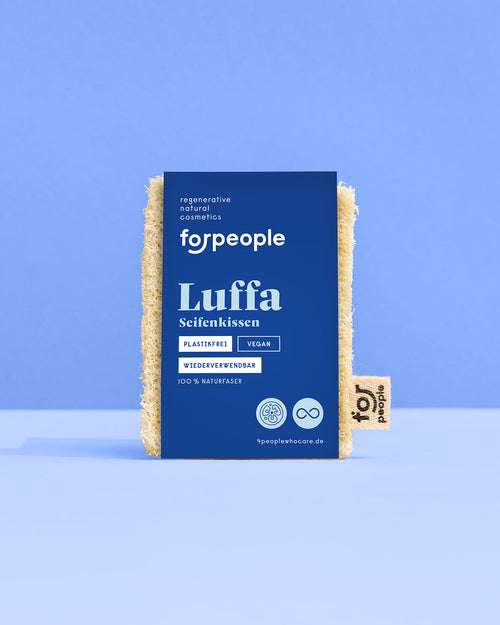
- Luffa Shower Sponge - Cleansing & Exfoliation, 1 piece €4.90, 3 pieces €13.90: made of loofah fibres, for the body.
- Luffa Soap Dish – Natural, €3.90: the same fibre as a rest for your soap; it is rinsed, dried and replaced in the same way.
- Aloe Vera Soap - Lemongrass, 75 g, €8.90: classic soap made from saponified plant oils, scented with essential oils.
- Solid Body Butter - Beeswax & Aloe Vera, 40 g, €9.90: no water according to its INCI list, for skincare after showering.
More on this: Mushy bar soap · Bar soap or liquid soap · Hygiene and Water-Free Cosmetics
From the blog: Less in the bathroom: a skincare routine with three products
Sources
- Bottone EJ, Perez AA 2nd, Oeser JL (1994): Loofah sponges as reservoirs and vehicles in the transmission of potentially pathogenic bacterial species to human skin. J Clin Microbiol 32(2): 469–472. https://doi.org/10.1128/jcm.32.2.469-472.1994
- Bottone EJ, Perez AA 2nd (1993): Pseudomonas aeruginosa folliculitis acquired through use of a contaminated loofah sponge: an unrecognized potential public health problem. J Clin Microbiol 31(3): 480–483. https://doi.org/10.1128/jcm.31.3.480-483.1993
- Chen Q, Shi Q, Gorb SN, Li Z (2014): A multiscale study on the structural and mechanical properties of the luffa sponge from Luffa cylindrica plant. J Biomech 47(6): 1332–1339. https://doi.org/10.1016/j.jbiomech.2014.02.010
- Cardinale M, Kaiser D, Lueders T, Schnell S, Egert M (2017): Microbiome analysis and confocal microscopy of used kitchen sponges reveal massive colonization by Acinetobacter, Moraxella and Chryseobacterium species. Sci Rep 7(1): 5791. https://doi.org/10.1038/s41598-017-06055-9