










What cement does to your skin
The effect starts as soon as water is added, in the bucket or through the sweat on your skin. A strongly alkaline solution then forms. GESTIS, the substance database of the German Social Accident Insurance, gives a pH of 11 to 13.5 for mixed cement (GESTIS 2026). The horny layer of the skin, by contrast, is slightly acidic at around pH 5.5 (Ananthapadmanabhan et al. 2004). Each step on the pH scale stands for a factor of ten.
Three properties come together:
- Alkaline: In experiments, solutions with a pH of just 10 made the horny layer swell and changed its lipids, even without surfactants (Ananthapadmanabhan et al. 2004). Mixed cement is well above that.
- Water-drawing: GESTIS describes a dehydrating effect for cement. The dry dust also attracts moisture (Alam et al. 2007).
- Mechanical: The fine grains abrade the skin, in mortar and concrete together with sand (HSE 2025).
Cement is classified as a skin irritant and carries the hazard statement “Causes skin irritation” (GESTIS 2026). Then there is the work itself: wetness, sweat inside the glove and the thorough wash in the evening. Why that alone dries the skin out is explained under Cracked hands from frequent washing.
When to seek medical advice?
Wet cement can cause chemical burns if it stays on the skin for longer, above all where it is trapped: in a glove, in a boot or when kneeling in fresh screed (HSE 2025). Such burns start gradually; many of those affected notice only mild irritation at first. In an Irish review of 46 cases over ten years, 13% happened in a domestic setting (Alam et al. 2007).
- Cement in a glove, a boot or your clothing: take it off straight away, dust off the skin, rinse under running water and clean thoroughly with soap (GESTIS 2026).
- Burning, redness, blisters or discoloured areas: after rinsing, have it checked by a doctor the same day. Mention that it was cement.
- Splashes in the eye: rinse for ten minutes under running water, keeping the eyelids open, then go straight to an eye doctor or a hospital (GESTIS 2026).
- Redness, scaling, cracks or small blisters that last for days or keep coming back: have it checked by a skin specialist, at work via the company doctor. Cement eczema may be behind it.
Cosmetics do not belong on irritated, broken or burnt skin.
Which material, which protection
| Material | What is special about it | Protection |
|---|---|---|
| Cement, fresh concrete, mortar, screed | strongly alkaline once mixed (pH 11 to 13.5), draws water; sand adds abrasion | waterproof gloves, long clothing, waterproof shoes or boots; let nothing run in from the top |
| Tile adhesive, grout, many fillers | often contain cement and are then to be treated like cement; what is in the product is stated on the packaging | gloves for grouting too; do not smooth joints with a bare finger |
| Lime plaster, lime mortar, limewash | contain slaked lime (calcium hydroxide); the saturated solution has a pH of 12.6 | as for cement; tightly fitting safety goggles where splashes are possible |
| Gypsum plaster, gypsum filler | almost neutral (pH 7.7) and not a hazardous substance under the CLP Regulation; the powder nevertheless draws water and abrades | gloves for longer jobs; wash and apply cream afterwards |
The values come from the data sheets on cement, calcium hydroxide and calcium sulphate (GESTIS 2026). That many tile adhesives contain cement is building practice; the label is what counts.
Gloves: For cement, GESTIS and the German accident insurer for the raw materials and chemical industry name nitrile-impregnated cotton gloves. Leather gloves are unsuitable because they let liquid through and are often chrome-tanned (BG RCI 2026). The British health and safety authority advises long gloves or gloves that fit tightly at the cuff, so that no cement gets trapped between glove and skin (HSE 2025). A cream is no substitute: according to GESTIS, barrier creams do not offer sufficient protection against cement.
“Low-chromate”: The label goes back to an EU rule. Cement and mixtures containing cement may not be sold or used if, once mixed with water, they contain more than 2 mg of soluble chromium(VI) per kilogram of dry cement. If a reducing agent ensures this, the packaging must state when the product was packed and how long the value holds under which storage conditions (REACH, Annex XVII, entry 47). The rule limits an accompanying substance that can sensitise the skin. It does not change the alkalinity: low-chromate cement is not considered harmless either (BG RCI 2026).
After work: five steps
- Dust off and rinse: Knock off dry dust, then hold your hands under running water.
- Wash: with lukewarm water and soap, thoroughly up past the wrists, but without a brush and without abrasives.
- Dry: completely, between the fingers too.
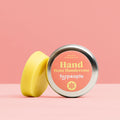
- Apply cream: a fat-based care product on clean, dry skin, for example the Solid Hand Cream - Beeswax. Include fingertips, knuckles and the edges of the nails.
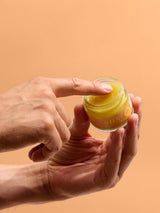
- Thicker in the evening: a rich layer before bed, for example the Beeswax Salve Larch & Mandarin in a Glass Jar, on intact skin only. How to do this with cotton gloves is shown on the page Overnight hand mask.
The order follows the hygiene notes in GESTIS: clean the skin with water and soap before breaks and at the end of work, then use fat-containing skin care products (GESTIS 2026). Steps 2 and 3 and the evening care are common practice. According to the British authority, skin care products replace the natural oils that the skin needs for its barrier (HSE 2025). How a wax film reduces evaporation is explained under Occlusion and TEWL. If the cream stings on rough areas, read Why does hand cream sting on cracked hands?.
DIY at the weekend
If you only spend one weekend tiling, concreting in a fence post or plastering a wall, it is easy to underestimate the material. These habits help:
- Put gloves on before you start mixing. Keep a second pair ready in case the first gets wet inside.
- Smooth joints with a grout float and sponge, not with your finger.
- Do not kneel in fresh screed or concrete. Trousers go over the top of your boots so that nothing runs in.
- Keep water within reach. Rinse splashes off straight away.
- Read the packaging: hazard statements, packing date and storage time.
In the days afterwards, apply cream in the morning, after washing your hands and in the evening.
Frequently asked questions
Why are my hands still rough days after concreting?
Because alkaline solution, loss of water and abrasion came together. The horny layer needs time to renew itself. Until then, regular care on clean, dry skin helps. If it does not improve after a few days, have a doctor look at your skin.
Can I apply cream before work so that the cement does not reach my skin?
No. A care cream is not protection, and according to GESTIS even barrier creams are not sufficient against cement. Waterproof gloves and closed clothing protect. Care comes afterwards.
Does vinegar help against cement on the skin?
The official guidance names running water and soap, not household remedies. We do not know of any tested recommendation for vinegar. Rinse for a long time with plenty of water.
How do I get dried mortar off my hands?
Soak it in lukewarm water and wash several times with soap instead of scratching or brushing. Solvents do not belong on the skin. For oil, grease and grime there is a separate page: Oil and grease on your hands: how do you wash them off gently?.
The solid cream is hard in the cold. How do I apply it after a day on the building site?
Carry the tin in an inside pocket, then the cream stays softer. Stroke over the surface with warm fingers and rub the thin layer into both hands. More under How do I apply a solid cream correctly?.
At forpeople
Our solid hand creams are care for the time after work. They are not skin protection products within the meaning of the German occupational safety rule TRGS 401, not hand cleaners and no substitute for gloves. According to the ingredient list, the Solid Hand Cream - Beeswax (30 g, €9.90) consists of beeswax, olive and sunflower oil, St. John's wort and aloe extract, with no water and no added fragrance; it smells of beeswax. The metal tin fits in a jacket and a toolbox and is refilled with the Solid Hand Cream Refill - Beeswax (30 g, €7.90). The Hand Care Set – For Rough, Cracked Hands (2× Solid Hand Cream) (60 g, €16.90) contains one tin and one refill. For the evening there is the Beeswax Salve Larch & Mandarin in a Glass Jar (50 g, €12.90) with olive, almond and castor oil, beeswax, larch resin, propolis and essential oils; it has a distinct scent. If you react to resin or propolis, first read Allergic to tree resin, colophony or propolis?. According to the safety notice, none of the four products is intended for injured or irritated skin. If you notice a skin reaction, stop using the product.
More on this: Hand care for manual work and gardening · Hand cream under latex or nitrile gloves? · Dry hands from paper, cardboard and chalk: what causes it?
From the blog: Hands and feet through winter: a routine for morning and evening
Sources
- Deutsche Gesetzliche Unfallversicherung, Institut für Arbeitsschutz (IFA): GESTIS-Stoffdatenbank (GESTIS Substance Database), data sheets “Zement” (cement, ZVG No. 80660), “Calciumhydroxid” (calcium hydroxide, ZVG No. 1150) and “Calciumsulfat” (calcium sulphate, ZVG No. 1170). Accessed 8 October 2026. https://gestis.dguv.de/data?name=080660
- Regulation (EC) No 1907/2006 of the European Parliament and of the Council (REACH), Annex XVII, entry 47 “Chromium VI compounds”. Consolidated version of 22 June 2026. https://eur-lex.europa.eu/legal-content/EN/TXT/?uri=CELEX:02006R1907-20260622
- Berufsgenossenschaft Rohstoffe und chemische Industrie (BG RCI): Praxishandbuch Baustoffindustrie, chapter A 1.14 “Chromate in der Betonindustrie”. Accessed 8 October 2026. https://www.bgrci.de/praxishandbuch-baustoffindustrie/a-grundlagen/a-1-allgemeines/a-114-chromate-in-der-betonindustrie
- Health and Safety Executive (HSE): Construction hazardous substances: Cement. Updated 4 September 2025, accessed 8 October 2026. https://www.hse.gov.uk/construction/healthrisks/hazardous-substances/cement.htm
- Ananthapadmanabhan KP, Moore DJ, Subramanyan K, Misra M, Meyer F (2004): Cleansing without compromise: the impact of cleansers on the skin barrier and the technology of mild cleansing. Dermatol Ther 17(Suppl 1): 16–25. https://doi.org/10.1111/j.1396-0296.2004.04s1002.x
- Alam M, Moynagh M, Lawlor C (2007): Cement burns: the Dublin national burns unit experience. J Burns Wounds 7: e4. PMID 18091981. https://pubmed.ncbi.nlm.nih.gov/18091981/