








What water, clay and grog do to the skin
Water. At the wheel, your hands are often wet for one to two hours at a stretch. In one study, the horny layer was about three times as thick after four hours of contact with water as before, and the ordered lipid layers between the cells were broken up in many places (Warner et al. 2003). A review names, as one possible explanation for the irritant effect of water, that it washes out or dilutes the water-binding substances of the horny layer. The same paper notes that much of this is still unclear (Tsai & Maibach 1999). The German statutory accident insurance sums it up for the workplace: water makes the skin swell, and with frequent contact over a longer period the skin's barrier can become weaker (DGUV 2026).
Clay. Clay minerals are very fine minerals built up in layers. In cosmetics they are used precisely because they take up substances and bind them (Moraes et al. 2017). In a laboratory study of two natural clays, oil absorption was around 37 and 84 per cent (Nkosi & Thembane 2024). The measurements were made on dry clay powder, not on skin. For your hands it seems likely, though it has not been measured: when slip dries on the skin, it takes water and skin oil with it. Chalk in climbing behaves in a similar way; more in Climbing chalk: what it does to your skin.
Grog. Grog is fired, ground clay that makes a clay body hold its shape better. When you throw, the grains rub over the edge of your hand and your fingertips like fine sandpaper. The DGUV counts contact with rough objects and hand cleaning with abrasives or brushes among the mechanical strains on the skin that are often underestimated. It also states that a swollen horny layer is mechanically less stable (DGUV 2026).
Washing. At the end the clay is washed off, often several times and with a brush. Soap also removes the skin's own lipids in the process; why is explained in Dry, cracked hands from frequent washing: what helps?
Step, strain and what helps
| Step | What strains the skin | What helps |
|---|---|---|
| Throwing at the wheel | Hands wet for a long time, slip, friction on clay and wheel head | Throw with little water, put lukewarm water in the bucket, rinse and dry your hands in breaks |
| Wedging and hand-building | Clay dries on the skin and feels tight | Rinse your hands in between instead of rubbing the clay off dry; keep a damp cloth ready |
| Grogged clay | Grains rub away the softened horny layer | Choose a finely grogged body for the wheel; use a sponge and a rib |
| Trimming and sanding | Dry clay sits on the skin as powder | Trim at the leather-hard stage instead of sanding dry; wash and cream your hands afterwards |
| Glazing and cleaning up | Glaze slurry, sponge and bucket: water once more | Wear gloves; for glazes, follow the manufacturer's information |
The column “What helps” is experience from the studio, not a measurement.
A routine in the studio and afterwards
- Do not let slip dry on your skin. Rinse your hands in the water bucket from time to time. Soak dried clay instead of rubbing it off.
- Wash with lukewarm water. First rinse off the coarse clay in the bucket, then wash your hands with a little soap under lukewarm water. Water that is too warm increases the irritant effect of cleansers (DGUV 2026).
- Dry thoroughly. Between the fingers and around the nails as well.
- Apply cream. The cream goes on dry skin, with a little more on fingertips, knuckles and cuticles. The DGUV recommends skin care before longer breaks and after work, not before or during a task that strains the skin (DGUV 2026). Clay left at the nail edge dries out the cuticles; more in Dry, torn cuticles: how to care for them.
- Rich in the evening. Before bed, apply a larger amount.
A water-free cream made of wax and oil leaves a film on the skin that reduces evaporation. That film is not protection against clay or water while you work.
Once a week or every day?
If you go to a class once a week, you often have rough hands for a day or two afterwards. There is time until the next session; the routine above is usually enough.
If you sit at the wheel for several hours every day, you are doing wet work in the sense of German occupational safety rules. The threshold of the technical rule TRGS 401 is regular skin contact with water for more than two hours per working day, or at least 15 hand washes per working day (DGUV 2026). In businesses, a skin protection plan with protection, cleansing and care then applies. A review of the pottery industry names wet work as the most common background to skin problems (Smith 1989). In your own studio, it makes sense to mix wet and dry tasks over the day.
Tips from ceramics forums, looked at soberly
- Grease or cream before throwing. A film of grease is quickly rubbed off in water and slip, and your fingers glide differently over the clay. In a business, a skin protection product according to the plan belongs before work; a care cream is not one.
- Glycerin on damp skin. Glycerin binds water in the horny layer and works best together with a film of oil or wax. The details are in Does glycerin dry out the skin?
- Gloves. They are common for glazing and cleaning up; at the wheel most people work with bare hands because they want to feel the wall thickness. What happens with cream under tight gloves is explained in Hand cream under latex or nitrile gloves?
When to seek medical advice?
Have your skin looked at by a doctor if
- it stays red, scaly or cracked for two to three weeks despite care and a break,
- small blisters or weeping spots appear,
- cracks are deep or bleed,
- the complaints always come after certain glazes or clay bodies.
In the pottery industry, contact dermatitis linked to wet work is the most common skin disease; more rarely, a contact allergy is behind it (Smith 1989). If you work as a potter, turn to your occupational physician or a skin specialist. Cosmetics do not belong on open, bleeding or weeping spots.
Frequently asked questions
Why are my hands dry after pottery although they were wet the whole time?
Water makes the horny layer swell and can wash water-binding substances out of it. Once the skin is dry again, it may then hold less water than before.
Should I put cream on my hands before pottery?
We advise against it. The film is quickly rubbed off in the water, and there is no evidence of a benefit. Apply cream after washing and in the evening.
Does hand cream harm the clay or the glaze?
Small traces of grease in moist clay burn off in the bisque firing. For bisque ware, many studios have the rule to touch it only with clean, grease-free hands so that the glaze adheres evenly. How big the influence is, is disputed; we have not found a measurement. If you want to be on the safe side, apply cream only after glazing.
Clay masks are cosmetics. So why does potter's clay dry out your hands?
A mask stays on the skin for a few minutes and is used where the skin produces a lot of oil. In pottery your hands are in contact with clay and water for hours, and the palms have no sebaceous glands to supply oil.
Can I take the tin of hand cream to the studio?
Yes, if you only open it after washing, with clean, dry hands. That way no clay gets into the cream.
At forpeople
Care for the time after pottery, on intact skin:
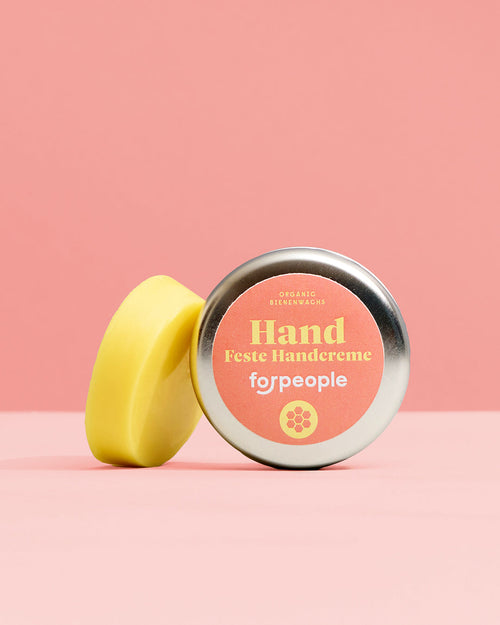
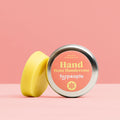
- Solid Hand Cream - Beeswax, 30 g, €9.90: beeswax, olive and sunflower oil, St. John's wort and aloe extract; without water and without added fragrance.
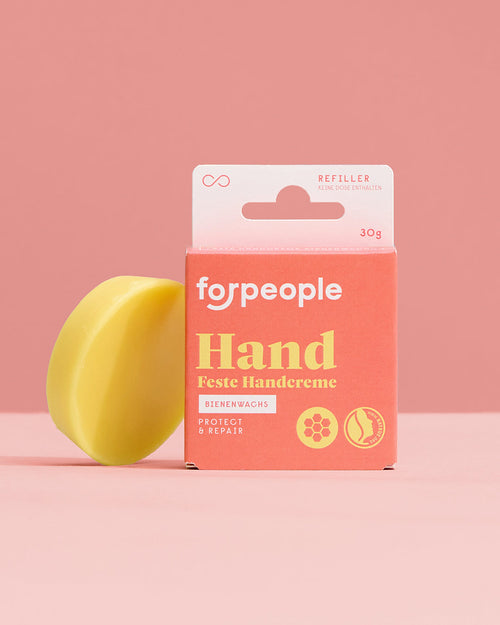
- Solid Hand Cream Refill - Beeswax, 30 g, €7.90: refills the tin. How it works is explained in Refillable Hand Cream: How the Refill Works.
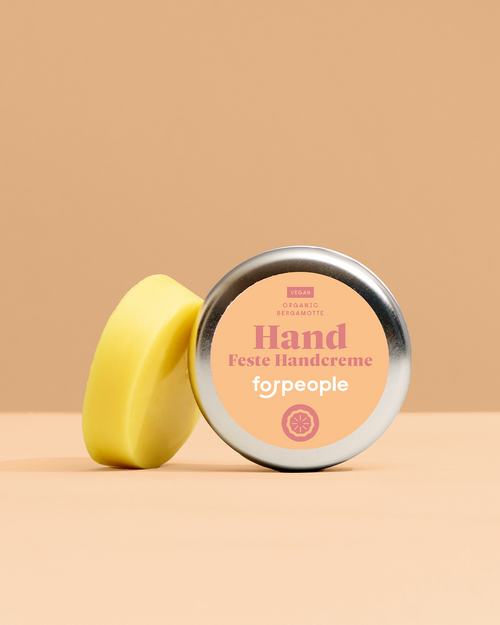
- Solid Vegan Hand Cream - Bergamot, 30 g, €9.90: vegan, with candelilla wax, jojoba oil and shea butter; with lemon and bergamot essential oils.
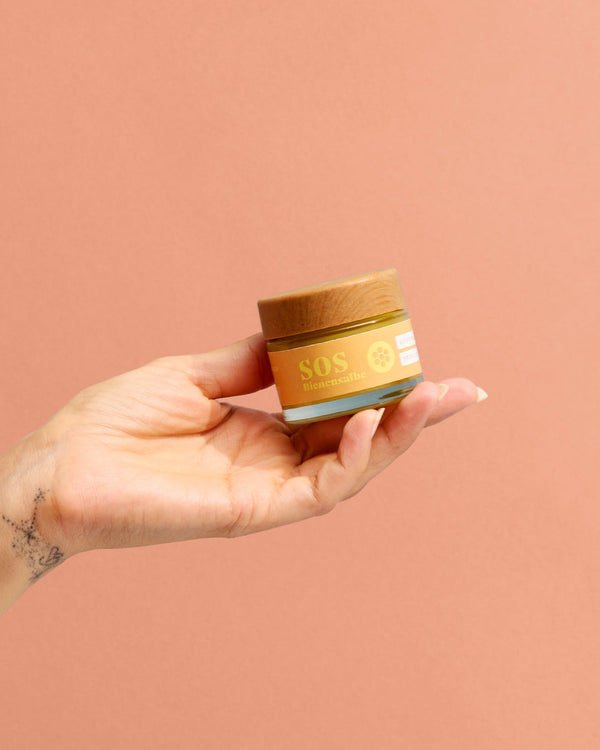
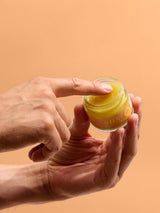
- Beeswax Salve Larch & Mandarin in a Glass Jar, 50 g, €12.90: a soft salve for the evening. It contains larch resin, propolis and essential oils; what that can mean for you is explained in Allergic to tree resin, colophony or propolis?
The creams are not a skin protection product in the sense of occupational safety and no substitute for gloves. Do not use them on injured or irritated skin.
More on this: Rough hands when knitting: when the yarn catches on your skin · Rough hands from washing up and cleaning: what helps? · Overnight hand mask: what it does and how to do it
From the blog: Bee Salve: Beeswax & Propolis for Dry, Stressed Skin
Sources
- Warner RR, Stone KJ, Boissy YL (2003): Hydration disrupts human stratum corneum ultrastructure. J Invest Dermatol 120(2): 275–284. https://doi.org/10.1046/j.1523-1747.2003.12046.x
- Tsai TF, Maibach HI (1999): How irritant is water? An overview. Contact Dermatitis 41(6): 311–314. https://doi.org/10.1111/j.1600-0536.1999.tb06990.x
- Deutsche Gesetzliche Unfallversicherung (2026): DGUV Information 212-017 Auswahl, Bereitstellung und Benutzung von beruflichen Hautmitteln. Ausgabe August 2026. https://publikationen.dguv.de/regelwerk/dguv-informationen/853/auswahl-bereitstellung-und-benutzung-von-beruflichen-hautmitteln
- Moraes JDD, Bertolino SRA, Cuffini SL, Ducart DF, Bretzke PE, Leonardi GR (2017): Clay minerals: Properties and applications to dermocosmetic products and perspectives of natural raw materials for therapeutic purposes – A review. Int J Pharm 534(1–2): 213–219. https://doi.org/10.1016/j.ijpharm.2017.10.031
- Nkosi SM, Thembane N (2024): Physical, chemical and biological characteristics of clays from Durban (South Africa) for applications in cosmetics. Anal Sci Adv 5(3–4): 2300062. https://doi.org/10.1002/ansa.202300062
- Smith AG (1989): Skin disease in the pottery industry. Ann Occup Hyg 33(3): 365–368. https://doi.org/10.1093/annhyg/33.3.365