






Why yarn catches on dry skin
The outermost layer of the skin, the horny layer, renews itself all the time. In well-hydrated skin the cells come off one by one or in small groups, without you seeing it. If the horny layer is too dry, the links between the cells are no longer broken down completely. The cells stay together in larger clusters and show up as fine, visible flakes (Harding et al. 2000).
In one experiment, three to six hours in dry air were enough for the water content of the horny layer on the forearm and cheek to drop measurably and for the skin surface to become rougher in some of the directions measured (Egawa et al. 2002). Most knitting happens in the heating season, which is exactly when this applies.
Single fibres thread themselves into such flakes, into fine cracks in the fingertip, into hangnails and rough nail edges. As far as we know, nobody has measured this. It is a mechanical explanation that fits what knitters experience.
It has little to do with friction in the usual sense. Dry skin actually glides over fabric more easily than moist skin: in a trial with 22 people, friction between the forearm and a cotton-polyester fabric rose by about a third from very dry to normally moist skin. The authors explain this by water making the horny layer softer and enlarging the contact area (Gerhardt et al. 2008). So it is not the whole hand that sticks to the yarn, but a single fibre on a single edge. The measurements were taken on the forearm, not on fingertips and not with knitting yarn.
Where it catches and what you do there
| Spot | Why there | What you do |
|---|---|---|
| Index finger the yarn runs over | The yarn rubs over the same narrow spot for hours; the skin there gets dry and rough | Care for it specifically in the evening; now and then, lead the yarn over a different spot or another finger |
| Fingertip that pushes the needle tip | Pressure on one point; the horny layer thickens and hardens at the edges | Push the needle at the shaft instead of the tip; care as described in Cracked fingertips in winter: causes and care |
| Nail edges and hangnails | Lifted strips of skin and rough nail edges act like small hooks | File nail edges smooth; clip hangnails close to the base, do not tear them off. More in Dry, torn cuticles: how to care for them |
| Thumb and edge of the hand | When you sew and cut fabric, the cloth glides over them; rough spots pull threads in satin and silk | Rich care in the evening; wash and dry your hands before cutting |
This mapping is experience from needlework, not a measurement.
When to apply cream so the yarn stays clean
Cream right before knitting has two drawbacks.
- The yarn runs differently. A review of skin friction sums it up: more moisture in the skin, from water or from a moisturiser, raises the friction coefficient (Sivamani et al. 2003). Many knitters notice this when the yarn drags and the fabric looks less even. This has not been measured for yarn.
- Grease passes on to the yarn. Up to 90 per cent of a product applied to the skin can be removed again by contact with the surroundings (Herrmann et al. 2017). When you knit, those surroundings are the yarn. On light, glossy yarns this can show as a mark.
So care belongs at the edges of the day:
- Rich in the evening. After the last row, put a larger amount on the backs of your hands, knuckles, fingertips and cuticles. If you like, pull cotton gloves over it; the instructions are in Overnight hand mask: what it does and how to do it.
- A little after washing your hands. Dry your hands well, then take a small amount, mainly for the backs of your hands.
- Thinly in the morning. By the time you knit in the afternoon or evening, hardly anything is left on the surface.
- Leave a gap before needlework. Wash your hands and dry them thoroughly. A quick test helps: press your fingertips briefly onto a sheet of paper. If a grease mark stays, wait a little longer or blot your palms.
How long the gap needs to be depends on the amount and the cream; there is no evidence-based number of minutes. As a rule of thumb from practice, allow half an hour after a small amount.
Delicate yarns, sewing and sheer tights
The finer and glossier the individual fibres, the more easily they thread themselves into a rough spot. Silk, mohair, microfibre and viscose are mentioned most often, and satin and lining fabrics in sewing.
- Before you cast on: wash your hands with lukewarm water and dry them, file rough nail edges with a fine file, clip hangnails close to the base.
- If something catches mid-row: look for the spot instead of pulling harder. Over a fine crack in the fingertip, a cotton finger cot or a strip of sticking plaster helps for the moment.
- Sheer tights: rough fingertips and nail edges pull threads. Thin cotton gloves while you put them on are the simplest fix.
In English-language craft forums, a “lotion bar” is often recommended for rough knitting hands: a solid, water-free bar of wax and oil. The principle is the same as a solid hand cream: you can keep the amount small, and nothing leaks in your project bag. It also gives off grease; the gap before needlework applies here too. What the term means exactly is explained in What is a lotion bar? Solid lotion vs hand cream.
When to seek medical advice?
Rough skin is a matter of care. Have your hands looked at by a doctor if
- cracks are deep, bleed or do not close over several weeks,
- the skin at the nail edge is red, warm or swollen, or there is pus,
- small blisters, weeping spots or heavy scaling appear,
- your skin keeps reacting after certain yarns, dyes or needles. A contact allergy may be behind it, and that needs a medical diagnosis.
Cosmetics do not belong on open, bleeding or weeping spots.
Frequently asked questions
Can I use hand cream right before knitting?
Better not. A moisturiser raises the friction of your skin, and some of the grease passes on to the yarn. Apply cream in the evening and after washing your hands, and leave time before needlework.
Does hand cream leave marks on wool or silk?
It can, as long as there is still cream on your palms. You see it most on light, glossy yarns. Whether a mark washes out depends on the yarn and the detergent; try it on your swatch.
Does the yarn take on the scent of the hand cream?
In the experience of many knitters, wool picks up smells easily. A cream without added essential oils smells only of its raw materials; one with citrus oils has a distinct scent. Which substances bring scent with them is shown in Without fragrance and essential oils: ingredients at a glance.
Do cotton and linen dry out your hands more than wool?
Many people report this. We do not know of any measurements. If that is your experience, use slightly richer care in the evening on days with cotton yarn.
Does a scrub help with the rough spots?
Forums often recommend a scrub of sugar and oil. It takes off loose flakes but does not replace care; leave it out on cracked or reddened skin. The pros and cons are in Hand scrub for dry hands: a good idea or not?
At forpeople
Care for the time after needlework, on intact skin:
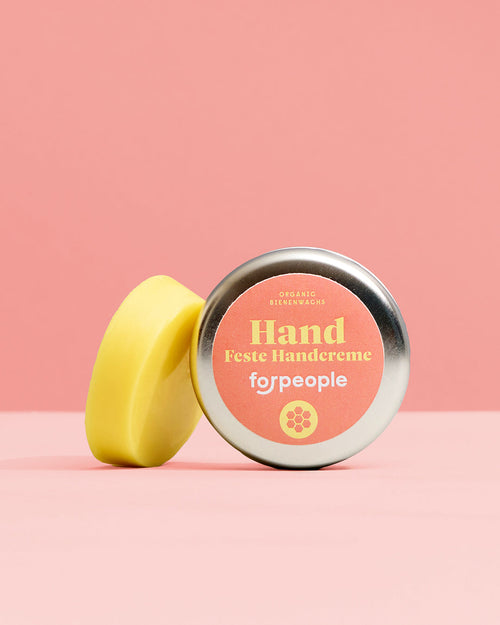
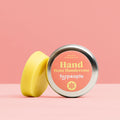
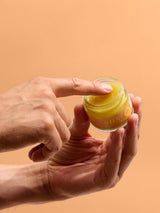
- Solid Hand Cream - Beeswax, 30 g, €9.90: beeswax, olive and sunflower oil, St. John's wort and aloe extract; without water and without added fragrance. It smells faintly of beeswax.
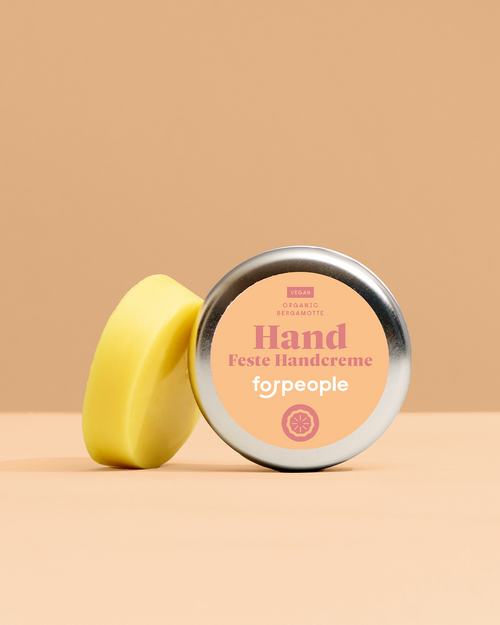
- Solid Vegan Hand Cream - Bergamot, 30 g, €9.90: vegan, with candelilla wax, jojoba oil and shea butter. It is scented with lemon and bergamot essential oils.
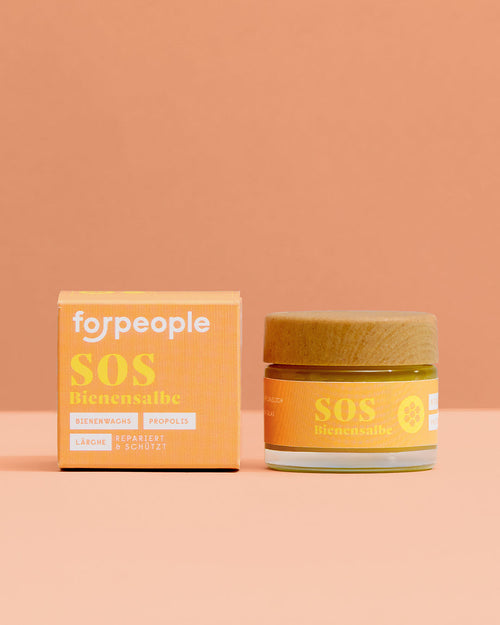
- Beeswax Salve Larch & Mandarin in a Glass Jar, 50 g, €12.90: a soft salve for the evening. It contains larch resin, propolis and essential oils; what that can mean for you is explained in Allergic to tree resin, colophony or propolis?
The solid creams are water-free and leave a film of wax and oil. That film is intended, but it does not belong on the yarn. Do not use the products on injured or irritated skin.
More on this: Dry hands from pottery: why clay dries out your skin · Hand care at the office without a greasy keyboard · Solid hand cream: beeswax or bergamot – which one suits you?
From the blog: Hands and feet through winter: a routine for morning and evening · Switching to solid skincare: what is different in the first weeks
Sources
- Harding CR, Watkinson A, Rawlings AV, Scott IR (2000): Dry skin, moisturization and corneodesmolysis. Int J Cosmet Sci 22(1): 21–52. https://doi.org/10.1046/j.1467-2494.2000.00001.x
- Egawa M, Oguri M, Kuwahara T, Takahashi M (2002): Effect of exposure of human skin to a dry environment. Skin Res Technol 8(4): 212–218. https://doi.org/10.1034/j.1600-0846.2002.00351.x
- Gerhardt LC, Strässle V, Lenz A, Spencer ND, Derler S (2008): Influence of epidermal hydration on the friction of human skin against textiles. J R Soc Interface 5(28): 1317–1328. https://doi.org/10.1098/rsif.2008.0034
- Sivamani RK, Goodman J, Gitis NV, Maibach HI (2003): Coefficient of friction: tribological studies in man – an overview. Skin Res Technol 9(3): 227–234. https://doi.org/10.1034/j.1600-0846.2003.02366.x
- Herrmann S, Daniels R, Lunter D (2017): Methods for the determination of the substantivity of topical formulations. Pharm Dev Technol 22(4): 487–491. https://doi.org/10.3109/10837450.2015.1135346