The problem: red, flaky patches on the nose, eyebrows and beard
The sides of the nose are red and flaky, yellowish-white flakes sit in the eyebrows, and flakes fall out of the beard after a shower. Make-up settles into the crease beside the nose, and the centre of the face feels oily and dry at the same time. Itching is usually mild. Typical pattern: it comes in autumn and gets better in summer.
Seborrhoeic dermatitis is a chronic or recurring form of eczema in areas with many oil glands (DermNet). Around 3 to 12 per cent of the population have it; it usually starts in late adolescence, is most common in young adults and older people and affects men more often than women (DermNet). In a large Dutch population study of more than 5,000 middle-aged and older people, doctors found seborrhoeic dermatitis in 14.3 per cent (Sanders et al. 2018). In babies it looks different and has its own page: Infant eczema or cradle cap? How to tell the flakes on your baby's head apart.
Whether it is simple dryness or seborrhoeic dermatitis can often be roughly told apart by the colour of the flakes, redness and course; the comparison is on Dry, flaky skin on the forehead, eyebrows and nose: what is behind it. This page is about where seborrhoeic dermatitis appears on the face and what looks similar. The table is based on specialist sources and does not replace a diagnosis; only a medical examination brings certainty.
| Area | Typical look of seborrhoeic dermatitis | What can look similar |
|---|---|---|
| Sides of the nose and the crease between nose and corner of the mouth | salmon-pink, thin, poorly defined patches with fine flakes, usually on both sides (DermNet) | rosacea with redness, bumps and pustules (Clark et al. 2015); skin made sore by blowing your nose |
| Eyebrows, the area between the brows, hairline | redness with yellowish, greasy flakes, at the hairline also arc- or petal-shaped (DermNet) | psoriasis with sharply defined, thick scales (Clark et al. 2015); contact dermatitis from hair dye or care products |
| Eyelid margins | red, scaly eyelid margins (seborrhoeic blepharitis) (DermNet) | eyelid eczema from cosmetics, other forms of eyelid inflammation |
| Beard and moustache | flakes and redness under the beard (AAD) | dry skin under the beard, inflamed hair follicles |
| Cheeks, butterfly-shaped across nose and cheeks | rather untypical | rosacea; rarely lupus erythematosus, an autoimmune disease (Clark et al. 2015) |
On darker skin, seborrhoeic dermatitis often looks less red and instead shows as flaky, lighter patches in the same places (DermNet). Beard, ears and scalp have their own pages: Itchy, flaky beard: beard dandruff in winter – causes and care, Dry, flaky skin on the ears: causes and care and Dry scalp or dandruff? Causes in winter and what helps.
Why seborrhoeic dermatitis flares up in winter
Malassezia lives on fat. The yeast is part of the normal skin flora. It cannot make fatty acids itself because it lacks the gene for it, and instead releases several fat-splitting enzymes onto the skin to obtain fats from its host (Xu et al. 2007). These enzymes split free fatty acids from the fats in sebum, which can trigger inflammation; differences in the skin barrier probably explain why some people are affected and others are not (DermNet). A review describes Malassezia as thriving in a lipid-rich environment, with free fatty acids promoting its growth; the inflammation then disturbs the outer layer of the skin, which flakes faster and holds water less well (Clark et al. 2015). That is why the dermatitis appears where there is a lot of sebum; it has nothing to do with poor hygiene.
Winter shifts the balance. In the Dutch population study, seborrhoeic dermatitis was markedly less common in summer than in winter; it was more frequent in men, in people with fair skin and in people with generally dry skin (Sanders et al. 2018). At a dermatology clinic in Istanbul, the share of diagnoses was 7.3 per cent of all patients in December and 3.8 per cent in June; the lower the temperature and humidity, the more frequent it was (Akbulut et al. 2022). The American Academy of Dermatology lists cold, dry weather, hot showers and baths especially at this time of year, harsh soaps and detergents, sweat and stress as typical triggers of flare-ups (AAD).
Stress, sleep and some illnesses play a part. Lack of sleep and stressful events are linked to flare-ups. Severe forms are more common with a weakened immune system, Parkinson's disease, depression and some other neurological conditions, and with certain psychiatric medicines (DermNet). Most people with it are otherwise healthy, though (Clark et al. 2015).
The solution step by step
| Step | What you do | Why |
|---|---|---|
| Straight away | The first time, have the diagnosis made by a dermatologist instead of buying antifungal or cortisone creams on suspicion | The doctor makes the diagnosis from location and appearance; a swab showing Malassezia proves nothing, because the yeast lives on everyone's skin (DermNet) |
| Straight away | Do not scratch off, rub off or peel away the flakes | Skin with seborrhoeic dermatitis is easily irritated, and irritation can trigger a flare-up (AAD) |
| Every day | Wash your face morning and evening with lukewarm water and a fragrance-free cleanser, rinse thoroughly, pat dry | This is what specialists advise; cleanser left on the skin can irritate it (AAD) |
| Every day | Then apply a thin layer of fragrance-free, alcohol-free care; no oil and no rich cream on the red, flaky patches | The AAD recommends fragrance-free care after washing, and products containing alcohol can trigger flare-ups (AAD); Malassezia depends on fats (Xu et al. 2007), and rich, occlusive care is considered a risk factor for the related Malassezia folliculitis (DermNet: Malassezia folliculitis) |
| Treatment | Use what your doctor prescribes or recommends, for as long and as often as agreed: usually antifungal creams, and for stronger inflammation cortisone or calcineurin inhibitors for a short time | In studies, antifungal agents were more effective than placebo and about as effective as cortisone, with fewer side effects (Okokon et al. 2015); cortisone works in the short term, but most studies only lasted four weeks (Kastarinen et al. 2014) |
| In winter | Wear a hat and scarf in the cold, do not shower hot, do not overheat rooms; wash off sweat after exercise | Cold, dry weather, hot water and sweat are among the common triggers (AAD) |
| Prevention | Note down your own triggers (stress, sleep, new products); if you have a beard, ask your doctor whether a medicated wash or shaving makes sense | Reducing stress and avoiding known triggers are part of self-care; under a beard, shaving helps some people (AAD) |
| In the long run | Expect it to come back, and plan a maintenance routine with your doctor | In adults, seborrhoeic dermatitis is often chronic, and longer-term maintenance treatment is frequently needed (DermNet) |
Whether a care oil actually harms the dermatitis has hardly been studied. Because Malassezia uses its fat-splitting enzymes to obtain fatty acids from fats (Xu et al. 2007), and plant oils and butters are fats too, we prefer to leave them off the patches; you can keep caring for the dry skin around them. Which ingredients hide behind “alcohol” on an ingredient list is explained in Alcohol in cosmetics: alcohol denat., fatty alcohols and benzyl alcohol.
What helps – and what rather does not
| Remedy or habit | Assessment |
|---|---|
| Antifungal cream or wash on medical advice | sensible: considered first choice for face and body (Clark et al. 2015) (Okokon et al. 2015) |
| Cortisone cream | only briefly and on medical instructions: works quickly in studies (Kastarinen et al. 2014), but longer use can thin the skin of the face and leave visible small blood vessels (DermNet), see Broken veins on the face (couperose): causes, winter protection and what helps |
| Coconut oil, olive oil or other oils on the patches | rather not: we know of no evidence of a benefit, and Malassezia uses fats (Xu et al. 2007) (Clark et al. 2015) |
| Tea tree oil or other undiluted essential oils | rather not: the effectiveness of herbal remedies is uncertain (DermNet), and concentrated fragrance oils add irritation |
| Apple cider vinegar, lemon, baking soda | no: we know of no evidence, while irritated skin is likely |
| Simply using anti-dandruff shampoo on the face | only after talking to your doctor: how and how long to use it on the face belongs in the practice |
| Hot showers, scrubbing the face with soap | no: hot water and harsh soaps are among the triggers (AAD) |
| Reducing stress, getting enough sleep | sensible: stress and lack of sleep are linked to flare-ups (DermNet) (AAD) |
Common mistakes
The most common mistake is to take seborrhoeic dermatitis for dry skin and apply ever richer creams, often oil or thick winter care. The flakes get softer, the redness stays. Second: rubbing off the flakes every day or removing them with a scrub until the skin burns. Third: applying a cortisone cream from an earlier treatment again and again whenever it turns red; on the face this is particularly delicate. Fourth: buying an antifungal cream on suspicion, although it could also be rosacea, perioral dermatitis or contact dermatitis; the picture is then harder to interpret in the practice. Fifth: trying many new products at once, especially with fragrance, alcohol or essential oils; introduce new products one at a time, as described in Trying new skincare: how do I test it on a small area?
When to seek medical advice?
Seborrhoeic dermatitis is usually harmless, but it should be confirmed by a doctor once, because several skin conditions look similar. See a dermatologist if:
- red, flaky patches appear on your face for the first time or do not improve after about two weeks of simple care,
- the eyelid margins are red and scaly, or your eyes burn or water; an eye examination may also be needed,
- the skin weeps, crusts or forms blisters or tiny pus spots; this can indicate an additional infection, which is described as a complication of seborrhoeic dermatitis (DermNet),
- bumps and pustules appear on permanently red cheeks and nose (see Rosacea in winter: recognising triggers and caring for your skin properly) or small red bumps develop around the mouth and nose (see Dry skin around the mouth and on the chin: causes and what helps),
- a butterfly-shaped redness across nose and cheeks gets worse in the sun, especially with joint pain,
- a patch is ring-shaped and grows at the edge, or thick, silvery scales develop (see Psoriasis in winter: why it often gets worse and how to care for your skin),
- the dermatitis suddenly becomes very pronounced or spreads widely, especially together with other symptoms, frequent infections or new medicines; severe forms are more common with some illnesses (DermNet),
- you use cortisone on your face for longer than agreed, or the skin becomes thin and shows small blood vessels.
For babies with flakes on the face or head, the paediatrician is the right place to go.
Frequently asked questions
Is seborrhoeic dermatitis on the face contagious?
No. The yeast involved, Malassezia, lives on the skin of almost everyone. The dermatitis is caused by your own skin's reaction, not by infection, and has nothing to do with poor hygiene.
Is it a fungus on my face?
Not in the usual sense. Malassezia is involved in the inflammation but belongs to the normal skin flora; finding it alone proves nothing. Antifungal agents reduce the number of yeasts and help many people. Which product is right is for your doctor to decide.
Which cream helps with seborrhoeic dermatitis on the face?
For treatment, doctors usually prescribe or recommend antifungal creams, and for stronger inflammation cortisone or calcineurin inhibitors for a short time. For everyday use, fragrance-free, alcohol-free, rather light care is suitable. Oils and butters do not belong on the patches.
What home remedies help?
There is no reliable evidence for home remedies. Oils such as coconut or olive oil provide fat for the yeast, and vinegar and lemon irritate. Specialists advise lukewarm washing, little irritation, avoiding triggers and medical treatment instead.
Why does my face flake after a shower?
Hot water and soap remove fats from the skin, loosened flakes become noticeable after drying, and hot showers are considered a trigger for flare-ups. Shower lukewarm and rinse shampoo thoroughly out of your beard and eyebrows.
Does seborrhoeic dermatitis go away?
It can stay quiet for a long time, but in adults it often returns in flare-ups, especially in winter. Many people therefore need a maintenance routine, which they agree with their doctor.
Do stress or diet have anything to do with it?
Stress and lack of sleep are linked to flare-ups. For diet there are only observational data; dietary supplements do not replace a medical assessment.
At forpeople
We do not have a product for seborrhoeic dermatitis, and none of our oils, butters or creams belongs on red, flaky patches. Our solid soaps, the Faceoil - Lavender and the foot cream contain essential oils; they are not suitable for irritated skin.
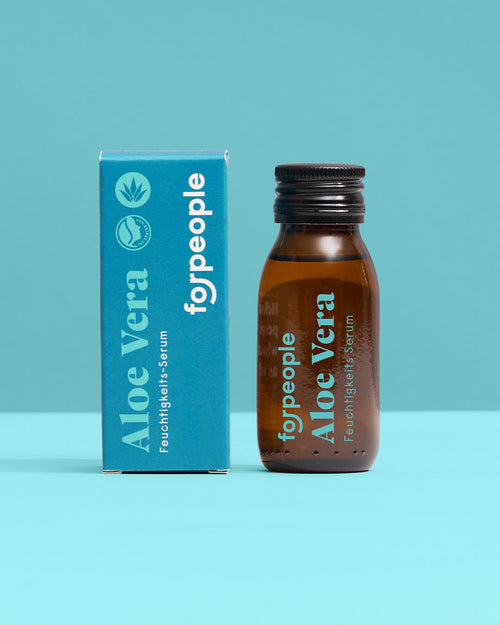
For dry but not reddened facial skin next to the patches, one product page names the face as its purpose: Aloe Vera Serum 99.6%, 50 ml, €9.90. According to its ingredient list it contains aloe vera juice with citric acid, potassium sorbate and sodium benzoate, no oil, no alcohol, no perfume and no essential oils, and according to the product page it leaves no greasy film. According to the safety note it does not belong on broken or irritated skin; if in doubt, ask your doctor whether it fits your routine.
Small, itchy spots on the chest and back can be Malassezia folliculitis, which often occurs together with seborrhoeic dermatitis (DermNet); more on Back acne: why spots on your back appear in winter and what helps.
Sources
- DermNet: Seborrhoeic dermatitis. Gaffoor Bholah N, March 2022, minor update July 2024, accessed 30 October 2026. https://dermnetnz.org/topics/seborrhoeic-dermatitis
- American Academy of Dermatology (AAD): Seborrheic dermatitis: Self-care. Updated 6 December 2022, accessed 30 October 2026. https://www.aad.org/public/diseases/a-z/seborrheic-dermatitis-self-care
- Clark GW, Pope SM, Jaboori KA (2015): Diagnosis and treatment of seborrheic dermatitis. American Family Physician 91(3): 185–190. https://www.aafp.org/pubs/afp/issues/2015/0201/p185.html
- Sanders MGH, Pardo LM, Franco OH, Ginger RS, Nijsten T (2018): Prevalence and determinants of seborrhoeic dermatitis in a middle-aged and elderly population: the Rotterdam Study. British Journal of Dermatology 178(1): 148–153. https://doi.org/10.1111/bjd.15908
- Akbulut TO, Suslu H, Atci T (2022): Is the Frequency of Seborrheic Dermatitis Related to Climate Parameters? Sisli Etfal Hastanesi Tip Bulteni 56(1): 91–95. https://doi.org/10.14744/SEMB.2021.67503
- Xu J, Saunders CW, Hu P, Grant RA, Boekhout T, Kuramae EE et al. (2007): Dandruff-associated Malassezia genomes reveal convergent and divergent virulence traits shared with plant and human fungal pathogens. Proceedings of the National Academy of Sciences 104(47): 18730–18735. https://doi.org/10.1073/pnas.0706756104
- Okokon EO, Verbeek JH, Ruotsalainen JH, Ojo OA, Bakhoya VN (2015): Topical antifungals for seborrhoeic dermatitis. Cochrane Database of Systematic Reviews (5): CD008138. https://doi.org/10.1002/14651858.CD008138.pub3
- Kastarinen H, Oksanen T, Okokon EO, Kiviniemi VV, Airola K, Jyrkkä J et al. (2014): Topical anti-inflammatory agents for seborrhoeic dermatitis of the face or scalp. Cochrane Database of Systematic Reviews (5): CD009446. https://doi.org/10.1002/14651858.CD009446.pub2
- DermNet: Malassezia folliculitis. Oakley A, updated by Stewart T, reviewed 2023, accessed 30 October 2026. https://dermnetnz.org/topics/malassezia-folliculitis