The problem: when the plaques come back in winter
In summer the skin was calm. From November, the patches on the elbows and knees thicken again, scales trickle from the hairline onto the dark coat, and under the wool jumper it itches. Many people with psoriasis know this rhythm.
Psoriasis is an inflammatory, non-contagious disease that usually runs in flares; the skin turns red, scales heavily and can itch (IQWiG: Psoriasis). Typical are sharply defined patches with silvery-white scales, especially on the head, elbows, knees and back, and also on the lower legs, buttocks and in skin folds; the nails can show small dents (NHS: Psoriasis) (IQWiG). In Germany an estimated 2 per cent of the population have psoriasis (IQWiG). Itch is common, especially during flares (DermNet: Plaque psoriasis).
That it gets worse in winter and better in summer is considered typical (DermNet). A review from Northern and Central Europe shows a mixed picture, though: in about 50 per cent of those affected there was no difference between the seasons, about 30 per cent were better in summer and about 20 per cent in winter, some of whom were clearly worse in summer (Jensen et al. 2022). Whether your psoriasis comes "only in winter" or is even better in winter is best shown by your own skin diary over a year.
The diagnosis is made by a dermatologist. Eczema, a fungal infection or dry patches can look similar; pointers for telling them apart are in Dry patches on the skin: when harmless, when to see a doctor?
Why it often gets worse in winter
| Trigger | What happens in winter | What you can do |
|---|---|---|
| Less UV light | most people with psoriasis find UV light helpful; the worsening in winter is explained by the lower UV index (DermNet) | light therapy is a medical treatment option (IQWiG); ask your practice |
| Cold and dry air | low humidity and cold weaken the skin barrier; existing skin diseases can get worse (Engebretsen et al. 2016) | care for the skin daily with a lipid-replenishing product, don't overheat rooms |
| Infections | infections, including with streptococci (strep A), can trigger flares (NHS) (DermNet); colds pile up in winter | have sore throats checked by a doctor, especially if flares followed in the past |
| Small injuries | cuts, scratches and grazes are triggers (NHS); dry skin cracks more easily in winter, and itch tempts you to scratch | don't scratch, wear gloves, choose clothing that doesn't chafe |
| Stress | stress is one of the known triggers (NHS); the end of the year and the dark months weigh on many people | plan breaks and relaxation; more in Dry skin from stress: what is behind it and what helps |
| Alcohol and smoking | both are on the list of triggers (NHS) | drink little alcohol, stop smoking |
| Medicines | some active ingredients can worsen psoriasis, for example lithium, beta blockers, certain antimalarials and terbinafine (DermNet) | don't stop them on your own; talk to your practice |
Especially important in winter is the Koebner phenomenon: in people with psoriasis, new plaques can appear on previously healthy skin exactly where the skin was injured or irritated, for example by scratching or stretching (Zheng et al. 2026). They usually appear about one to two weeks after the injury, sometimes after three days, rarely much later; how often this happens varies between 11 and 75 per cent of those affected, depending on the study (Zheng et al. 2026). Cracked winter skin, scratched areas, chafing clothes and shaving are therefore more than a side issue. The European guideline also often names winter itch in psoriasis (Weisshaar et al. 2025); why itch increases at night is explained in Itchy skin at night in bed: why it gets worse in the evening and what helps.
The solution step by step
| Step | What you do | Why |
|---|---|---|
| In autumn: discuss a plan | book an appointment with a dermatologist before the dark season; clarify what to do in a flare and whether light therapy is an option | treatment depends on the type, severity and body site (NHS); light therapy is one of the options (IQWiG) |
| Every day: care | apply a rich, lipid-replenishing product every day, also in symptom-free phases; apply it after showering or bathing | as recommended by IQWiG; the care keeps the skin supple and protects it from drying out (IQWiG: Skin care) |
| Every day: washing | shower briefly in lukewarm water, pat dry instead of rubbing, unperfumed wash products | as listed in the general measures for itch (Weisshaar et al. 2025) |
| Scales | don't scratch or pull them off; ask your practice whether a scale-loosening product with salicylic acid or urea suits you | injuries can trigger new plaques (Zheng et al. 2026); care products with urea and salicylic acid exist for scaling (IQWiG) |
| Protect the skin | wear gloves outdoors, a smooth layer under wool, keep nails short, shave carefully | less friction and injury, less occasion for the Koebner phenomenon |
| Everyday life | don't smoke, little alcohol, regular exercise, reduce stress | part of what people with psoriasis can do themselves (NHS) |
| In a flare | contact your practice early instead of waiting; use medicines as agreed | cortisone and vitamin D3 derivatives for the skin are common groups of active ingredients (IQWiG); your practice decides which one suits you |
How heated air dries out the skin and when a humidifier makes sense is covered in Humidity and skin: what dry heated air does and what helps.
What helps – and what tends not to
| Measure | Assessment |
|---|---|
| Daily lipid-replenishing care | helps keep the skin supple (IQWiG); it does not treat the disease itself |
| Sun on a winter holiday | many benefit from UV light (DermNet); sunburn, however, can trigger flares (IQWiG), and in some people light makes the skin worse (DermNet) |
| Removing scales with a brush, pumice stone or fingernails | tends not to; the injury can trigger new plaques |
| Scale-loosening products over large areas on your own initiative | tends not to; clarify with your practice which products, where and for how long |
| Tea tree oil or other essential oils on the plaques | tends not to; the guideline on itch advises avoiding such irritants (Weisshaar et al. 2025) |
| Stopping a cortisone cream as soon as it looks better | not on your own; your practice sets the duration |
| Less alcohol, no smoking | sensible; both can encourage flares (NHS) |
Common mistakes
- Only caring for the skin during a flare. Care belongs in the calm phases too (IQWiG).
- Picking off scales. This injures the skin and can trigger new plaques.
- Only seeing the practice in January. If you know your winter flares, discuss the plan in autumn.
- Scooping cream out of the pot with your fingers and sharing it. The NHS advises not to share emollients and to use a spatula (NHS).
- Going near an open fire, candle or cigarette in freshly creamed clothing. Clothing and bedding that have soaked up a lot of emollient burn more easily (NHS).
- Blaming joint pain on the winter weather. It can be part of psoriasis and belongs in the practice.
When to get medical advice?
Have your skin looked at by a dermatologist if
- you notice red, scaly, sharply defined patches and don't know what they are (NHS),
- the treatment isn't working or causes side effects (NHS),
- joints keep hurting, stiffening or swelling; in an estimated one in four people with psoriasis the joints are inflamed too (psoriatic arthritis) (IQWiG),
- your nails change, for example with small dents or lifting (DermNet),
- many new spots suddenly appear after a sore throat,
- you are taking a new medicine and your skin gets worse; don't stop it on your own,
- psoriasis is a heavy emotional burden for you; this is common, and there are counselling services and self-help groups (IQWiG).
Call the emergency number 112 or get to an emergency department straight away if your skin quickly turns red and forms small white, pus-filled bumps, especially together with a high temperature, chills or a fast heartbeat (NHS). Redness that spreads quickly over large parts of the body also needs medical attention the same day. For winter itch caused by drying out, see Asteatotic eczema (winter eczema): when dry skin turns into eczema.
Frequently asked questions
Why is psoriasis worse in winter?
Because less UV light reaches the skin, cold and heated air dry it out, and infections, small injuries and stress can trigger flares. For about half of those affected, though, the seasons make little difference.
Can psoriasis get better in winter?
Yes. In a review, about 20 per cent of those affected were better in winter, some of whom were clearly worse in summer. A skin diary shows how it is for you.
Is psoriasis contagious?
No. Psoriasis is an inflammatory disease in which, according to current knowledge, the immune system plays a role; it is not transmitted (NHS).
What helps with scalp psoriasis in winter?
Your dermatologist decides on the treatment; active ingredients are also available as solutions, which are easier to apply to the hairy scalp. Hats with a smooth lining rub less. For telling a dry scalp and dandruff apart, see Dry scalp or dandruff? Causes in winter and what helps.
What can I do about psoriasis on my hands in winter?
Hands are particularly exposed to cold, water and friction. Wear gloves outdoors, care for them with a lipid-replenishing product after washing, and have cracked areas looked at by a doctor. Hand eczema can look similar; see Dry hands or hand eczema? How to tell the difference.
Can I remove the scales?
Not by scratching, picking or rubbing, because injuries can trigger new plaques. Thick scales can be loosened with scale-loosening products; ask your practice which one suits you.
What is the Koebner phenomenon?
New psoriasis plaques appear on previously healthy skin where it was injured, for example after a scratch, a graze or chafing. They usually show up after one to two weeks.
How do I care for the skin on elbows and knees in winter?
With a lipid-replenishing product, every day, and without rubbing. Rough elbows and knees without psoriasis are covered in Dry, rough elbows and knees: causes and what helps. If the patches are sharply defined, red and thickly scaled, they belong in the practice.
At forpeople
We don't recommend any of our own products for psoriasis plaques. It's best to agree on lipid-replenishing basic care with your practice; some basic care products contain scale-loosening additives such as urea or salicylic acid (IQWiG), ours don't. According to the product page, our care does not belong on injured or irritated skin. For dry skin in areas without plaques, this is suitable:
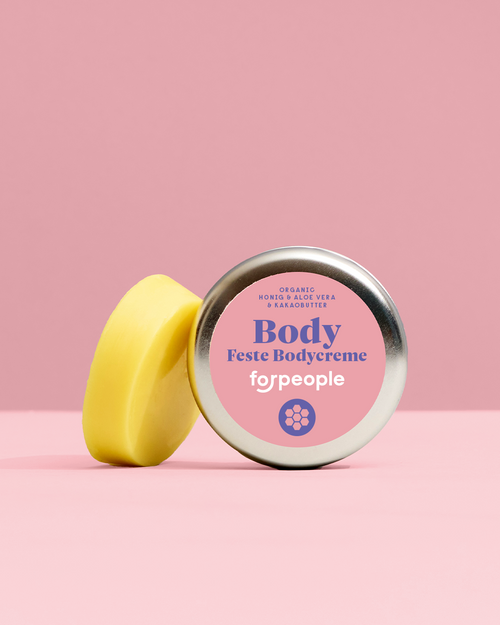
- Solid Body Butter - Beeswax & Aloe Vera, 40 g, €9.90: cocoa butter, olive oil, beeswax, sunflower oil, shea butter and aloe vera extract; according to the ingredient list without essential oils. According to the product page, apply after showering to still damp skin.
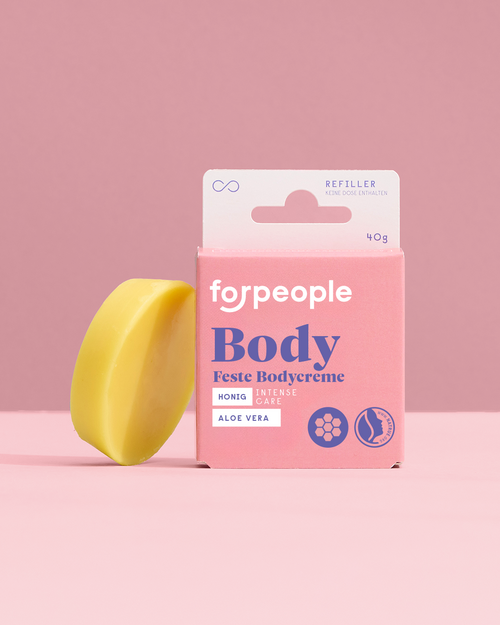
- Solid Body Butter Refill - Beeswax & Aloe Vera, 40 g, €7.90: the same butter for refilling the tin.
Care does not replace treatment. It's best to try new products on a small area first.
Read more: Itchy skin in winter: showering, care and when to see a doctor · Dry skin from medication: causes and what you can do
Sources
- Institute for Quality and Efficiency in Health Care (IQWiG): Schuppenflechte (Psoriasis). gesundheitsinformation.de, updated 10 Mar 2021, accessed 29 Oct 2026. https://www.gesundheitsinformation.de/schuppenflechte-psoriasis.html
- Institute for Quality and Efficiency in Health Care (IQWiG): Schuppenflechte – Hautpflege und Medikamente zum Auftragen [Psoriasis – skin care and topical medicines]. gesundheitsinformation.de, updated 10 Mar 2021, accessed 29 Oct 2026. https://www.gesundheitsinformation.de/hautpflege-und-medikamente-zum-auftragen.html
- DermNet: Chronic plaque psoriasis. Yoo LJH, Storan E (2023), Stanway A (2004), reviewed July 2023, accessed 29 Oct 2026. https://dermnetnz.org/topics/plaque-psoriasis
- NHS: Psoriasis. Last reviewed 10 Mar 2026, accessed 29 Oct 2026. https://www.nhs.uk/conditions/psoriasis/
- Jensen KK, Serup J, Alsing KK (2022): Psoriasis and seasonal variation: A systematic review on reports from Northern and Central Europe – Little overall variation but distinctive subsets with improvement in summer or wintertime. Skin Research and Technology 28(1): 180–186. https://doi.org/10.1111/srt.13102
- Zheng L, Han X, Zheng H, Zhang Y (2026): Linear psoriasis and Koebner phenomenon: A review. Journal of Research in Medical Sciences 31: 6. https://doi.org/10.4103/jrms.jrms_364_25
- Engebretsen KA, Johansen JD, Kezic S, Linneberg A, Thyssen JP (2016): The effect of environmental humidity and temperature on skin barrier function and dermatitis. Journal of the European Academy of Dermatology and Venereology 30(2): 223–249. https://doi.org/10.1111/jdv.13301
- Weisshaar E, Müller S, Szepietowski JC, Dalgard F, Garcovich S, Kupfer J et al. (2025): European S2k Guideline on Chronic Pruritus. Acta Dermato-Venereologica 105: adv44220. https://doi.org/10.2340/actadv.v105.44220