The problem: corn, callus or plantar wart?
For a few weeks a small yellowish bump has been pressing on your little toe, under the ball of your foot you feel a point like a stone in your shoe with every step, or there is a rough patch on your heel with dark dots in it. This is typical from autumn onwards: the winter boots come out of the cellar, they fit more tightly with thick socks, and at the weekend you walk barefoot through the indoor pool or the sauna.
Usually one of four things is behind it: a callus, a corn, a plantar wart or a blister. They look similar but need different things. You can care for a callus yourself, a corn mainly needs the pressure taken off and often a podiatrist, a wart is a contagious viral infection of the skin, and a blister needs protecting until it has gone. Corns also form on the hands, for example from tools or dumbbells (IQWiG 2025b); common warts often sit on the fingers and the backs of the hands (IQWiG 2023).
How to tell the four apart. The following table summarises the features that specialist sources describe. It is a guide, not a diagnosis: only a medical or podiatric examination can tell these spots apart with certainty, if in doubt with a skin sample (IQWiG 2025a).
| Feature | Callus | Corn | Plantar wart | Blister |
|---|---|---|---|---|
| Where | flat areas on the heel, ball of the foot and big toe, where pressure and friction act | on the toes and under the foot, often just above a bone; always at a pressure point | on the sole and heel, also in places without particular pressure | where the shoe has recently rubbed |
| Appearance | yellowish, smooth, the skin lines remain visible | round, raised, yellowish beige, with a glassy core in the middle; between the toes whitish and softer | rough, the skin lines do not run through it, often black or brownish dots | small bubble of clear fluid; a blood blister is red or black |
| Pain | usually none | mainly with pressure from above on the centre | more when squeezed from the sides; like a sting when you step on it | burns and hurts when walking |
| Cause | repeated pressure and friction | sustained pressure on one point | wart viruses (human papillomaviruses), contagious | friction, less often heat or a skin reaction |
| What helps | reduce pressure, smooth, care | take the pressure off; the core is removed by a podiatrist | often goes away on its own; otherwise pharmacy or doctor | protect it, do not pierce it |
Sources for the table: IQWiG 2025a, IQWiG 2023, DermNet: Viral wart, DermNet: Corn and callus, NHS: Blisters.
Two differences help most in everyday life. The glassy core in the middle belongs to a corn; a plantar wart lacks it and instead often has brownish dots (IQWiG 2025a). These dots are small blood vessels of the wart; if it is filed down, they can bleed in pinpoints. Corns do not have these vessels (DermNet: Viral wart). And: a corn always sits where there is pressure, a wart also appears in places that bear hardly any load.
Why this happens in autumn and winter
Pressure in the shoe. Calluses and corns are a normal response of the skin to sustained pressure or friction. The cells of the outer skin divide more often and the horny layer becomes thicker (IQWiG 2025a). Poorly fitting shoes, foot deformities and a lot of activity are considered causes (Freeman 2002). If the pressure stays on one point, a callus can turn into a corn: in the centre, horny material compacts and presses into the deeper skin like a thorn, which causes the pain (IQWiG 2025a). In winter, stiff lined boots and thick socks reduce the space in the shoe; this is an observation from practice. The side wall then presses on the little toe, and rolling off the foot presses on the big toe.
Dry skin. People with very dry skin develop calluses and corns more often under pressure and friction (IQWiG 2025a). Why feet dry out in winter is explained in Dry feet in winter: what causes it, what helps?
Damp skin and walking barefoot. Wart viruses enter the skin through small injuries and cracks; infection is easier when the skin is damp, softened or injured (IQWiG 2023). People at higher risk include those who often use communal showers, for example at sports or in swimming pools (IQWiG 2023). In winter that means the indoor pool and the sauna; on top of that, feet sweat and soften in winter shoes. Softened skin between the toes then often looks whitish; what can be behind it is explained in Skin peeling between the toes: moisture, athlete's foot or dryness?
The solution step by step
| Step | What you do | Why |
|---|---|---|
| Right away | Find the shoe that presses and leave it off for now; try on winter boots with the socks you wear in them | Without pressure, a corn usually recedes gradually |
| Right away | Do not cut with a blade, razor blade, corn plane or scissors; do not pierce a blister | Risk of injury and infection, especially for the inexperienced |
| Take the pressure off | Ring-shaped pads around the corn, soft insoles, toe pads or toe separators for pressure between the toes; for foot deformities, advice from a medical supply shop or an orthopaedic shoemaker | Pads spread the pressure around the spot |
| Smooth | Soak the callus and corn in a foot bath for about ten minutes and rub off the top layer with a pumice stone, for example every other evening | This makes the thickened skin thinner step by step without injuring the living skin |
| Every evening | Apply a thin layer of a rich foot cream to rough heels, the balls of the feet and the callused skin around the spot; not on the corn, not on a wart, not between the toes | Dry skin thickens more easily under pressure; cream, however, treats neither the core nor the wart |
| Corn | If it still hurts once the pressure is off, have the core removed by a podiatrist | Podiatrists work with suitable instruments |
| Wart | Do not scratch it, use a separate file or pumice stone for it, cover it with a waterproof plaster when swimming; if it bothers you, ask at a pharmacy or doctor's practice | Warts are contagious and can spread on your own skin |
| Prevent | Pool shoes in indoor pools, saunas and changing rooms; keep feet dry, change socks daily | Damp, softened skin lets wart viruses in more easily |
Sources for the table: IQWiG 2025a, IQWiG 2025b, IQWiG 2023, DermNet: Corn and callus, NHS: Corns and calluses, NHS: Blisters. How to use a pumice stone and how much callus should remain is explained in Pumice Stone Wet or Dry? How to Remove Calluses Properly; why flat calluses grow back is covered in Calluses keep coming back: why they regrow and what helps.
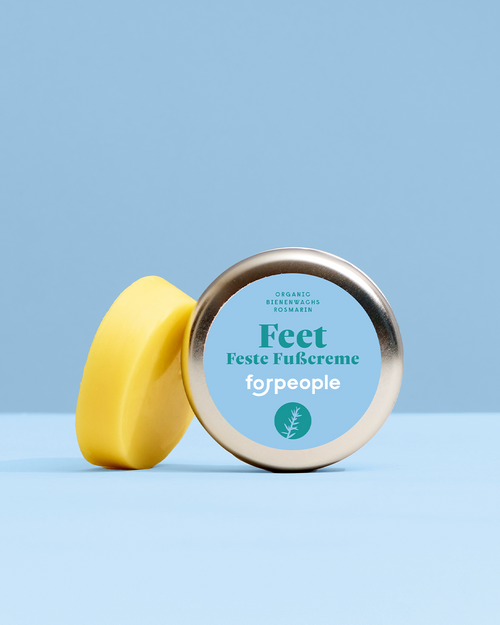
The Solid Foot Cream – Rosemary & Sage is intended for caring for rough skin on the heels and balls of the feet: according to its product page, for dry, rough feet and heels with superficial cracks. It consists of sunflower and olive oil, beeswax and shea butter, plus St John's wort and aloe extract and essential oils of rosemary, eucalyptus and clary sage. It is care for calluses, not a remedy for corns or warts, and does not belong on either. The product page also says: do not apply to injured skin, not suitable for children under 7 because it contains eucalyptol and camphor, and if you have diabetes or reduced sensation in your feet, have skin changes checked by a professional early on. Why socks on top make sense is explained in Foot cream overnight with socks: does it help?
What helps – and what does not
| Measure or assumption | Assessment |
|---|---|
| Roomier shoes, pads, insoles | helps; without pressure, a corn usually recedes |
| Foot soak and pumice stone | helps with calluses and corns if only the top layer is removed |
| Corn plasters, creams or tinctures with salicylic acid or urea | possible if you have no other problems with the skin on your feet; do not use them yourself if you have diabetes or circulation problems |
| Cutting out a corn yourself, planing calluses | no; risk of injury and infection |
| Foot cream on the corn or wart | no; cream cares for the rough skin around it but does nothing to the core or the wart |
| Using the same file on a wart as on calluses | better not; it can spread the viruses |
| Waiting with a wart | often reasonable; in studies with schoolchildren, about half of the warts had disappeared after one year |
| Vinegar, lemon or baking soda on the spot | not proven; acids irritate the unaffected skin at the edge |
Sources: IQWiG 2025a, IQWiG 2025b, IQWiG 2023, Freeman 2002, Schaper et al. 2024. The entries on foot cream are our own assessment. What home remedies actually do to calluses is explained in Vinegar, baking soda, lemon: home remedies for calluses.
Common mistakes
- Taking everything for a callus. A wart does not get smaller with pumice stone and cream, and a corn comes back as long as the shoe presses.
- Digging out the core with a knife or razor blade. The blade easily hits living skin; this belongs with a podiatrist.
- Corn plasters with diabetes. Keratolytic products can then damage the skin and encourage inflammation.
- Sticking the plaster over the whole area around it. The acid also acts on the unaffected skin at the edge.
- Wearing last year's boots with thicker socks. The shoe becomes too tight, and the pressure sits exactly where the corn forms.
- Walking barefoot through indoor pools and saunas. Communal showers are among the known risk factors for warts.
- Piercing a blister or pulling off the skin. The skin on top protects the spot; once open, it gets infected more easily.
When to seek medical advice
Skincare keeps rough skin supple; it does not treat corns, warts or inflamed spots. Have the spot looked at by a podiatrist or doctor if
- you have diabetes, circulation problems, a weakened immune system or reduced sensation in your feet; then do not treat corns and calluses yourself (NHS: Corns and calluses) and do not use chemical agents or plasters on them (Schaper et al. 2024); more in Dry skin with diabetes: causes and care for feet and legs,
- the spot bleeds, releases pus or fluid, hurts badly or has not improved after three weeks of self-care (NHS: Corns and calluses),
- the skin around it is red, swollen or warm, or a corn appears deep and inflamed with pus (IQWiG 2025b),
- a blister is hot and contains yellow or green pus, keeps coming back or appears for no obvious reason (NHS: Blisters),
- a wart is very large, very painful, keeps coming back, bleeds or changes, or if you are worried about a growth on your skin; some skin changes only resemble warts (IQWiG 2023),
- toes swell up red-violet a few hours after damp cold, itch or burn; this can be a chilblain, see Chilblains on toes and fingers: how to recognise them, prevent them and what helps,
- cracks in the callus are deep or hurt when you walk; see Cracked heels: when to see a podiatrist or doctor
Frequently asked questions
Corn or wart: how can I tell the difference?
A corn has a glassy core in the middle and always sits at a pressure point; it hurts mainly with pressure from above. A plantar wart interrupts the skin lines, often shows black dots and hurts more when squeezed from the sides. A doctor or podiatrist can tell for certain.
Corn or callus: what is the difference?
A callus is a flat, usually painless thickening. A corn is smaller, round and has a core that presses into the depth and therefore hurts. A callus can turn into a corn if the pressure stays on one point.
Corn or blister?
A blister is filled with fluid and forms quickly, for example after a day in new shoes. A corn is firm, grows over weeks and contains no fluid.
Can I remove a corn with its core myself?
You can remove the top layer of thickened skin with a pumice stone after a foot soak. The core is removed by a podiatrist; blades, corn planes and razor blades are too dangerous for use at home.
Do corn plasters help?
They contain keratolytic agents such as salicylic acid and are used over several weeks. For people without skin problems on their feet they are an option; with diabetes or circulation problems they are not. If the pressure stays, the corn comes back.
Why do I get more corns in winter?
Firm, lined boots and thick socks leave less room in the shoe, and dry heated air dries out the skin. Both favour pressure spots.
Can I put foot cream on a corn or a wart?
No. Care for the rough skin around it; the corn needs the pressure taken off, and the wart may need treatment from a pharmacy or doctor.
Is a plantar wart contagious?
Yes. The viruses are passed on through direct skin contact and through objects such as towels. Pool shoes, your own towels and covering the wart when swimming reduce the risk; whether this protects reliably has not been studied.
At forpeople
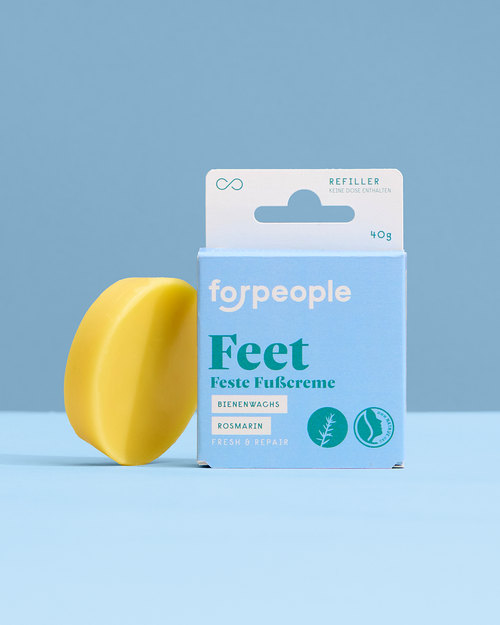
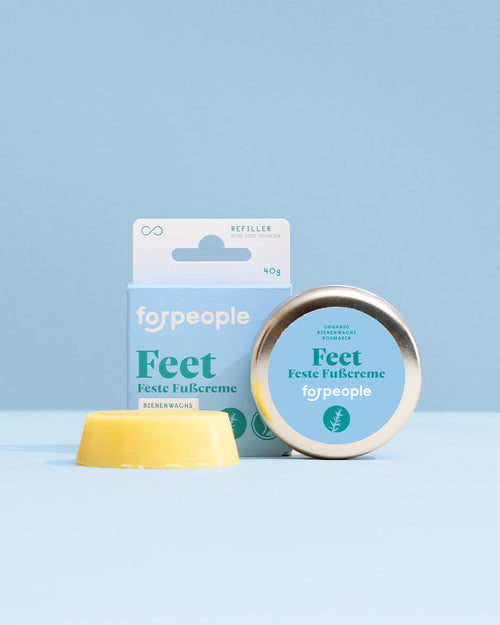
Our products do not treat corns or warts. For the rough, callused skin on the heels and balls of the feet there is a solid, water-free foot cream in a refillable metal tin.
Solid Foot Cream – Rosemary & Sage, 40 g, €9.90: sunflower and olive oil, beeswax, shea butter and essential oils; not for children under 7, not on injured skin.
Solid Foot Cream Refill - Rosemary & Sage, 40 g, €7.90: the same formula for refilling the tin.
Foot Care Set – For Dry, Rough Feet (2× Rosemary Cream), 80 g in total, €16.90.
More on this: Dry, cracked skin on the toes: big toe, tops of the toes and ankle · Does Walking Barefoot Give You More Calluses?
From the blog: What goes into the solid foot cream – and why
Sources
- Institute for Quality and Efficiency in Health Care (IQWiG) (2025a): Hühnerauge [Corns]. gesundheitsinformation.de, updated 19 March 2025, accessed 29 October 2026. https://www.gesundheitsinformation.de/huehnerauge.html
- Institute for Quality and Efficiency in Health Care (IQWiG) (2025b): Was tun bei Hühneraugen? [What can you do about corns?]. gesundheitsinformation.de, updated 19 March 2025, accessed 29 October 2026. https://www.gesundheitsinformation.de/was-tun-bei-huehneraugen.html
- Institute for Quality and Efficiency in Health Care (IQWiG) (2023): Warzen [Warts]. gesundheitsinformation.de, updated 2 January 2023, accessed 29 October 2026. https://www.gesundheitsinformation.de/warzen.html
- DermNet: Viral wart. Oakley A (1996), updated by Gomez J (December 2016), revised February 2021 and November 2025, accessed 29 October 2026. https://dermnetnz.org/topics/viral-wart
- DermNet: Corn and callus. Oakley A (2005), accessed 29 October 2026. https://dermnetnz.org/topics/corn-callus
- Freeman DB (2002): Corns and calluses resulting from mechanical hyperkeratosis. Am Fam Physician 65(11): 2277–2280. PubMed: https://pubmed.ncbi.nlm.nih.gov/12074526/
- NHS: Corns and calluses. Last reviewed 28 July 2026, accessed 29 October 2026. https://www.nhs.uk/conditions/corns-and-calluses/
- NHS: Blisters. Last reviewed 22 November 2023, accessed 29 October 2026. https://www.nhs.uk/conditions/blisters/
- Schaper NC, van Netten JJ, Apelqvist J, Bus SA, Fitridge R, Game F et al. (2024): Practical guidelines on the prevention and management of diabetes-related foot disease (IWGDF 2023 update). Diabetes Metab Res Rev 40(3): e3657. https://doi.org/10.1002/dmrr.3657