


What handball resin is
Resin makes the ball easier to grip. In handball it has long been used to hold the ball more securely and throw more accurately (Nakayama et al. 2024).
Classic resin is based on colophony, the solid part of pine resin. A German utility model filed in 1998 states that mixtures containing colophony had been the usual handball resins until then. It describes a formula of hydrogenated colophony and fatty acids, as a paste or, dissolved in alcohol, as a spray (DE 298 18 097 U1). Colophony consists of about 90 to 95 per cent resin acids and is strongly water-repellent (Siboro et al. 2025). The International Chemical Safety Card for colophony gives its solubility in water as: none (ILO/WHO 2004).
There are also grip products on the market that their manufacturers describe as water-soluble or washable; we did not find an independent overview of them. Because resin also sticks to the hall floor, it is banned in many sports halls. Since 2019 the world federation has had a separate ball category for playing without resin (Nakayama et al. 2024).
How resin and colophony are related is explained in Larch resin, pine pitch, pine tar: the difference.
What removes which resin
| Type of resin | What removes it | Note |
|---|---|---|
| Classic colophony-based resin, as a paste from the tin | Massage in oil, a fat-based cream or resin remover, wipe off, then soap | Water alone is not enough |
| Resin as a spray | As above | In the utility model the resin is dissolved in alcohol; the alcohol evaporates, the resin stays |
| Grip product sold as water-soluble or washable | Warm water and soap, as stated on the pack; oil for what is left | Manufacturer's information |
| Resin-free ball | Nothing to remove, wash your hands as usual | Care after showering still makes sense |
Why fat? In the utility model a fatty acid such as oleic acid keeps the resin mixture soft; it also says this makes the resin easier to remove with an alkaline cleaning agent (DE 298 18 097 U1). You use both on your hands: oil softens the resin and takes away its stickiness, and classic soap is alkaline and rinses off the rest. That oil lifts resin off the skin is experience from the sports hall; to our knowledge nobody has measured it.
Resin removers differ from product to product; what they contain is on the label. If your skin feels tight afterwards, use oil next time.
Step by step: getting resin off your hands
- Start dry. Put about a teaspoon of oil or a little fat-based cream on your dry hands.
- Massage until the resin softens. Rub palms and fingers against each other. Allow about a minute; that is a rule of thumb from practice.
- Wipe off. Wipe away oil and resin with a paper towel or an old towel. Do not pull, do not scratch.
- Wash. Lukewarm water and soap take off the oil film and what is left. If something remains, repeat the first three steps instead of scrubbing.
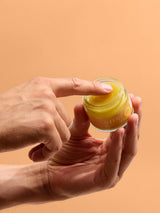
- Dry and apply cream. Pat your hands dry and massage in a small amount of cream.
What is better left alone
Peeling and rubbing off. Anything sticky takes skin cells with it when it is pulled off. In skin research the stratum corneum is removed layer by layer in exactly this way: with adhesive film that is pressed on and pulled off (Lademann et al. 2009). This has not been measured specifically for handball resin, but the principle is the same. On calluses and fingertips, a piece of hard skin easily tears off with it.
Solvents. Methylated spirits, petroleum spirit, nail polish remover or paint thinner dissolve resin, but they also strip fat from the skin. The German occupational safety rule TRGS 401 assumes that skin dries out after contact with surfactants or organic solvents. It requires skin cleaning to be as easy on the skin as possible and, where possible, without organic solvents (AGS 2022). The rule applies to the workplace; it also works as a yardstick for the changing room.
Brushes and hot water. The same rule advises against cleaning brushes and elsewhere recommends lukewarm water (AGS 2022).
Why resin hands become dry and cracked
We did not find a study on handball players' hands. The explanation is made up of known building blocks:
- Cleaning: resin remover, soap and often solvents several times a week. Surfactants and solvents dry the skin out (AGS 2022); more in Dry, cracked hands from frequent washing: what helps?
- Pull on the stratum corneum: resin sticks skin to ball and skin to skin; every time they separate, the outermost layer of skin is put under load.
- Friction and pressure: catching and throwing put load on the fingertips and the base of the fingers. The skin responds with calluses, and thick, dry calluses tear more readily. Why is explained in Gym calluses: care for them or remove them?
Care around training and matches
- Before training and matches: wash your hands, dry them well, no cream. A fresh film of fat changes your grip, on the ball as on a climbing hold; the reasoning is in Moisturise before or after climbing?
- Straight afterwards: remove the resin, wash, dry, apply a thin layer of cream.
- In the evening and on days off: a little more cream, massaged in thoroughly. It has time overnight; how to do that is shown in Overnight hand mask: what it does and how to do it.
- Open cracks and blisters: do not apply cream. Keep them clean and cover them before you reach for the resin again.
When to seek medical advice?
Colophony is one of the known triggers of contact allergy. The safety card states that repeated or prolonged skin contact may cause sensitisation (ILO/WHO 2004); TRGS 401 lists colophony in adhesives and grip agents among the allergenic substances (AGS 2022). Have your hands looked at by a skin doctor if
- they are red, itch, sting or form small blisters after using resin, even hours or days later,
- cracks bleed, weep or have not closed after a few days,
- a spot is red, warm and swollen or throbs,
- nothing changes despite a few weeks of care.
Whether you have a contact allergy is clarified by a test at a skin doctor's practice. Background is in Allergic to tree resin, colophony or propolis? Cosmetics care for the skin; they do not treat skin conditions.
Frequently asked questions
Does handball resin come off with soap and water alone?
Classic resin hardly does. Colophony does not dissolve in water, and with soap alone you have to rub for a long time. Fat first, then soap is quicker. With grip products sold as water-soluble, soap may be enough.
Which oil should I use?
Any vegetable oil from the kitchen works, and so does baby oil. You do not need a special skin oil for this.
Can I use methylated spirits or nail polish remover?
They dissolve resin but strip fat from the skin. For skin cleaning, TRGS 401 requires products without organic solvents where possible. With oil and soap you can do without them.
Does the solid hand cream have a scent?
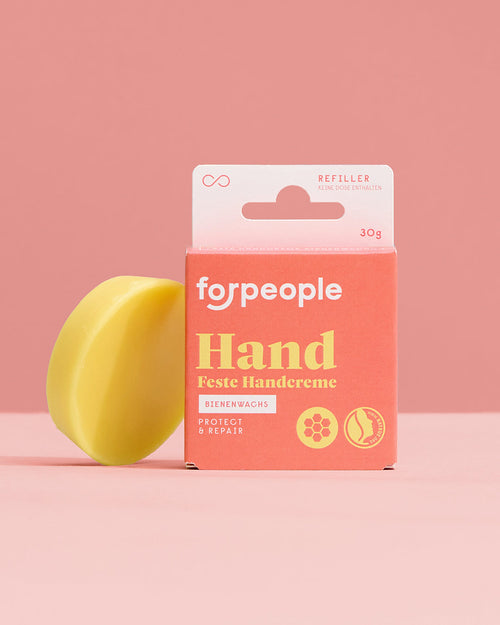
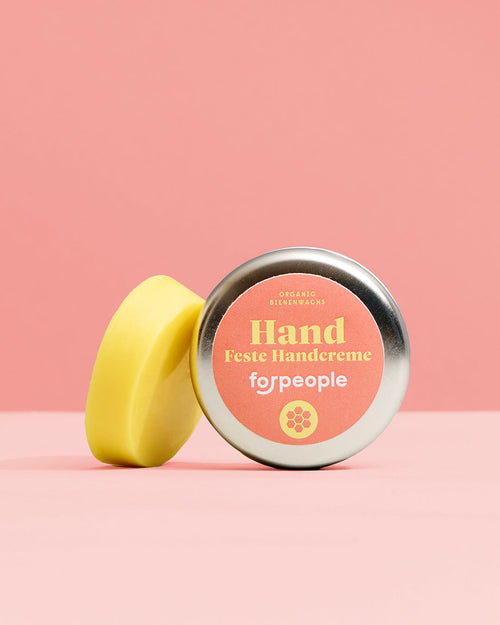
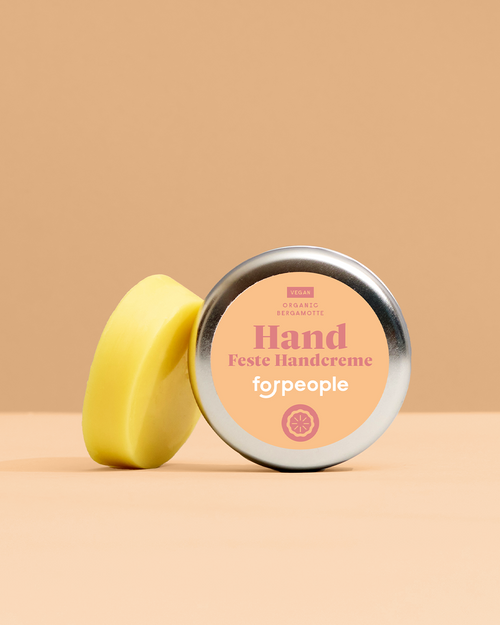
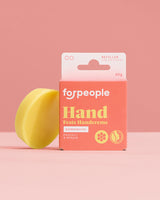
According to its ingredient list, the beeswax version contains no added fragrance; it smells of its raw materials, mainly beeswax. The bergamot version contains lemon and bergamot essential oils. For an overview see Without fragrance and essential oils: ingredients at a glance.
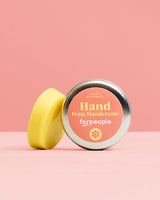
What happens to the tin in my sports bag?
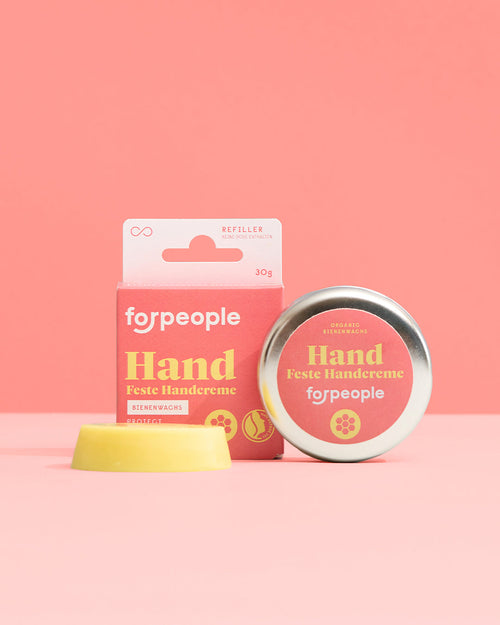
A solid cream does not leak. In a hot car it becomes soft and firms up again once it cools. When it is empty, you put in the Solid Hand Cream Refill - Beeswax (30 g, €7.90).
At forpeople
Our solid hand creams are care for the time after training and matches, not a resin remover and not a skin protection product.
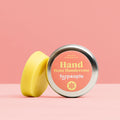
- Solid Hand Cream - Beeswax, 30 g, €9.90: beeswax, olive and sunflower oil, St. John's wort and aloe extract; without water and without added fragrance.
- Solid Vegan Hand Cream - Bergamot, 30 g, €9.90: vegan, with candelilla wax, jojoba oil and shea butter; with lemon and bergamot essential oils.
- Hand Care Set – For Rough, Cracked Hands (2× Solid Hand Cream), 60 g, €16.90: one tin and one refill of the beeswax version.
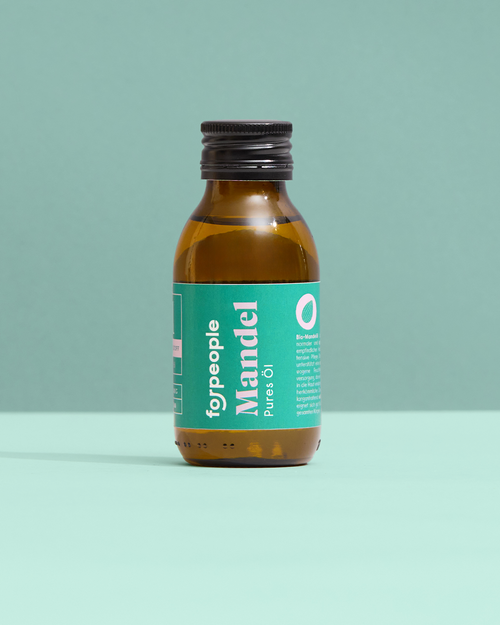
- Almond Oil - pure, 100 ml, €14.90: pure almond oil. For removing resin, any cooking oil works just as well.
We deliberately do not name our salves with larch resin here; anyone who reacts to colophony should be careful with larch resin too. Do not use the products on injured or irritated skin.
More on this: Tree resin on your hands: how do you get it off? · Oil and grease on your hands: how do you wash them off gently? · Rowing and paddling: how to care for calluses and wet hands
From the blog: Climbing with cracked hands? Solid hand cream with beeswax nourishes, protects and holds up. · Switching to solid skincare: what is different in the first weeks
Sources
- Nakayama S, Trejo-Silva A, Gomez-Ruano MA, Aida H (2024): Impact of a Ball Regulation Change on Game Performance and Shooting Play in Japanese U-15 Girls' Handball. Percept Mot Skills 131(5): 1814–1833. https://doi.org/10.1177/00315125241274215
- Olesen HL (2000): Handballharz. Deutsches Gebrauchsmuster DE 298 18 097 U1, angemeldet am 9.10.1998, veröffentlicht am 10.2.2000. https://patents.google.com/patent/DE29818097U1/de
- Siboro SAP, Salma SA, Syuhada, Putri KSS, Yuliati F, Lee WK, Lim KT (2025): Gum Rosin in Medical and Pharmaceutical Applications: From Conventional Uses to Modern Advancements. Materials (Basel) 18(10): 2266. https://doi.org/10.3390/ma18102266
- Internationale Arbeitsorganisation (ILO), Weltgesundheitsorganisation (WHO) (2004): Internationale Chemikalien-Sicherheitskarte ICSC 0358, Colophonium. Stand April 2004, deutsche Fassung. https://chemicalsafety.ilo.org/dyn/icsc/showcard.display?p_lang=de&p_card_id=0358&p_version=2
- Lademann J, Jacobi U, Surber C, Weigmann HJ, Fluhr JW (2009): The tape stripping procedure – evaluation of some critical parameters. Eur J Pharm Biopharm 72(2): 317–323. https://doi.org/10.1016/j.ejpb.2008.08.008
- Ausschuss für Gefahrstoffe (2022): TRGS 401 Gefährdung durch Hautkontakt – Ermittlung, Beurteilung, Maßnahmen. Ausgabe Oktober 2022, GMBl 2022 S. 895–926 (Nr. 40), zuletzt geändert und ergänzt GMBl 2024 S. 769 (Nr. 36). https://www.baua.de/DE/Angebote/Regelwerk/TRGS/TRGS-401