







The half-marathon training plan is set, the weekly mileage is going up. After the long Sunday run, your heel is hard, there is a blister on your second toe, and the nail on your big toe looks dark. This page sorts out what happens to the skin on your feet when you run and what you can do before, after and between runs. Long hikes with a backpack have a page of their own: Foot care before and after hiking.
What running does to the skin on your feet
Running is repetition. Whether a blister forms depends on how strong the friction is and how often something moves across the skin: the higher the friction, the fewer repetitions it takes. Moist skin increases friction, very dry or very wet skin reduces it. Blisters form preferentially where a thick horny layer sits firmly on the structures underneath, that is on the sole and heel; more speed and load increase the risk (Knapik et al. 1995).
The foot changes during a run. In a study with ten recreational runners, the forefoot became narrower after ten kilometres on the treadmill, the arch flatter, and the feet clearly warmer. The gap between the big toe and the front of the shoe changed with every step. The authors see this as an explanation for bruised toenails, which develop when the nail repeatedly hits the front of the shoe (Song et al. 2024).
The skin adapts: repeated, low-level friction makes the outer skin thicker, which can make blisters less likely (Knapik et al. 1995). That is why new shoes and sudden jumps in mileage are riskier than your usual run.
| Area | What happens when you run | Care | Where care ends |
|---|---|---|---|
| Heel | Friction at the heel edge, pressure on landing; callus, cracks at the edge | moisturise in the evening, smooth hard edges | deep or bleeding cracks: podiatrist or doctor |
| Ball of the foot | Pressure at push-off; callus, blisters under the callus | moisturise in the evening, do not remove the callus | pinpoint pain on pressure: have it checked |
| Toes and toenails | Impact against the front of the shoe; blisters on the toe tips, dark nails | cut nails straight and not too short | dark nail with no clear cause, pain under the nail: see a doctor |
| Between the toes | Sweat, warmth, moisture | dry thoroughly, do not moisturise | whitish and soggy, itchy, split: think of a fungal infection |
Sources for the table: Knapik et al. 1995, Song et al. 2024, Schaper et al. 2024. Matching care to each area is based on practice. On fungal infection between the toes, see Dry feet or athlete's foot? Signs and when to see a doctor.
Callus: how much should stay?
Callus is not a care mistake but the skin's response to pressure and friction. A study with people from Kenya and the USA showed that people who often walk barefoot have thicker and harder calluses without losing tactile sensitivity while walking (Holowka et al. 2019). What that means for barefoot runners is covered in Do I get more callus from walking barefoot?
For runners in shoes, this means: the area under the heel and the ball of the foot stays, hard, raised edges get smoothed. Callus becomes a problem when it dries out. Then it is rigid, can crack at the heel edge, and a blister can form under a thick plate that you can hardly see. Smooth on a rest day and a few days before a race, not the night before, and with a pumice stone or file rather than a blade. Which tool is suitable is covered in Pumice stone wet or dry? Removing callus properly; why callus grows back as long as the pressure remains, in Callus keeps coming back: why it regrows and what helps.
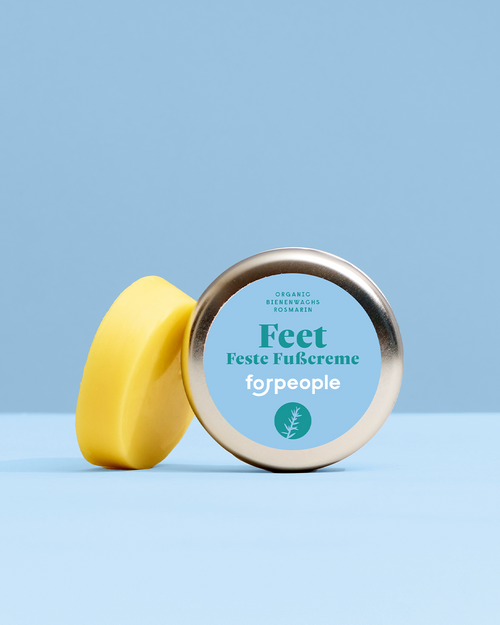
To keep the horny layer supple, moisturise in the evening. According to its product page, the Solid Foot Cream – Rosemary & Sage is meant for dry, rough feet and heels, for example after long days on your feet: sunflower and olive oil, beeswax and shea butter leave a thin film on the skin. It contains no water and is therefore applied to slightly damp skin, for instance after a shower. Essential oils of rosemary, eucalyptus and clary sage give it its scent; according to the product page it is not suitable for children under 7 and contains eucalyptol and camphor. Why heel skin cracks is explained in Why heel skin gets so thick and cracks.
Blisters: what prevents them and what is not proven
Over long distances, blisters are the rule rather than the exception: in a study during multi-stage ultramarathons, 83 percent of participants developed at least one (Lipman et al. 2016). Prevention has been studied less well than you might think. A systematic review found little high-quality evidence for socks, antiperspirants and barrier layers; thin paper tape seems most likely to help (Worthing et al. 2017). In a randomised study with 128 ultramarathon runners, paper tape applied to blister-prone areas before the start reduced blisters by 40 percent (Lipman et al. 2016).
For socks, there is an older finding: 35 long-distance runners got fewer and smaller blisters with acrylic socks than with otherwise identical cotton socks (Herring & Richie 1990). Antiperspirants with emollients and drying powders, on the other hand, do not appear to lower the likelihood of blisters (Knapik et al. 1995).
How runners handle it in practice is shown by a survey after French trail ultramarathons with 533 participants. Those who took preventive measures most often used an anti-friction cream, followed by special socks, paper tape and lemon juice. The strongest risk factor for a blister was having had blisters before; none of the prevention methods was as clearly linked to fewer blisters as a shorter running distance (Damoisy et al. 2023). A survey cannot separate cause and effect, but it shows how little the usual home remedies are backed up.
What can be derived from the mechanism and the studies:
- Wear new shoes and socks on several runs before a race; the skin needs time to adapt.
- Start with dry feet; change wet socks on long runs.
- Tape known problem areas with paper tape beforehand.
- Pay attention to a warm, rubbing spot early, not only to the finished blister.
Once a blister has formed, it is not a job for a skin care cream. Ask at a pharmacy or a doctor's practice how to look after it. On friction elsewhere on the body: Preventing chafing when running and cycling.
Petroleum jelly, deer tallow, anti-friction cream: before the start?
A film of fat in the shoe sounds like less friction, and many people use one. Its benefit for the feet has not been shown: in the French survey, anti-friction cream was the most common method, but no clear protection could be read from the results (Damoisy et al. 2023), and the systematic review found little evidence for barrier layers overall (Worthing et al. 2017). Measurements suggesting that thick lubricants lower friction only for a limited time and can even increase it afterwards are described in Foot care before and after hiking. What is in deer tallow products is explained in Deer tallow: what's in it and what the alternatives are.
Our foot cream is not a running lubricant. It is meant for care in the evening, so that the skin stays supple until the next run. On the morning of a race, put dry socks on dry feet. If you have had good experiences with a lubricant on specific spots, you do not have to give it up; try it in training, not on race day.
Toenails: cut them straight, take dark nails seriously
Long nails hit the front of the shoe with every step, especially downhill. The guideline on the diabetic foot recommends cutting toenails straight across (Schaper et al. 2024); for runners this is a good rule too, along with not cutting them too short and doing it a few days before a race rather than the night before. The authors of the treadmill study also recommend shoes with a high, long toe box so the toes have room, and lacing that stops the foot sliding forward without constricting it (Song et al. 2024).
A nail that turns blue or black after a long run is usually a bruise under the nail. According to figures from a review cited in this study, between 0.1 and 14 percent of runners report toenail injuries on marathon day, most often on the big toe (Song et al. 2024). Even so, a dark nail does not belong in the "that's just how it is" category: a dark discolouration can also have other causes, including, rarely, a melanoma under the nail, and even a confirmed bleed does not reliably rule this out (Löser & Mayser 2014). So have it checked by a doctor if a dark nail appears without a clear cause, if a dark streak is visible in the nail, if the discolouration does not grow out with the nail or spreads to the surrounding skin, or if there is strong pressure under the nail. Drilling or piercing it yourself is not part of the plan.
After the run and on rest days
| When | What | Why |
|---|---|---|
| Straight after the run | Shoes off, change wet socks, wash feet in lukewarm water, dry thoroughly, including between the toes | Get the moisture out; spot blisters, pressure marks and nails early |
| In the evening | Moisturise heels and balls of the feet thinly, not between the toes, loose cotton socks | the skin stays supple until the next run |
| On rest days | short foot bath, smooth hard callus edges, trim nails if needed | no freshly worked skin in the next training session |
| Running shoes | Take out the insoles, let them air-dry, not on the radiator | dry shoes rub less and smell less |
| Before a race | moisturise the evening before, dry feet in the morning, tried-and-tested socks | damp, softened skin rubs more |
The table describes a practical routine; the reasoning is based on Knapik et al. 1995 and Schaper et al. 2024. How long and how warm a foot bath should be is covered in Foot bath before moisturising: how long, how warm, when it makes sense; what the sock does overnight, in Foot cream overnight with socks: what does it do?
When to see a podiatrist or doctor
Cosmetics care for intact skin. According to its product page, our foot cream does not belong on broken skin. Get advice from a podiatrist or doctor if
- a blister is large, very painful or filled with blood, or the surrounding skin turns red, warm, swollen or fills with pus,
- a toenail turns dark without a clear cause, a dark streak appears or there is strong pressure under the nail,
- a nail grows in or the skin at the nail edge is inflamed,
- cracks in the heel are deep, bleed or hurt when you run (Cracked heels: when to see a podiatrist or doctor?),
- one spot presses like a point; this could be a corn or a wart,
- the skin between the toes is whitish and soggy, itches or splits.
If you have diabetes or reduced sensation in your feet, more caution applies. The international guideline advises inspecting both feet completely every day, including between the toes, wearing socks without seams and changing them daily, not removing calluses yourself with chemical agents or plasters, and not applying care for dry skin between the toes (Schaper et al. 2024). If you run with diabetes, discuss shoes, training volume and foot care with your doctor or podiatrist.
Frequently asked questions
Should I remove my callus as a runner?
Not completely. Callus under the heel and the ball of the foot protects. Only smooth hard, raised edges, on a rest day and a few days before a race, and keep the skin supple with care in the evening.
Does petroleum jelly prevent blisters when running?
That has not been shown. Anti-friction creams are widely used, but studies so far show no clear protection. The most thoroughly studied option is thin paper tape on known problem areas.
Why do my toenails turn black from running?
Usually the nail hits the front of the shoe with every step and a bruise forms underneath. Room for the toes, firm lacing and short, straight-cut nails help prevent it. A dark nail without a clear cause should be checked by a doctor.
Which socks work for long runs?
In a study with long-distance runners, acrylic socks led to fewer and smaller blisters than cotton socks. More important than the material is that the sock fits, does not wrinkle and has been tried out in training.
When should I moisturise my feet if I run regularly?
In the evening after washing, thinly on heels and balls of the feet, not between the toes. In the morning before a run, keep your feet dry.
Can I use the solid foot cream before a race?
The evening before, yes; in the morning, no. It is meant for care, not as a lubricant in the shoe.
Is the solid foot cream suitable for children who run along?
According to the product page, it is not suitable for children under 7 because it contains eucalyptol and camphor.
At forpeople
Our foot care is meant for dry, rough feet and heels, for the evening after a run. It does not treat blisters, injuries or fungal infections and does not belong between the toes.
Solid Foot Cream – Rosemary & Sage, 40 g, €9.90: water-free, made of sunflower and olive oil, beeswax and shea butter, with essential oils of rosemary, eucalyptus and clary sage.
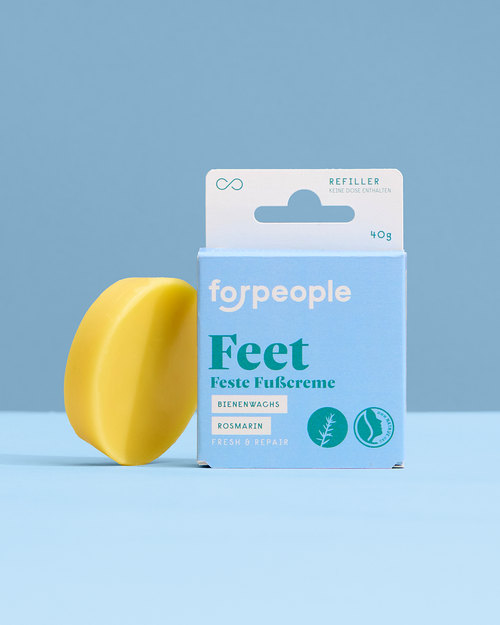
Solid Foot Cream Refill - Rosemary & Sage, 40 g, €7.90: the same cream for refilling the tin.
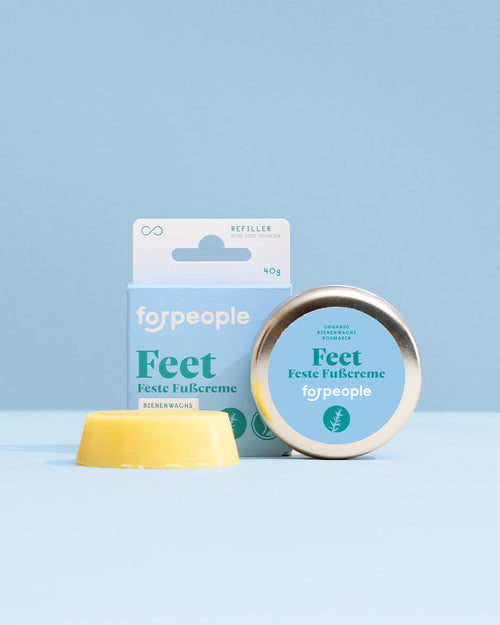
Foot Care Set – For Dry, Rough Feet (2× Rosemary Cream), 80 g, €16.90: two foot creams in metal tins, for example one for home and one for your sports bag.
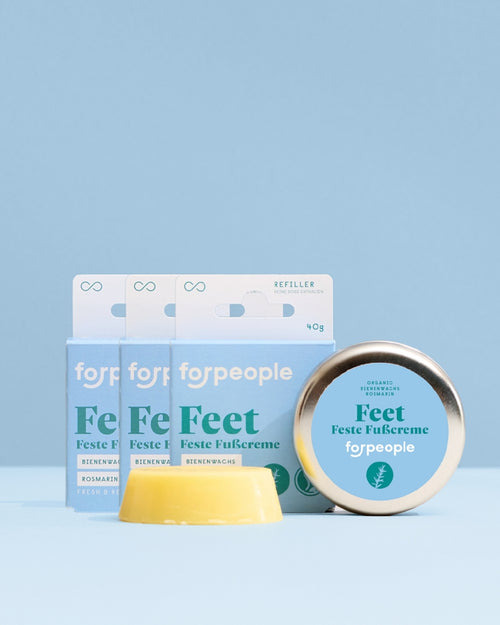
Foot Care Set XL – for Dry Feet, 160 g, €29.90: one tin and three refills of the foot cream.
More on this: Hand cream for feet, foot cream for hands: does it work? · Why heel skin gets so thick and cracks
Sources
- Knapik JJ, Reynolds KL, Duplantis KL, Jones BH (1995): Friction blisters. Pathophysiology, prevention and treatment. Sports Med 20(3): 136–147. https://doi.org/10.2165/00007256-199520030-00002
- Worthing RM, Percy RL, Joslin JD (2017): Prevention of Friction Blisters in Outdoor Pursuits: A Systematic Review. Wilderness Environ Med 28(2): 139–149. https://doi.org/10.1016/j.wem.2017.03.007
- Herring KM, Richie DH Jr (1990): Friction blisters and sock fiber composition. A double-blind study. J Am Podiatr Med Assoc 80(2): 63–71. https://doi.org/10.7547/87507315-80-2-63
- Lipman GS, Sharp LJ, Christensen M, Phillips C, DiTullio A, Dalton A et al. (2016): Paper Tape Prevents Foot Blisters: A Randomized Prevention Trial Assessing Paper Tape in Endurance Distances II (Pre-TAPED II). Clin J Sport Med 26(5): 362–368. https://doi.org/10.1097/JSM.0000000000000319
- Damoisy JB, Destombes V, Savina Y, Pröpper CJ, Braun C, Tanné C (2023): Epidemiology, prevention methods, and risk factors of foot blisters in French trail ultramarathons. J Sports Med Phys Fitness 63(8): 921–926. https://doi.org/10.23736/S0022-4707.23.14937-1
- Holowka NB, Wynands B, Drechsel TJ, Yegian AK, Tobolsky VA, Okutoyi P et al. (2019): Foot callus thickness does not trade off protection for tactile sensitivity during walking. Nature 571(7764): 261–264. https://doi.org/10.1038/s41586-019-1345-6
- Song Y, Cen X, Sun D, Bíró I, Mao Z, Fang Y, Gu Y (2024): Influence of changes in foot morphology and temperature on bruised toenail injury risk during running. Sci Rep 14(1): 1826. https://doi.org/10.1038/s41598-024-51826-w
- Löser C, Mayser PA (2014): Dunkler Nagel: Klinik, Diagnostik und Therapie der Melanonychie. Hautarzt 65(4): 327–336. https://doi.org/10.1007/s00105-013-2706-y
- Schaper NC, van Netten JJ, Apelqvist J, Bus SA, Fitridge R, Game F et al. (2024): Practical guidelines on the prevention and management of diabetes-related foot disease (IWGDF 2023 update). Diabetes Metab Res Rev 40(3): e3657. https://doi.org/10.1002/dmrr.3657