


Are men's lips built differently?
We know of no difference between men and women in the protective layer of the red of the lips. A review article describes its structure like this: 3 to 5 cell layers instead of about 16 in the rest of the facial skin, hardly any sebaceous glands, no sweat glands, no hair (Sun et al. 2025). That is why a lot of water evaporates through the lips. In one measurement, water loss at the red of the lips was almost three times as high as at the cheek (Kobayashi & Tagami 2004). The measurements were taken on 303 women; we do not know of comparable measurements on men's lips.
The same review does describe differences for the skin around the mouth: there, men have more sebaceous and sweat glands and larger hair follicles than women (Sun et al. 2025). That is of little use to the red of the lips, because in everyone it has hardly any sebaceous glands and depends on a film from outside. More on this: Why do lips dry out so quickly?
What differs are habits and wishes: shaving or a beard right up to the edge of the lips, and care that should not be visible. That does not take a label saying “for men”. The same goes for hands: Hand cream for men: what really matters.
What makes lip balm shine
Shine appears when a smooth, liquid film sits on the lips and reflects light in one direction. Lip gloss is designed for that. In sticks, the fats decide the result: in a study on lipsticks, the viscosity of the oils and the wax used played the main role for the sensory properties; according to the authors, this is also how shine can be adjusted (de Clermont-Gallerande et al. 2018).
For everyday use there is a general rule. It is experience, not a measured value, and not a promise for any particular product:
- Firm rather than soft: A stick with plenty of wax leaves little behind when you stroke it over your lips. A soft balm or a product with a lot of liquid oil leaves a thicker layer.
- Thin rather than thick: During the day, one stroke over each lip is enough. The thicker the layer, the more likely it is to shine.
- Spread it: Rub your lips together briefly or spread the film with a fingertip right to the edge.
- Blot it: Whatever is still visibly sitting on top afterwards, take off with a tissue. A thin film stays.
Shine, colour, taste: what the label tells you
In the EU, every cosmetic pack carries a list of ingredients in descending order of weight; anything that makes up less than 1 % may follow at the end in any order. Perfume and flavour compositions appear there as “parfum” or “aroma”. Colourants may be listed at the end and usually carry a CI number (Regulation (EC) No 1223/2009, Article 19). How the list is structured is shown in How to Read an INCI List.
| What you want | What to look for | How to spot it in the ingredient list |
|---|---|---|
| No shine | a firm stick, applied thinly | a wax near the top, for example “Cera Alba” (beeswax) or “Candelilla Cera”; a hint, not a guarantee |
| No colour | a balm without colourants | no entries with “CI” and a five-digit number |
| No sweet taste | without flavourings and sweeteners | no “aroma”, no sweeteners such as “Sodium Saccharin” or “Sucralose” |
| Little scent | without perfume; essential oils are scented too | no “parfum”; essential oils are listed with the Latin plant name and “Oil” |
| Protection on days outdoors | lip balm with a sun protection factor | SPF stated on the pack; mineral filters are called “Zinc Oxide” and “Titanium Dioxide” and are white pigments |
Shaving, beard and the edge of the lips
In a wet shave the blade runs right up to the edge of the lips. A review article describes that dense, stiff beard hair is often shaved with more pressure and in several strokes, and that both make skin irritation from shaving more likely (Maurer et al. 2016). For the lips this means in practice:
- Rinse: Rinse shaving foam, gel or soap off your lips as well. Surfactants dissolve fats, and the red of the lips has little of them.
- Leave out: Aftershave is meant for the shaved skin. Leave your lips out.
- Care afterwards: Apply lip balm once you have dried your face.
- Small cuts: Lip balm does not belong on a fresh cut at the edge of the lips. Wait until the spot has closed.
With a moustache, the balm goes on the red of the lips only. Take a little off with your fingertip for that; wax in the moustache makes the hairs stick together. For the beard itself there are separate products: Beard balm or beard oil: what is the difference?. What facial skin needs after shaving is covered in After shaving: what does facial skin need?.
Two fixed times instead of reaching for the stick all day
- In the morning after brushing your teeth and shaving: apply thinly, spread, blot the excess.
- In the evening before bed: a thicker layer. Shine does not matter then. More on this: Dry lips in the morning: does lip balm overnight help?
Then there are occasions: before going out in cold and wind, and on days in the sun. According to Germany's Federal Office for Radiation Protection (BfS), no protective measures are normally needed at a UV index of 1 to 2; from 3 upwards protection is required, with sunscreen for uncovered skin (BfS, UV index). Your lips are uncovered skin: Do I need lip balm with SPF?
In between: do not lick your lips. Saliva evaporates quickly, and the lips are drier afterwards. On the worry of getting used to the stick: Can you become dependent on lip balm?
When to seek medical advice?
Have it checked by a doctor if your lips stay cracked for weeks despite care, are very red or swollen, weep or bleed, if the corners of your mouth keep splitting, or if a rough, scaly or hardened spot persists. If your lips burn or redden after a new lip balm, stop using it and get advice.
Frequently asked questions
Do men need their own lip balm?
No. In everyone, the red of the lips has hardly any sebaceous glands and needs the same film of wax and oil. The ingredient list tells you something, the wording on the front does not.
Which lip balm does not shine?
As a rule, the least visible is a firm, wax-rich stick that you apply thinly, spread and blot. That is no guarantee: every thick layer shines.
Can you see lip balm with mineral sun protection?
Zinc oxide and titanium dioxide are white pigments. Spread thinly, a pale sheen tends to remain; a thick layer is more clearly visible.
Why do some lip balms taste sweet?
Mostly because of flavourings or sweeteners. Both are in the ingredient list. A stick without these additives tastes of its raw materials: of wax, oil and an essential oil, if it contains one.
My stick feels hard at first. Is that a defect?
No. A stick with plenty of wax is firm at room temperature, and it is exactly this build that leaves little behind. Hold it against your lips for a moment and the surface becomes softer. In a trouser pocket your body heat makes it soft; a jacket pocket is the better place. More on this: Lip balm in a paper stick: how to use it properly.
At forpeople
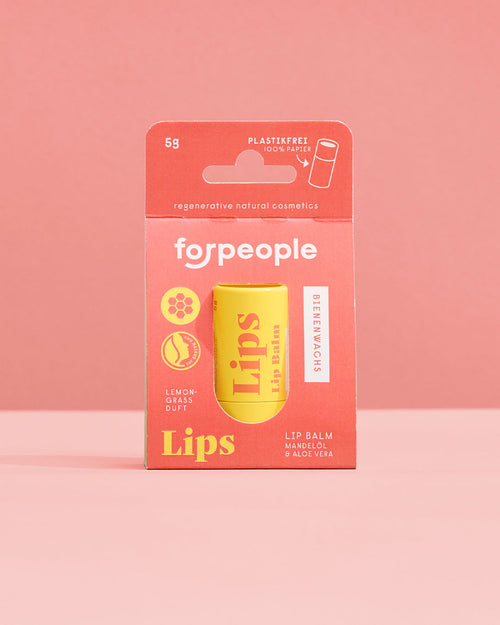
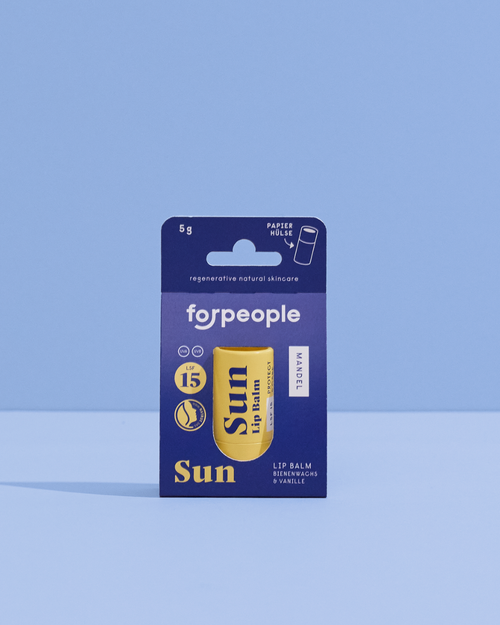
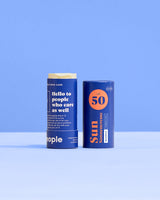
We do not offer a lip balm specifically for men, and none without scent. Our two sticks are water-free, list beeswax first in the ingredient list and come in a paper tube from which you push the balm up from below. How matt or shiny they look on your lips depends on how thick the layer is; we cannot promise either.
- Lip Balm - Lemongrass, 5 g, €4.90: according to the ingredient list, beeswax, sunflower oil, shea butter, almond oil, hemp seed oil, aloe vera extract and lemongrass essential oil. The list contains no colourant, no “aroma” and no sweetener. The stick smells of lemongrass; citral, citronellol and geraniol are declared.
- Lip Balm - SPF15 Almond & Vanilla, 5 g, €7.90: for days outdoors. The UV filters are zinc oxide and titanium dioxide, non-nano according to the product information. Both are white pigments; a pale sheen is possible. Essential oils and sweeteners are not in the list, vanilla extract is.
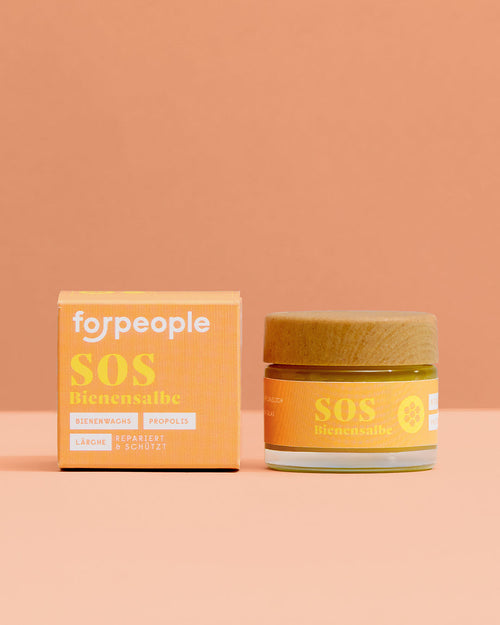
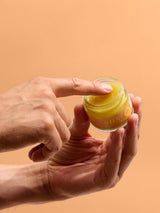
- Beeswax Salve Larch & Mandarin in a Glass Jar, 50 g, €12.90: a soft salve for the thicker layer in the evening. It is scented and contains larch resin, propolis and essential oils of mandarin, rosemary and fir.
Our beeswax is unbleached, comes from northern Germany and is from organic beekeeping with Bioland certification. All three products are cosmetics and, according to the product information, not meant for injured or irritated skin. If your skin reacts, stop using them.
More on this: Face care for men: what does the skin really need? · Can you become dependent on lip balm? · Hand cream for men: what really matters
From the blog: Skincare for days in the snow: hands, lips, face
Sources
- Kobayashi H, Tagami H (2004): Functional properties of the surface of the vermilion border of the lips are distinct from those of the facial skin. British Journal of Dermatology 150(3): 563–567. https://doi.org/10.1046/j.1365-2133.2003.05741.x
- Sun F, Liu Y, Zhang T (2025): Aging of the Human Lip: Current Knowledge and Clinical Implications. Journal of Cosmetic Dermatology 24(8): e70310. https://doi.org/10.1111/jocd.70310
- de Clermont-Gallerande H, Abidh S, Lauer A, Navarro S, Cuvelier G, Delarue J (2018): Relations between the sensory properties and fat ingredients of lipsticks. OCL – Oilseeds and fats, Crops and Lipids 25(5): D502. https://doi.org/10.1051/ocl/2018053
- Europäisches Parlament und Rat (2009): Verordnung (EG) Nr. 1223/2009 vom 30. November 2009 über kosmetische Mittel, Artikel 19. ABl. L 342 vom 22.12.2009, S. 59. https://eur-lex.europa.eu/eli/reg/2009/1223/oj
- Maurer M, Rietzler M, Burghardt R, Siebenhaar F (2016): The male beard hair and facial skin – challenges for shaving. International Journal of Cosmetic Science 38(Suppl 1): 3–9. https://doi.org/10.1111/ics.12328
- Bundesamt für Strahlenschutz (BfS): Was ist der UV-Index? Stand 4. August 2026. https://www.bfs.de/DE/themen/opt/uv/uv-index/einfuehrung/einfuehrung.html