The problem: the red ring around the mouth
It often starts in autumn: the lips are chapped, the child runs the tongue over them because it feels better for a moment, and after a few days a reddened, flaky ring forms around the mouth. On the way to school in the wind it stings, the scarf rubs, and eating oranges or tomatoes smarts. The lips themselves are dry and cracked. Specialists speak of lip-licking eczema; it is described as common and stubborn, kept going by constant licking (Altmeyer et al. 2026). A case report of a ten-year-old girl describes a sharply defined, red, scaly and cracked area that evenly covered the edge of the lips and the skin around the mouth; her mother recalled that the girl licked her lips all the time (Sil & Priyam 2019).
Not every red ring around the mouth is lip-licking dermatitis. The overview is based on specialist sources; it does not replace a diagnosis. Only an examination at the paediatrician's brings clarity.
| What you see | What may be behind it | What fits now |
|---|---|---|
| Red, rough, flaky ring around the lips, sharply defined, lips dry and cracked; the child licks often | lip-licking dermatitis (Sil & Priyam 2019), (Fonseca et al. 2020) | a layer of ointment and breaking the habit as described below |
| Small red bumps, blisters or pustules around the mouth, nose or eyes; a narrow rim right next to the lips often stays clear | perioral dermatitis, which also occurs in children between about 7 months and 13 years (DermNet, Periorificial dermatitis) | no greasy ointment, paediatrician |
| Honey-coloured crusts on the face that spread | impetigo, a contagious bacterial infection that can also settle on eczema (Hartman-Adams et al. 2014) | paediatrician |
| Groups of similar-looking, painful blisters or small punched-out sores, often with fever, especially in a child with atopic eczema | eczema herpeticum, a dermatological emergency (DermNet, Eczema herpeticum) | medical care the same day |
| Itchy, dry eczema in other places too, for example in the elbow creases and behind the knees | atopic eczema; in toddlers, saliva and food often lead to eczema around the mouth and chin (DermNet, Atopic dermatitis) | paediatrician; see Dry skin or atopic eczema? |
Cracked corners of the mouth are covered under Cracked corners of the mouth: causes, care and when to see a doctor, dry skin around the mouth in adults under Dry skin around the mouth and on the chin.
Why this happens in autumn and winter
Lips dry out quickly. The skin of the lips has no sebaceous or sweat glands and only thin protection (Altmeyer et al. 2026). Dry, cracked lips are common in the cold winter months, and many people then lick them to moisten them. That helps for a moment but keeps the problem going (Fonseca et al. 2020). Why lips dry out so quickly is explained in detail under Why do lips dry out so quickly?
Saliva irritates. It contains digestive enzymes that attack the thin skin of the lips, break down its protective barrier and make it more vulnerable to further irritants (Fonseca et al. 2020). The specialist literature therefore classifies lip-licking dermatitis as irritation, not allergy: saliva is the most common irritant on the lips (Fonseca et al. 2020). In cold air it evaporates quickly, and afterwards the skin is drier than before. That is why the redness often sits exactly where the tongue and saliva reach.
Winter reinforces the cycle. Cold, windy weather is considered a trigger of inflammation of the lips (cheilitis) (Altmeyer et al. 2026), and indoors the heated air dries things out further. Then there are the habits of the cold season: a scarf over the mouth that gets damp from breathing and rubs, a runny nose wiped with the back of the hand, and in toddlers saliva and food residue around the mouth and chin (DermNet). In babies and toddlers, constant use of a dummy can cause irritation limited to the contact area (Altmeyer et al. 2026). Children with atopic eczema are prone to dry lips anyway (Fonseca et al. 2020).
The solution step by step
| When | What you do | Why |
|---|---|---|
| Straight away | For a red, rough ring without bumps, crusts or blisters: cover the lips and the reddened skin around them thinly with an unperfumed ointment, for example plain petroleum jelly. | A thick film of fat protects the skin from further saliva; good experience with plain petroleum jelly is described (Altmeyer et al. 2026), (Fonseca et al. 2020). |
| Before going out, meals and sleep | Renew the layer of ointment. In the evening it can be a little thicker. | For people prone to dry lips, applying care several times a day and before bed is recommended in winter (Fonseca et al. 2020). |
| After eating | Dab the mouth and chin with lukewarm water, pat dry with a soft cloth, then apply again. | Food residue, acidic fruit and sauces irritate the damaged skin; so does rubbing with wet wipes. |
| When the child licks | Don't scold. Distract and offer the child's own lip balm stick: instead of licking, reapply. | A substitute action such as applying a lip balm is one of the techniques that help to break the licking habit (Fonseca et al. 2020). |
| With a dummy | Give the dummy less often and choose a smaller one. | This is what the specialist literature advises for children who use a dummy (Altmeyer et al. 2026). |
| Outdoors | A scarf or snood made of cotton or a smooth fabric under the wool; change it when it is damp in front of the mouth. | Damp, scratchy wool rubs on the irritated skin; more under Wool scratches the skin. |
| Every day | Don't let your child pick or bite off the flakes; rinse off toothpaste residue after brushing. | Pulling off flakes leads to cracks and delays recovery (Fonseca et al. 2020). |
An ointment only helps if no other skin condition is involved. In perioral dermatitis, occlusive ointments based on paraffin or petroleum jelly are considered a possible trigger (DermNet). If you see small bumps instead of an even red ring, have it checked before applying a thick layer.
What helps – and what rather doesn't
| Remedy or habit | Assessment |
|---|---|
| Unperfumed ointment, plain petroleum jelly | useful as a protective layer against saliva, unless the paediatrician says otherwise; a comparison of different bases under Petroleum jelly or beeswax salve |
| Lip balm with flavour, mint, fragrance or essential oils | rather not: plain balms with as little fragrance, colouring and flavouring as possible are recommended (Fonseca et al. 2020); a stick that tastes of fruit also invites licking |
| Zinc ointment | not on your own initiative; whether a zinc preparation suits your child's skin is for the paediatrician to decide |
| Ointment with dexpanthenol from the pharmacy | possible as an unperfumed basic care; if in doubt, ask at the pharmacy or practice |
| Cortisone cream from the medicine cabinet | not without medical advice: cortisone on the face is considered the most common trigger of perioral dermatitis (DermNet); mild preparations are used specifically by the practice for pronounced lip-licking dermatitis (Fonseca et al. 2020) |
| Honey, kitchen oil, quark | assessed under How useful are home remedies for chapped lips?; on irritated skin they do not replace an ointment, and honey invites licking |
| Scolding, forbidding, taping | rather not: licking is often an unconscious habit; distraction and a substitute action work better |
| Perfumed wet wipes for wiping | rather not; lukewarm water and dabbing are enough |
A common worry is that you become dependent on lip balm and the lips then hold less moisture themselves. That is a myth, explained under Can you become dependent on lip balm?
Common mistakes
The most common mistake is applying ointment only once in the morning. Saliva comes all day, and the skin needs its protective layer especially before going out, before meals and before sleep. The second mistake is a flavoured lip balm: the child licks it off and wets the skin again in the process. Third: telling the child off for licking; pressure often turns a habit into a secret one. Fourth: using a cortisone cream from the cupboard that may have been prescribed for something else. And fifth: taking bumps, crusts or blisters for stubborn lip-licking dermatitis and applying more and more ointment instead of having the skin examined.
When to see a doctor
Medical care the same day: if groups of painful blisters or small punched-out sores appear, especially in a child with atopic eczema, and all the more with fever, exhaustion or swollen lymph nodes. Eczema herpeticum is considered one of the few dermatological emergencies, and prompt treatment can often avoid a hospital stay (DermNet). If the lips, tongue or face suddenly swell or your child has trouble breathing, call the emergency number 112.
See the paediatrician soon:
- Honey-coloured crusts form, or the patches spread to the cheeks and nose. Impetigo is contagious; under the German Infection Protection Act, children with impetigo contagiosa may only return to nursery and school once a doctor judges that further spread is no longer to be feared (§ 34 IfSG).
- Small red bumps or pustules appear around the mouth, nose or eyes; perioral dermatitis may be behind them (DermNet).
- The skin weeps, bleeds or is very painful, or the corners of the mouth stay cracked.
- Your child also has itchy eczema elsewhere, or atopic eczema is known.
- The redness started after a new toothpaste or lip balm; if a contact allergy is suspected, a patch test helps (Altmeyer et al. 2026).
- After two weeks of a consistent layer of ointment and less licking it is no better, or the licking seems compulsive and distresses your child.
Frequently asked questions
Which ointment helps with my child's lip-licking dermatitis?
An unperfumed ointment such as plain petroleum jelly has proven itself, applied thinly to the lips and the skin around them before going out, meals and sleep. If there are bumps, crusts or blisters, have the skin checked at the paediatrician's first.
How long does lip-licking dermatitis last?
There is no fixed duration. The eczema stays as long as the irritant stays and only disappears when the licking stops (Altmeyer et al. 2026). How quickly it settles depends on how consistently the protective layer is kept up and how soon the licking eases.
Does zinc ointment help with lip-licking dermatitis?
That cannot be said in general. What matters is a protective layer against saliva. Whether a zinc preparation fits is something to clarify with the paediatrician or pharmacy.
Is lip-licking dermatitis contagious?
No, it is an irritation caused by saliva. Impetigo, however, is contagious and can settle on irritated skin; honey-coloured crusts are the warning sign.
Can a baby get lip-licking dermatitis too?
Yes, in babies and toddlers saliva, teething and dummies are common reasons for irritated skin around the mouth. How to protect a baby's face in winter is explained under Protecting a baby's face from the cold. For infants, the paediatrician decides what may go on the skin.
How do I help my child stop licking?
Without pressure: explain why the lips sting, give your child their own lip balm stick and make it a signal to reapply instead of licking. Praise when it works helps more than reminders.
What is the difference from perioral dermatitis?
Lip-licking dermatitis is an evenly red, rough ring directly around the lips. In perioral dermatitis there are small bumps or pustules around the mouth, nose or eyes, and a narrow rim next to the lips often stays clear. There, thick ointments can do harm.
Do adults get lip-licking dermatitis too?
Yes, the mechanism is the same. The same rules apply to adults: don't lick, use a plain balm, rinse off triggers such as toothpaste residue. More under Dry skin around the mouth and on the chin.
At forpeople
We do not recommend a product of our own for lip-licking dermatitis in children. The irritated skin needs an unperfumed ointment, if in doubt after consulting the paediatrician. Our lemongrass lip balm and the beeswax balm contain essential oils and are not suitable here.
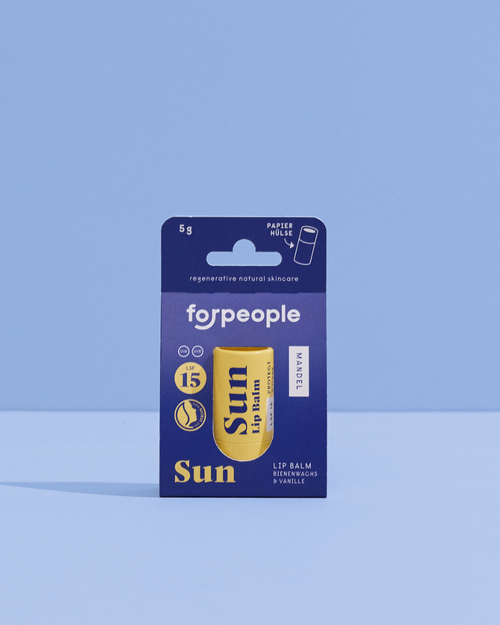
For teenagers and adults whose lips are chapped in winter but not broken, there is the Lip Balm - SPF15 Almond & Vanilla, 5 g, €7.90. According to the ingredient list it contains beeswax, sunflower oil, shea butter, almond oil, hemp seed oil, aloe vera, vitamin E, vanilla extract and the mineral UV filters zinc oxide and titanium dioxide, without essential oils. It is meant for the lips, not for the irritated skin around them; according to the product page, do not use it on broken or irritated skin. If you have a nut allergy, note the almond oil.
Read more: Dry children's hands in winter · Cold sore or dry lips? · Protecting a baby's face from the cold · Cracked corners of the mouth
From the blog: Face and lips through the winter: a daily routine
Sources
- Fonseca A, Jacob SE, Sindle A (2020): Art of prevention: Practical interventions in lip-licking dermatitis. International Journal of Women's Dermatology 6(5): 377–380. https://doi.org/10.1016/j.ijwd.2020.06.001
- Altmeyer P, Bacharach-Buhles M, Schröder-Bergmann SL: Lippenleckekzem. Altmeyers Enzyklopädie, last updated 21 Mar 2026. Accessed 29 Oct 2026. altmeyers.org
- Sil A, Priyam P (2019): Lip smacker's cheilitis. Indian Pediatrics 56(12): 1083. PMID 31884455
- DermNet: Periorificial dermatitis (Perioral dermatitis). Shah N (July 2022). Accessed 29 Oct 2026. dermnetnz.org/topics/periorificial-dermatitis
- DermNet: Atopic dermatitis. Stanway A (2004), updated by Jarrett P (February 2021), minor update May 2023. Accessed 29 Oct 2026. dermnetnz.org/topics/atopic-dermatitis
- Hartman-Adams H, Banvard C, Juckett G (2014): Impetigo: diagnosis and treatment. American Family Physician 90(4): 229–235. PMID 25250996
- DermNet: Eczema herpeticum. Lin CY (2010), updated May 2023. Accessed 29 Oct 2026. dermnetnz.org/topics/eczema-herpeticum
- Gesetz zur Verhütung und Bekämpfung von Infektionskrankheiten beim Menschen (Infektionsschutzgesetz, IfSG; German Infection Protection Act), section 34(1). Accessed 29 Oct 2026. gesetze-im-internet.de/ifsg/__34.html