



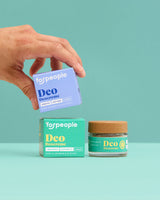
Body butter by body area: the overview
The table applies to a water-free body butter made of plant butters, oils and wax. If “Aqua” is on the list, the product is an emulsion; see Salve, balm, butter, solid cream: the difference.
| Body area | Does the body butter fit? | What to watch |
|---|---|---|
| Arms, legs, torso | yes, that is what it is made for | apply thinly, easiest on warm, still slightly damp skin |
| Elbows, knees, shins | yes | use a little more |
| Backs of the hands and fingers | yes | you can feel the film: little during the day, more in the evening |
| Heels, balls of the feet, tops of the feet | yes | apply in the evening, socks on top |
| Face | only on single dry patches, and only after a test | very little; leave out forehead, nose and chin |
| Lips and eye area | it is not meant for these | use a lip balm stick, leave out the eye area |
How the skin differs in these areas
The stratum corneum, the outermost layer of the skin, is not equally thick everywhere. In a study of 301 people it had on average 9 cell layers on the face, 13 on the trunk, 15 on the arms and legs, 47 on the palms and soles and 86 on the heel (Ya-Xian et al. 1999). Sebaceous glands are found almost everywhere on the body, except on the palms of the hands and the soles of the feet (Smith & Thiboutot 2008).
So heels and the balls of the feet have a lot of hard skin and no fat film of their own; a rich film is rarely too much there. On the face the stratum corneum is thinner and its barrier weaker than on the trunk, arms and legs, and even more so on the eyelids and the red of the lips (Tagami 2008).
Formula comparison: body butter, hand cream and foot cream
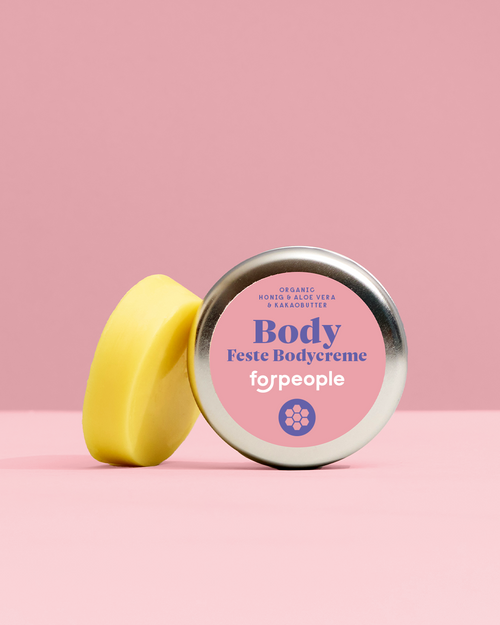
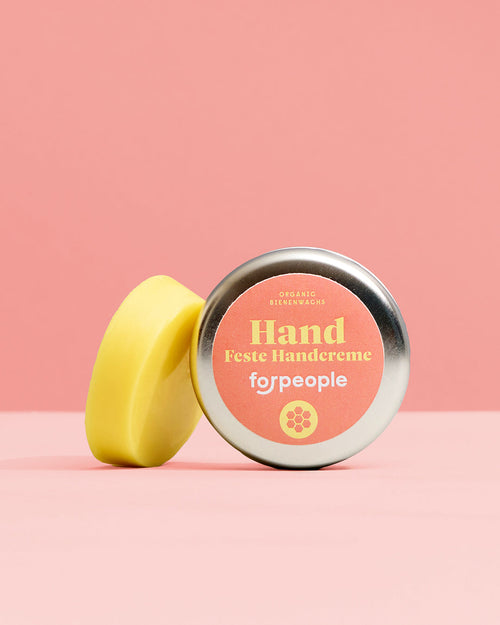
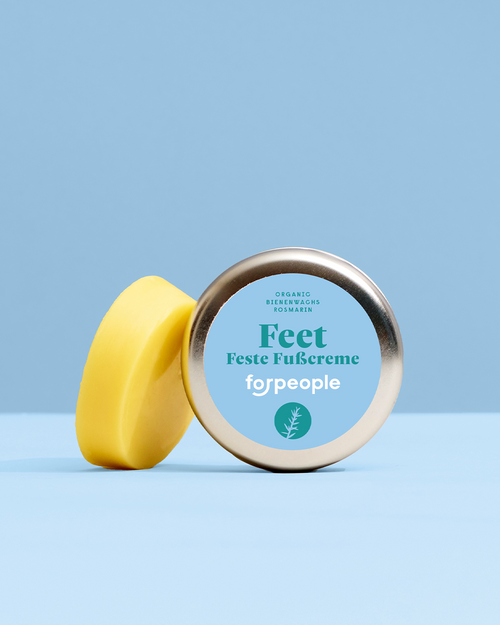
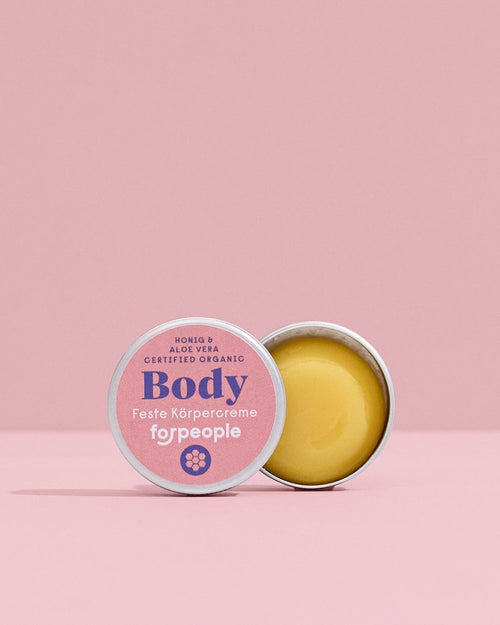
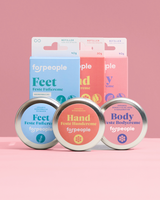
How close the three are is shown by our solid creams: Solid Body Butter - Beeswax & Aloe Vera, Solid Hand Cream - Beeswax and Solid Foot Cream – Rosemary & Sage. The details come from the ingredient lists (INCI) on the product pages, as of October 2026; for your own item, the list on the packaging applies. Ingredients are listed in descending order of weight; only below 1 % is the order free (Regulation (EC) No 1223/2009).
| Feature | Body butter | Hand cream | Foot cream |
|---|---|---|---|
| First ingredient | Cocoa butter (Theobroma Cacao Seed Butter) | Beeswax (Cera Alba) | Sunflower oil (Helianthus Annuus Seed Oil) |
| Further oils, waxes and butters, in this order | Olive oil, beeswax, sunflower oil, shea butter | Olive oil, sunflower oil | Beeswax, olive oil, shea butter |
| Plant extracts | Aloe vera | St. John's wort, aloe vera | St. John's wort, aloe vera |
| Essential oils | none | none | Rosemary, eucalyptus, clary sage |
| Fragrance components named individually | none | none | Linalool, Limonene, Geraniol |
| Water, emulsifier, preservative | not included | not included | not included |
| Entries on the list | 6 | 5 | 12 |
| Net quantity | 40 g | 30 g | 40 g |
| Metal tin with refill | yes | yes | yes |
What you can read from this:
- The same building blocks: Beeswax, olive oil, sunflower oil and aloe vera extract are in all three.
- A different order: In the body butter a plant butter comes first, in the hand cream the wax, in the foot cream a liquid oil.
- Scent: According to their lists, the body butter and the hand cream contain no essential oils and smell of their raw materials, above all of beeswax. The foot cream smells of herbs.
What the lists do not show: how much of each ingredient is included and how hard a piece is. More wax usually makes a water-free cream firmer, and a plant butter softens at skin temperature. Which of the three is harder or softer cannot be derived from the order alone; we have no measurements.
If you already have the body butter, you can use it on your hands and feet. The reverse question is answered in Can I use hand cream on my feet?
Body butter on the face?
Here the answer is more cautious. What the skin does not take up stays on it as a film. If your forehead, nose and chin tend to shine, a few drops of oil usually work better. That is our assessment, not a measured value; more in Face oil on oily skin: does that work?
Does cocoa butter promote blackheads? The figures on this come from animal tests. On the rabbit ear, cocoa butter was given a grade of 4 on a scale from 0 to 5, beeswax 0 to 2 depending on its source (Fulton 1989). Single raw materials were tested on animals, not finished products on people. When finished cosmetics were later tested for four weeks on the backs of six people, the result was: products with raw materials graded in this way do not necessarily promote blackheads themselves (Draelos & DiNardo 2006). This study is small, too. For a particular formula, neither a yes nor a no can be derived from it. How your skin reacts over a few weeks is more reliable.
If you want to try the body butter on your face:
- Test first: for a few days on a small area at the jawline. Steps: Trying a new product: how do I test it on a small area?
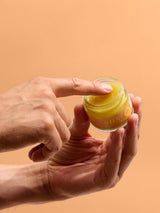
- Use very little: stroke a fingertip over the piece and dab only the dry patch.
- Leave out the eye area and the lips.
- Watch: If the skin turns red, burns or you notice more blackheads, stop.
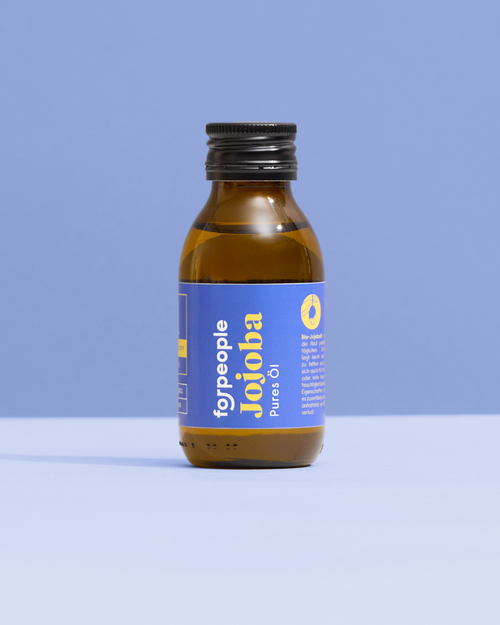
These steps are common practice. For the whole face an oil is the more obvious choice: Jojoba Oil - pure consists, according to its ingredient list, of the oil alone; a few drops on still damp skin are enough.
Lips and eye area
Lips: Some of what sits on the lips is swallowed. The EU Cosmetics Regulation requires the safety assessment of a product to take the site of application into account; it names the inadvertent swallowing of lip products as an example of its own (Regulation (EC) No 1223/2009). A body butter is intended as care for the body; for the lips there is lip balm in a stick. More in Why do lips dry out so quickly?
Eye area: The product page of our body butter says: avoid contact with the eyes; in case of eye contact, rinse thoroughly with water immediately. So leave the eyelids and the area around the eyes free.
One tin for everything when travelling
A solid butter does not leak at normal temperatures, and on a short trip one tin can be body care, hand cream and foot cream at once. On airport security: Solid Cream in Hand Luggage: Liquid or Not?
Take the butter out of the tin with clean, dry fingers, and do not leave the tin in the car or in the sun: it softens in the warmth.
The Solid Body Butter Mini – Beeswax & Aloe Vera (8 g, €5.90) has the same formula according to its ingredient list and comes in a small metal tin.
When to seek medical advice?
Cosmetics care for the skin; they do not treat diseases. Seek medical advice if the skin turns red, burns, swells or blisters after a product and this does not subside once you stop using it. The same applies if cracks on hands or heels are deep, bleed or hurt, if you suspect acne on your face, or if very dry skin does not improve despite a few weeks of care. If symptoms remain after eye contact and rinsing, have the eye examined.
Frequently asked questions
Does the body butter replace a hand cream?
On the hands it leaves the same kind of film. Our solid hand cream has beeswax in first place and the shorter list; the body butter additionally contains cocoa butter and shea butter.
Is body butter enough for rough heels that look cracked?
It keeps the hard skin supple if you apply it generously in the evening and put socks on top. It does not dissolve thick hard skin.
Does the body butter sink in on the hands, or does a film remain?
The oils spread as you massage them in; butter and wax remain on the skin as a thin film. How long you feel it depends above all on the amount.
Does the body butter smell strongly on the hands or face?
According to its ingredient list it contains no perfume and no essential oils. It smells of its raw materials, above all of beeswax, whose scent is reminiscent of honey. More in Why does beeswax smell of honey, and why does the scent change?
Can I use the body butter as a lip balm?
It is not meant for that. For the lips there is lip balm in a stick.
At forpeople
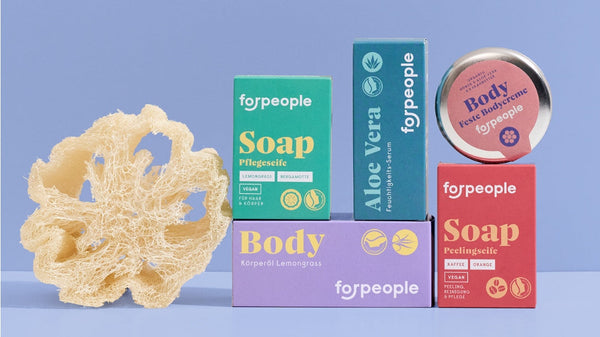
- Solid Body Butter - Beeswax & Aloe Vera, 40 g, €9.90: water-free, with cocoa butter and shea butter, without essential oils according to its ingredient list.
- Solid Hand Cream - Beeswax, 30 g, €9.90: water-free, beeswax in first place, without essential oils according to its ingredient list.
- Solid Foot Cream – Rosemary & Sage, 40 g, €9.90: water-free, with shea butter and essential oils.
- Jojoba Oil - pure, 100 ml, €16.90: a single oil with no added scent; a few drops are enough for the face.
For all of them: do not use on injured or irritated skin. If you notice a skin reaction, stop using the product.
More on this: Body Oil or Body Butter – Which One When? · Cocoa butter or shea butter: what is the difference? · Can I use body oil on my face too?
From the blog: Less in the bathroom: a skincare routine with three products
Sources
- Ya-Xian Z, Suetake T, Tagami H (1999): Number of cell layers of the stratum corneum in normal skin – relationship to the anatomical location on the body, age, sex and physical parameters. Archives of Dermatological Research 291(10): 555–559. https://doi.org/10.1007/s004030050453
- Smith KR, Thiboutot DM (2008): Thematic review series: skin lipids. Sebaceous gland lipids: friend or foe? Journal of Lipid Research 49(2): 271–281. https://doi.org/10.1194/jlr.R700015-JLR200
- Tagami H (2008): Location-related differences in structure and function of the stratum corneum with special emphasis on those of the facial skin. International Journal of Cosmetic Science 30(6): 413–434. https://doi.org/10.1111/j.1468-2494.2008.00459.x
- Regulation (EC) No 1223/2009 of the European Parliament and of the Council of 30 November 2009 on cosmetic products, Article 19(1)(g) and Annex I, Part A, point 6. OJ L 342, 22.12.2009, p. 59. https://eur-lex.europa.eu/eli/reg/2009/1223/oj
- Fulton JE Jr (1989): Comedogenicity and irritancy of commonly used ingredients in skin care products. Journal of the Society of Cosmetic Chemists 40(6): 321–333. https://library.scconline.org/v040n06/13
- Draelos ZD, DiNardo JC (2006): A re-evaluation of the comedogenicity concept. Journal of the American Academy of Dermatology 54(3): 507–512. https://doi.org/10.1016/j.jaad.2005.11.1058