





What changes over the years, and what does not
Sebum: In men, sebum output barely changes until around the age of 80; in women it declines gradually after the menopause (Pochi et al. 1979). In a series of measurements on 150 healthy women aged 18 to 80, the amount of sebum on cheek, neck, décolleté, forearm and back of the hand fell markedly with age and was lowest in those over 70 (Luebberding et al. 2013).
Lipids of the stratum corneum: On the face, hand and leg of women in different age groups, one study found markedly lower levels of all major lipid types in the stratum corneum with increasing age, ceramides in particular. In winter the levels were lower still (Rogers et al. 1996).
What hardly changes: In the series on 150 women, the water content of the stratum corneum and water loss through the skin were only weakly related to age (Luebberding et al. 2013). So what older skin lacks is mainly fat. How slowly it recovers once its barrier has been disturbed is shown by the measurements under Why do hands get drier with age?
Dry skin is common in later life but, according to one review, not a normal part of ageing. On top of the changes in the skin itself there is often a lot of heated or air-conditioned air (White-Chu & Reddy 2011). What the hormonal change contributes in women is covered under Dry skin during menopause: what changes?
Where on the body it occurs most often
In a survey of 1,710 people in 14 nursing homes and 6 hospitals in Germany, just under half had dry skin (48.8 per cent), most often on the feet and legs (42.9 per cent) (Lichterfeld et al. 2016). That applies to people in nursing homes and hospitals, not to all older people.
On the lower leg the skin produces little sebum anyway; the figures are under Why are shins dry and flaky in winter? We found no measurement series for the back and flanks; they are hard to reach and easily missed when moisturising.
What changes and what it means for your care
| What changes | What it means for your care |
|---|---|
| Less sebum on the skin surface | Add fat from outside: oil or a rich, oil-based product after showering |
| Fewer lipids in the stratum corneum, fewer still in winter | Richer care during the heating season; do not overheat rooms |
| The skin barrier is more easily disturbed | Short, lukewarm showers; soap only where it is needed |
| Back, lower legs and feet are harder to reach | Sit down to moisturise; a long-handled applicator; accept help |
| Falls often have more serious consequences in later life | Apply oil only after stepping out, on a non-slip surface |
The first three rows follow sources 1, 2, 3 and 5; everything else is common care practice.
A routine where nothing slips
- Shower briefly with lukewarm water. Armpits, groin and feet need soap; on arms and legs, water is usually enough. That is common practice, not a measured rule.
- Step out first, then moisturise. Do not apply oil in the shower or in the bath, and do not add it to bath water if you are unsteady on your feet. Even a few drops make the floor slippery, for the next person too.
- Pat dry and sit down. The skin can still be slightly damp. Sit on a stable chair, with a non-slip mat or a towel under your feet.
- Pour the oil into your hand, not onto your skin. That way nothing drips.
- Soles of the feet last, and only while seated. Put on socks or slippers before you stand up.
- Wipe your hands before you reach for a grab rail, walking stick or rollator. Wipe up drops on the floor straight away with a little washing-up liquid.
Once a day is a good start; the shins can have a second round in the evening.
Oil, butter or both, and what about urea?
Oil spreads quickly over large areas. A solid butter leaves the more noticeable film and suits small, very dry patches. The comparison is under Body Oil or Body Butter – Which One When?
Neither contains water or humectants. A position paper by German skin specialists states that care for dry skin should contain both water-binding and lipid-replenishing components, and that the drier the skin, the higher the lipid content should be, preferably as a water-in-oil cream. According to this paper, urea has by far the best evidence (Augustin et al. 2019). So oil and butter cover only the lipid side. How the two complement each other is explained under Urea or water-free cream? Rough heels and dry hands.
The review on dry skin in older people advises watching out for known contact allergens in skincare products, such as wool wax (lanolin), aloe vera and parabens (White-Chu & Reddy 2011). Essential oils can also trigger reactions. How to test beforehand is described under Trying a new product: how do I test it on a small area?
When someone else does the moisturising
In the survey from nursing homes and hospitals, people who could care for their skin themselves had dry skin less often than those who needed help (Lichterfeld et al. 2016). If you moisturise a relative: the person sits safely, you warm the oil briefly in your hands, and you take a look at the skin as you go. Show anything unusual to the GP practice or the care service.
When to seek medical advice?
Cosmetics care for intact skin; they do not treat medical conditions. Have your skin looked at by a doctor if
- it itches severely or persistently, especially at night; itching in later life has many possible causes;
- it cracks in a net-like pattern, is red or weeps; doctors then often speak of asteatotic eczema;
- it is very thin and tears at the slightest knock, or patches bleed and do not close;
- the dryness appears suddenly or began with a new medication. Do not stop anything on your own;
- a leg swells or changes colour, or new spots and other skin changes appear;
- nothing changes after a few weeks of regular care.
If you have diabetes, have your lower legs and feet checked regularly by a doctor or podiatrist. Do not apply skincare products to broken or irritated skin.
Frequently asked questions
Can I apply the oil while I am still in the shower?
Better not. Oil makes the shower tray and tiles slippery. Step out first, sit down, and then apply the oil to skin that is still slightly damp.
How do I reach my back and lower legs if bending is difficult?
You can reach your lower legs while seated, with your foot on a low stool. For the back, medical supply shops sell long-handled applicators; an oil is easier to spread with one than a solid butter.
Is oil enough, or do I need a cream with urea?
These are two jobs. Oil and butter add fat and slow evaporation. Urea binds water in the stratum corneum and is well studied. If your skin feels supple with oil, that is enough. If it stays rough and flaky, a urea lotion underneath can make sense.
Is the solid body butter too hard for stiff fingers?
It is solid at room temperature and softens with body warmth. After showering, stroke the bar straight over warm, still slightly damp skin. An oil works without any pressure.
Do the oil and the butter have a scent?
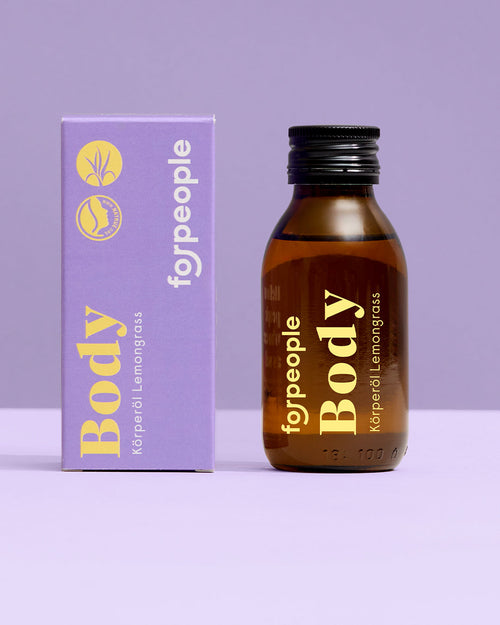
Body Oil Lemongrass contains lemongrass essential oil. According to their ingredient lists, the almond oil and the body butter contain no added essential oils. The butter smells of beeswax.
At forpeople
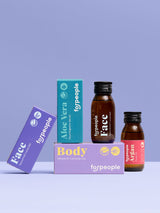
- Body Oil - Lemongrass, 100 ml, €16.90: sesame, safflower, sea buckthorn seed and sunflower oil with turmeric extract and lemongrass essential oil.
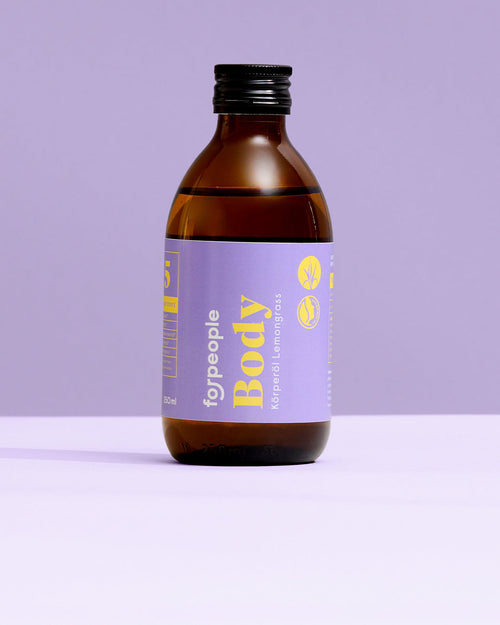
- Body Oil - Lemongrass large, 250 ml, €34.90: the same formula in the larger bottle.
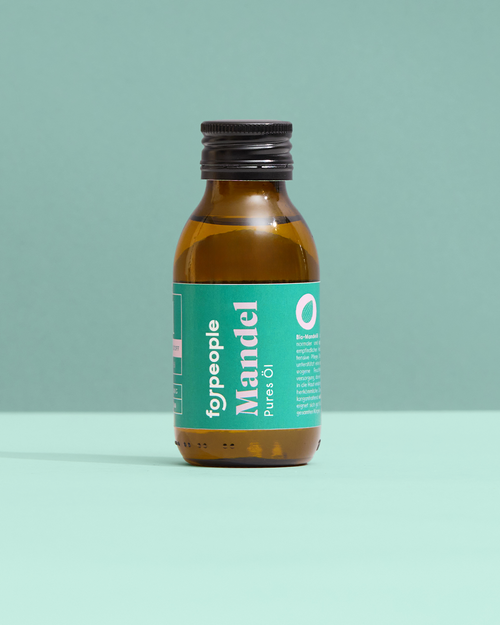
- Almond Oil - pure, 100 ml, €14.90: a single oil, with no added scent according to the ingredient list.
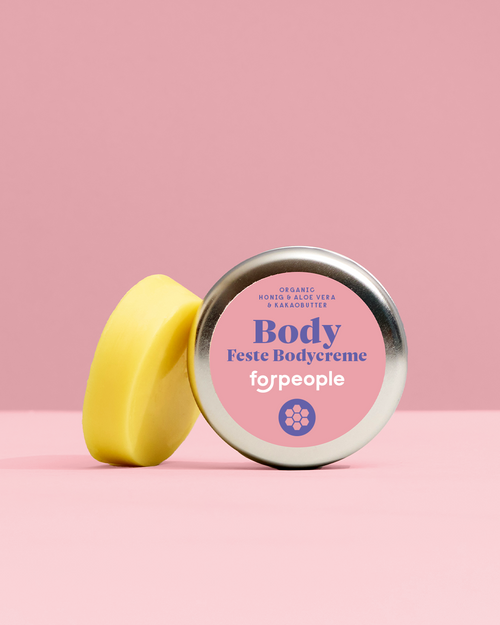
- Solid Body Butter - Beeswax & Aloe Vera, 40 g, €9.90: water-free, made of cocoa butter, olive oil, beeswax, sunflower oil, shea butter and aloe vera leaf extract; for shins and elbows.
The oils come in glass bottles; do not handle the bottle with oily hands. Do not use the products on injured or irritated skin.
More on this: Why do feet get drier with age? · How soon should you moisturise after a shower? The 3-minute rule · Do I need to soap my whole body in the shower? · Compression stockings: when should I moisturise legs and feet?
From the blog: Less in the bathroom: a skincare routine with three products
Sources
- Pochi PE, Strauss JS, Downing DT (1979): Age-related changes in sebaceous gland activity. Journal of Investigative Dermatology 73(1): 108–111. https://doi.org/10.1111/1523-1747.ep12532792
- Luebberding S, Krueger N, Kerscher M (2013): Age-related changes in skin barrier function – quantitative evaluation of 150 female subjects. International Journal of Cosmetic Science 35(2): 183–190. https://doi.org/10.1111/ics.12024
- Rogers J, Harding C, Mayo A, Banks J, Rawlings A (1996): Stratum corneum lipids: the effect of ageing and the seasons. Archives of Dermatological Research 288(12): 765–770. https://doi.org/10.1007/BF02505294
- Lichterfeld A, Lahmann N, Blume-Peytavi U, Kottner J (2016): Dry skin in nursing care receivers: A multi-centre cross-sectional prevalence study in hospitals and nursing homes. International Journal of Nursing Studies 56: 37–44. https://doi.org/10.1016/j.ijnurstu.2016.01.003
- White-Chu EF, Reddy M (2011): Dry skin in the elderly: complexities of a common problem. Clinics in Dermatology 29(1): 37–42. https://doi.org/10.1016/j.clindermatol.2010.07.005
- Augustin M, Wilsmann-Theis D, Körber A, Kerscher M, Itschert G, Dippel M, Staubach P (2019): Diagnosis and treatment of xerosis cutis – a position paper. Journal der Deutschen Dermatologischen Gesellschaft 17 Suppl 7: 3–33. https://doi.org/10.1111/ddg.13906