







The problem: sweat and odour in winter clothing
In the morning you head for the train in coat, scarf and boots at sub-zero temperatures, the heating is on in the carriage, and it is 23 degrees in the office. After half an hour the shirt under your jumper is damp, your feet are stuck in lined boots, and in the evening shoes and socks smell stronger than trainers in summer. Many people are surprised: surely you should sweat less in winter.
The switch is typical. If you come into a heated room warmly dressed from outside, you are briefly too well wrapped up, and the body cools down with sweat. Where it shows is typical too: under the arms, where thick layers sit, and on the feet, which spend all day in closed, lined shoes.
Why it happens in autumn and winter
The body cools with sweat, in winter too. Eccrine sweat glands sit almost everywhere on the body and produce most of the sweat; their job is cooling. Density is highest on the palms and soles, around 250 to 550 glands per square centimetre, and these glands respond to heat as well as to emotional stimuli (Baker 2019). Clothes that are too warm in a heated room are heat that the body has to get rid of, whatever the season outside.
Odour only develops through bacteria. Fresh sweat hardly smells. In the armpit, certain groups of bacteria, above all corynebacteria and some staphylococci, are linked to odour, and odour increases over the course of the day (Troccaz et al. 2015). On the feet, the typical smell comes mainly from isovaleric acid, which Staphylococcus epidermidis, a normal skin resident, produces from a protein building block in sweat; in people with strong foot odour, Bacillus subtilis was also frequently found (Ara et al. 2006).
Clothes and shoes hold on to moisture and odour. In a study from Ghent, polyester shirts smelled considerably more intense and less pleasant than cotton shirts after a training session; different bacteria multiplied on polyester (Callewaert et al. 2014). For the feet, the NHS advises people who sweat heavily to avoid enclosed boots and tight shoes and to wear socks that absorb moisture (NHS 2023). In winter, that is exactly what is difficult: the lined boot is closed, and the lining hardly dries overnight. What this moisture does to the skin of the feet, which then dries out again in heated air in the evening, is covered in Dry feet in winter: what causes it and what helps?
The solution step by step
| Step | What you do | Why |
|---|---|---|
| Right away, when you come in | Take off jacket, scarf and thick layer before you start to sweat | the body does not have to cool itself with sweat against the warmth of your clothes |
| Every day: washing | Wash armpits and feet with soap and dry thoroughly, including between the toes | removes sweat, odour compounds and some of the bacteria |
| Every day: deodorant | Apply deodorant to clean, dry armpits; on long days, wash in between and apply again | a deodorant without aluminium salts works on odour, not on the amount of sweat |
| Every day: socks and shoes | Change socks daily, twice a day if you sweat heavily; do not wear the same shoes two days in a row | shoes need time to dry out |
| Prevention: clothing | Layers instead of one thick jumper; next to the skin, cotton, wool or silk rather than tight synthetics | layers can be adjusted; synthetics hold on to odour more strongly |
| Prevention: boots | In the evening take out the insoles and let the boots air-dry open; wash socks at 60 degrees | damp lining and socks are a habitat for bacteria |
Sources for the table: NHS 2025: Smelly feet, NHS 2023: Excessive sweating, DermNet 2022, NHS 2025: Body odour, Callewaert et al. 2014. Taking off layers when you come in is based on practice.
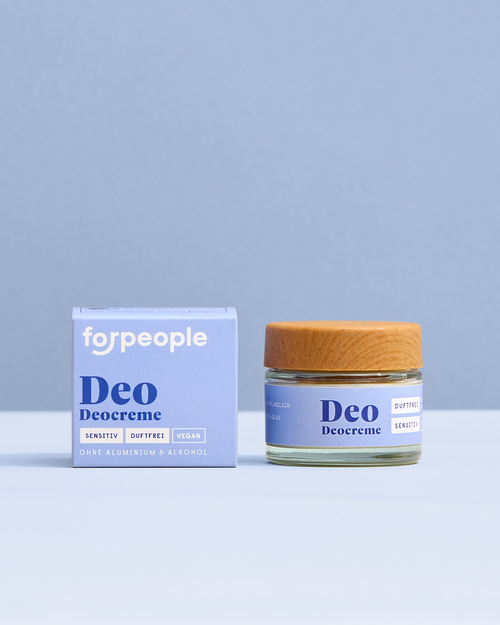
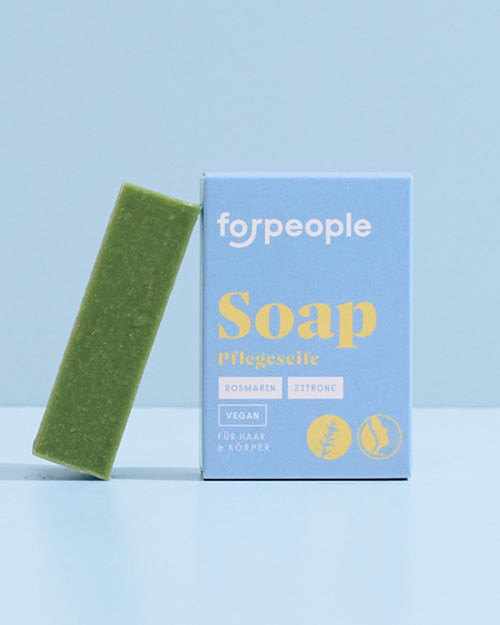
For the armpits, the Sensitive Deodorant Cream is the one to use: according to the product page, baking soda binds odour compounds and potato and corn starch absorb some moisture; it contains no aluminium salts, so it does not change the amount of sweat. According to the product page, a pea-sized amount per armpit on clean, dry skin is enough. It is not meant for the feet. For washing, a bar of soap such as the Aloe Vera Soap – Rosemary & Lemon works, which according to its product page is meant for hands, face and body. How a deodorant without aluminium works is explained in How do aluminium-free deodorants work? Odour, sweat and ingredients; how much and when, in Applying deodorant cream: how much, when, how often?
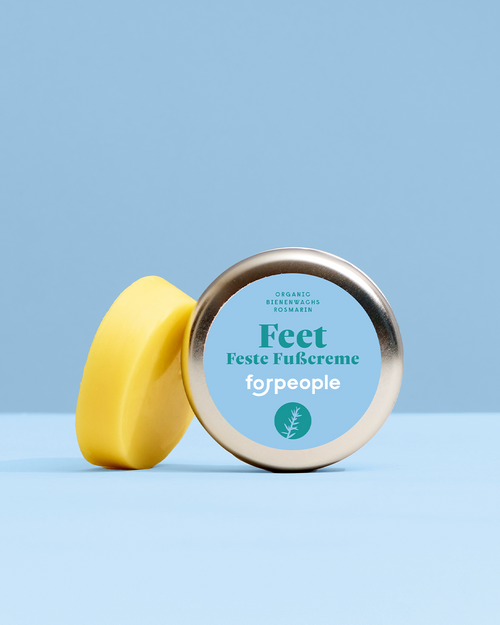
If you moisturise your feet in the evening after a day in boots, use care for dry feet, for example the Solid Foot Cream – Rosemary & Sage, on heels and balls of the feet, not between the toes. It is care, not a foot deodorant; according to the product page it is not suitable for children under 7.
What helps, and what does not really
| Measure | Assessment |
|---|---|
| Socks that absorb moisture, fresh every day | fits: this is what the NHS advises for heavy sweating |
| Alternating shoes and letting them dry between wears | fits: explicitly recommended for smelly feet |
| Tight synthetic clothing next to the skin | better not: advised against for heavy sweating; polyester held more odour in a study |
| More deodorant on top of old sweat | better not: wash, dry, apply again instead |
| Foot powder or foot antiperspirant from a pharmacy or chemist | possible: named as self-help for smelly feet |
| Drying boots on the radiator | better not: leather and glue suffer; air-dry them open instead, insoles separately |
| Drinking less so you sweat less | not sensible: sweating is for cooling; if you are dressed too warmly, you will sweat anyway |
Sources: NHS 2025: Smelly feet, NHS 2023: Excessive sweating, Callewaert et al. 2014, Baker 2019. The assessment of radiators and drinking is based on practice. If deodorant cream leaves greasy marks in jumpers and shirts, see Does deodorant cream stain? Preventing and removing marks.
Common mistakes
- Keeping the thick jumper on indoors. The body then cools with sweat that the jumper holds on to.
- The same boots every day. Lining and insole do not dry completely overnight.
- Deodorant on damp or unwashed skin. A deodorant without aluminium salts can do little against old sweat.
- Not drying between the toes after showering. It stays warm and damp there; with whitish, soggy, itchy skin between the toes, think of athlete's foot, see Dry feet or athlete's foot? Signs and when to see a doctor.
- Switching from antiperspirant to deodorant and giving up after a few days. People who do not use antiperspirant carry many times more bacteria in their armpits on average (Troccaz et al. 2015); the first weeks after switching are therefore not a fair test. More in Aluminium-free deodorant: how it works and how to switch and Deodorant or antiperspirant: what is the difference?
When to see a doctor
Sweating in winter is usually a matter of clothing. See your GP if
- you sweat when your body does not need to cool down and self-help is not enough; according to the NHS especially if it has lasted at least six months, happens at least once a week, restricts your daily life or runs in the family (NHS 2023),
- you regularly wake up sweaty at night, especially together with fever, cough, diarrhoea or unintended weight loss (NHS 2023),
- you suddenly sweat much more than usual or the odour has changed (NHS 2025),
- you are taking a new medicine and have sweated more since; do not stop it yourself (NHS 2023),
- small, crater-like pits appear on the sole of the foot, especially on the ball and heel, together with a strong odour. This can be a superficial bacterial skin infection that occurs with sweaty feet and long wear of closed footwear such as rubber boots (DermNet 2022),
- the skin between the toes is soggy, red or split, or the skin in your armpit reacts to a deodorant with redness and stinging that does not settle; on the armpit, see Baking soda in deodorant: why it's there and skin reactions.
Hot flushes and night sweats during menopause also belong with a doctor if they are a burden; what changes in the skin during this time is covered in Dry skin during menopause: what changes?
Frequently asked questions
Why do I sweat so much in winter?
Usually it is the switch between cold outside and warmth inside. If you come into a heated room in thick clothing, you are dressed too warmly and the body cools with sweat. Layers you can take off help.
Why do my winter shoes smell?
Feet have a great many sweat glands. In a closed, lined boot the sweat stays put, and skin bacteria turn it into odour compounds such as isovaleric acid. Alternate shoes, let them air-dry and change socks daily.
Which socks make sense in winter?
Socks that absorb moisture, for example made of wool or cotton, and that you change every day. If you sweat heavily, twice a day.
Can I use the deodorant cream on my feet?
Our deodorant cream is meant for the armpits. For the feet, there are foot powders and foot deodorants from pharmacies and chemists.
Why does my jumper smell even though I use deodorant?
Synthetic fabrics hold on to odour more strongly than cotton, and different bacteria live on them. If the jumper smells as soon as it warms up, it is the fabric. Wash it and wear a layer of natural fibre next to your skin.
Are night sweats in winter normal?
A duvet that is too warm or an overheated bedroom can be the reason. If you regularly wake up drenched, or fever or weight loss come with it, see your GP.
At forpeople
Our deodorant cream works on odour and does not reduce the amount of sweat; how long it lasts for you depends on sweat, clothing and temperature.
Sensitive Deodorant Cream, 50 g, €8.90: potato starch, shea butter, baking soda, sunflower oil, corn starch and candelilla wax; no added fragrance, no essential oils, no alcohol, no aluminium salts; for the armpits.
Aloe Vera Soap – Rosemary & Lemon, 75 g, €8.90: for washing armpits and feet; contains essential oils of rosemary and lemon.
Solid Foot Cream – Rosemary & Sage, 40 g, €9.90: water-free care for dry feet in the evening, not between the toes; with essential oils.
More on this: Bar soap or shower gel: differences for skin and everyday use · Humidity and skin: what dry heated air does and what helps
Sources
- Baker LB (2019): Physiology of sweat gland function: The roles of sweating and sweat composition in human health. Temperature 6(3): 211–259. https://doi.org/10.1080/23328940.2019.1632145
- Troccaz M, Gaïa N, Beccucci S, Schrenzel J, Cayeux I, Starkenmann C, Lazarevic V (2015): Mapping axillary microbiota responsible for body odours using a culture-independent approach. Microbiome 3(1): 3. https://doi.org/10.1186/s40168-014-0064-3
- Callewaert C, De Maeseneire E, Kerckhof FM, Verliefde A, Van de Wiele T, Boon N (2014): Microbial odor profile of polyester and cotton clothes after a fitness session. Appl Environ Microbiol 80(21): 6611–6619. https://doi.org/10.1128/AEM.01422-14
- Ara K, Hama M, Akiba S, Koike K, Okisaka K, Hagura T, Kamiya T, Tomita F (2006): Foot odor due to microbial metabolism and its control. Can J Microbiol 52(4): 357–364. https://doi.org/10.1139/w05-130
- NHS (2025): Smelly feet. Last reviewed 16.07.2025, accessed 29.10.2026. https://www.nhs.uk/conditions/smelly-feet/
- NHS (2023): Excessive sweating (hyperhidrosis). Last reviewed 07.11.2023, accessed 29.10.2026. https://www.nhs.uk/conditions/excessive-sweating-hyperhidrosis/
- NHS (2023): Night sweats. Last reviewed 09.11.2023, accessed 29.10.2026. https://www.nhs.uk/symptoms/night-sweats/
- Lam C (2022): Pitted keratolysis. DermNet, July 2022, accessed 29.10.2026. https://dermnetnz.org/topics/pitted-keratolysis
- NHS (2025): Body odour (BO). Last reviewed 14.05.2025, accessed 29.10.2026. https://www.nhs.uk/conditions/body-odour-bo/