The problem: your scalp itches after colouring
Touching up the roots before the holidays, at home or at the hairdresser’s: it already burns while the dye is developing, and by the evening your scalp feels tight. Or everything seems fine at first, and the next day or the day after, your hairline and the skin behind your ears itch and your eyelids are swollen. Typically, it happens suddenly after years without problems.
According to the British NHS, stinging and burning, an itchy rash, dryness, tightness and soreness, and blisters are among the common skin reactions to hair dye; symptoms can appear up to 72 hours after colouring. Severe reactions and anaphylaxis are rare (NHS: Hair dye reactions). The table helps you get your bearings. It does not replace a diagnosis; only a medical examination, with a patch test if an allergy is suspected, gives a clear answer.
| What you notice | When | What it may be |
|---|---|---|
| Burning and stinging, then a red, dry, tight scalp | While the dye is on or shortly afterwards | Irritation from the alkaline mixture with an oxidising agent (Chan & Maibach 2010) |
| Painful, weeping or crusted patch | After bleaching, often with foil or heat | Chemical or heat burn of the scalp (Chan & Maibach 2010): have it checked by a doctor |
| Itchy, dry rash on the upper eyelids or the rims of the ears | Hours to days after colouring | Mild form of a PPD allergy (DermNet: PPD allergy) |
| Marked redness, blisters and swelling of the scalp, eyelids, face and neck | Hours to days after colouring, often faster once sensitised | Severe allergic contact reaction (DermNet: PPD allergy): see a doctor the same day |
| Swelling of the lips, tongue or throat, difficulty breathing, dizziness | Usually quickly | Rarely anaphylaxis (NHS: Hair dye reactions): call 112 |
| Flakes and itching even without colouring | Regardless of when you coloured, often in winter | Dry scalp or dandruff, see Dry scalp or dandruff? Causes in winter and what helps |
Why it happens: chemistry on the scalp
Irritation from oxidation. Permanent hair dyes and bleaches work with hydrogen peroxide under alkaline conditions, bleaches additionally with persulfates. This mixture can irritate the scalp and, in extreme cases, cause chemical burns; heat burns from hot foil or the hair dryer come on top (Chan & Maibach 2010). A scalp that is already dry, scratched or irritated reacts more strongly. In winter, heated indoor air, hats and hot blow-drying dry the scalp out further. This is why packs of permanent hair dye carry the mandatory warning not to colour if your scalp is sensitive, irritated or damaged, or if you have a rash on your face (Directive 2009/134/EC).
Allergy to dyes. PPD is a precursor of permanent hair colours. It is only permitted in oxidative hair dyes with so-called couplers, and at no more than 2 % when applied (BfR 2011). PPD is considered a strong contact allergen. Among people with eczema who were patch tested for PPD in Europe, a median of about 4 % reacted (Thyssen & White 2008). An allergy usually lasts for life; once sensitised, the reaction comes faster, within hours to days, and is more severe. Those affected often also react to related substances, such as toluene-2,5-diamine, which some dyes contain instead of PPD; about half of people with a PPD allergy can use it, but only after testing first (DermNet: PPD allergy).
Severe swelling is often misjudged. In a Danish survey of 55 people with severe allergic reactions to hair dye, the face, scalp and ears were often badly swollen; this was frequently mistaken for a different kind of swelling, and five people were admitted to hospital (Søsted et al. 2002). Because the dye starts on the scalp, an allergy often shows first in places you would not link to hair dye: the eyelids, the neck and the ears. More about these areas in Dry skin on the neck, nape and décolleté: causes and what helps and Dry skin around the eyes and on the eyelids: causes and what helps.
Black henna paves the way. For “black henna” tattoos, red henna is mixed with PPD. A review estimates that about 2.5 % of people tattooed this way develop a PPD allergy; afterwards they often react to hair dyes containing PPD (de Groot 2013). This is why it is also part of the mandatory warning on the pack (Directive 2009/134/EC).
And pure henna? Red henna itself rarely causes allergies (de Groot 2013). However, authorities found henna hair dyes with added PPD and no couplers; this produces a substance with a very high allergenic potential (BfR 2011). If your scalp itches after a “henna” colour, take a close look at the ingredient list.
The solution step by step
| Step | What you do | Why |
|---|---|---|
| Straight away | If it burns strongly: rinse the dye out immediately rather than waiting for the end of the development time; wash hair and scalp thoroughly with lukewarm water and a mild shampoo | This is what the British NHS advises as soon as a reaction starts (NHS: Hair dye reactions) |
| Straight away | Do not scratch, do not blow-dry with hot air, no hair mask, no oil and no home remedies on the irritated scalp | Every new product can irritate further and makes it unclear what is having an effect |
| The same day | With swelling of the eyelids or face, blisters or weeping skin, see your GP or a dermatologist; with swelling in the mouth or difficulty breathing, call 112 | These are the signs of severe reactions (DermNet: PPD allergy), (NHS: Hair dye reactions) |
| Keep | Keep the pack or the ingredient list; ask the hairdresser for the exact colour used | The practice needs the substances for the allergy test |
| Until it is clarified | Do not colour, not even with another brand; no henna tattoos | After a reaction, the pack states explicitly: do not colour (Directive 2009/134/EC) |
| Get it checked | Patch test at a dermatologist’s | It shows whether there is an allergy to PPD or other substances (NHS: Hair dye reactions) |
| If an allergy is confirmed | No more oxidative hair dyes; tell your hairdresser; alternative colours only after testing at the practice | Even semi-permanent dyes cause reactions in about 10 % of people with a PPD allergy (DermNet: PPD allergy) |
| Prevention without an allergy | Only colour when your scalp is settled, wear gloves, apply a protective layer of petroleum jelly along the hairline, do not exceed the development time | This is what DermNet advises for people without an allergy (DermNet: PPD allergy) |
What helps – and what doesn’t
| Measure or assumption | Assessment |
|---|---|
| Self-test 48 hours before colouring, as many packs describe | Manufacturers almost always recommend it, but the instructions vary widely (Friis et al. 2018). Experts criticise that it has not been validated and leaves strong allergens on the skin in high concentrations (Thyssen et al. 2012). An unremarkable test is no assurance; if you have reacted before, do not test yourself but have it tested at the practice |
| “Ammonia-free” means no allergy risk | no: allergies are mostly triggered by PPD and related dyes, less often by preservatives or fragrances (DermNet: PPD allergy) |
| “PPD-free” is safe for people with a PPD allergy | not without a test: substitutes such as toluene-2,5-diamine work for about half of them and not for the other half (DermNet: PPD allergy) |
| Henna instead of chemical dye | pure red henna rarely triggers allergies (de Groot 2013); some “henna” dyes contained PPD (BfR 2011), so read the ingredient list |
| A black henna tattoo on holiday | no: it can trigger a lifelong PPD allergy (de Groot 2013) |
| Vinegar, essential oils or other home remedies on the irritated scalp | not studied; acid and fragrances can irritate further |
| Antihistamines or cortisone | only on the advice of a pharmacy or practice (NHS: Hair dye reactions); they do not change the fact that the dye has to be avoided in future |
Common mistakes
The mistake with the biggest consequences is to keep colouring because last time it “only itched”. With an allergy, the next reaction can come faster and be much stronger (DermNet: PPD allergy). Second: extending the development time so grey hair is covered better, or colouring a freshly scratched, flaky scalp. Third: putting swollen eyelids the day after colouring down to the eye cream. Fourth: simply switching brands after a reaction without knowing the ingredients. Fifth: not telling the hairdresser that it has itched before. And if you work in a salon, protect your own hands; what helps is in Hand care for hairdressers: what goes on your skin, and when?.
When to seek medical advice?
Call 112 straight away if your lips, mouth, tongue or throat suddenly swell, you struggle to breathe or swallow, your skin or lips turn pale or bluish, or you feel dizzy (NHS: Hair dye reactions). Do not drive yourself in this situation.
See your GP or a dermatologist the same day if your eyelids, face, ears or scalp swell, blisters form or the skin weeps (DermNet: PPD allergy).
See a practice in the next few days if
- itching and redness do not clearly ease after a few days or come back after every colouring,
- your eyelids, ear rims or neck itch and flake after colouring,
- a painful, open or crusted patch remains after bleaching,
- you have reacted to a henna tattoo before and want to colour your hair,
- a child or teenager reacts; according to the warning, permanent hair dyes are not intended for people under 16 (Directive 2009/134/EC).
Bring the pack or the ingredient list. How to proceed after a reaction to a cosmetic in general, and where to report it, is explained in Reacting to a cosmetic: what to do, where to report, returns.
Frequently asked questions
Is it normal for the scalp to burn while colouring?
A slight tingling happens. Strong burning is a sign that the mixture is irritating the skin: then rinse the dye out immediately instead of waiting for the development time to end.
What helps if my scalp itches after colouring?
Rinse thoroughly with lukewarm water and a mild shampoo, do not scratch, use no new products and do not colour again for now. If it does not improve within a few days, or blisters or swelling appear, see a practice.
What are the symptoms of a hair dye allergy?
Itching and a dry rash on the eyelids and ear rims in mild cases; in severe cases redness, blisters and marked swelling of the scalp, face, eyelids and neck, often only hours to days after colouring.
How long does the scalp itch after colouring?
Mild irritation usually eases within a few days. An allergy can last longer. Symptoms can begin up to 72 hours after colouring.
Which home remedies help?
We know of no reliable evidence for home remedies. Rinsing with a mild shampoo and leaving the scalp alone is the safe route; vinegar or essential oils can irritate further.
How can I test whether I am allergic to hair dye?
The only dependable way is a patch test at a dermatologist’s. Experts consider the self-test on the pack unreliable; after a reaction it does not replace testing at the practice.
My scalp itches after henna. Am I allergic?
Pure red henna rarely causes allergies. However, some henna hair dyes contained PPD. Check the ingredient list and have it looked at if it itches a lot or swells.
Can I colour my hair again after an allergy?
Not with oxidative hair dyes. Whether another colour is an option can only be clarified by testing at the practice.
At forpeople
We do not make hair dye, and we have no product for an irritated scalp. Until your scalp has settled, nothing new belongs there.
Coloured hair is often dry along the lengths and ends. For that, an oil whose product page explicitly mentions hair is suitable:
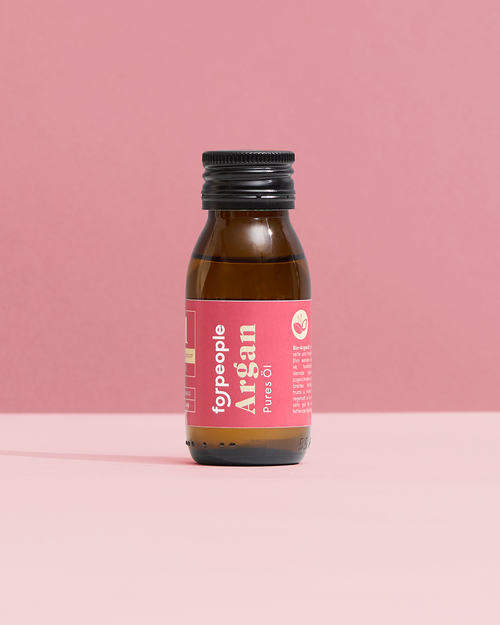
- Argan Oil - pure, 50 ml, €19.90: pure argan oil with no other ingredients; according to the product page, as a leave-in care for lengths and ends. Not on an irritated scalp.
How much oil belongs in the ends is explained in Oil for hair ends: which one, how much?. Plasters and earrings also often cause contact reactions: Plaster allergy: a rash under the plaster – irritation or allergy? and Infected ear piercing: leave the stud in or take it out, nickel or infection?. Flakes on the face and eyebrows often have other causes: Seborrhoeic dermatitis on the face: flakes on the nose, eyebrows and beard in winter.
Sources
- NHS: Hair dye reactions. Last reviewed 29.12.2025, accessed on 30.10.2026. https://www.nhs.uk/conditions/hair-dye-reactions/
- DermNet: Allergy to paraphenylenediamine. Ngan V (2002), updated by Gomez J, August 2018, accessed on 30.10.2026. https://dermnetnz.org/topics/allergy-to-paraphenylenediamine
- Commission Directive 2009/134/EC of 28 October 2009 amending Annex III to Council Directive 76/768/EEC concerning cosmetic products (warnings for hair dyes). OJ L 282 of 29.10.2009. Accessed via umwelt-online on 30.10.2026 (German text). https://umwelt-online.de/recht/eu/08_09/09_0134r.htm
- German Federal Institute for Risk Assessment (BfR) (2011): Henna-Haarfärbemittel mit p-Phenylendiamin (PPD) stellen ein Gesundheitsrisiko dar [Henna hair dyes containing PPD pose a health risk]. Opinion No. 024/2011 of 19 January 2011. https://www.bfr.bund.de/cm/343/henna_haarfaerbemittel_mit_p_phenylendiamin_ppd_stellen_ein_gesundheitsrisiko_dar.pdf
- de Groot AC (2013): Side-effects of henna and semi-permanent “black henna” tattoos: a full review. Contact Dermatitis 69(1): 1–25. https://doi.org/10.1111/cod.12074
- Thyssen JP, White JML (2008): Epidemiological data on consumer allergy to p-phenylenediamine. Contact Dermatitis 59(6): 327–343. https://doi.org/10.1111/j.1600-0536.2008.01427.x
- Søsted H, Agner T, Andersen KE, Menné T (2002): 55 cases of allergic reactions to hair dye: a descriptive, consumer complaint-based study. Contact Dermatitis 47(5): 299–303. https://doi.org/10.1034/j.1600-0536.2002.470508.x
- Thyssen JP, Søsted H, Uter W et al. (2012): Self-testing for contact sensitization to hair dyes – scientific considerations and clinical concerns of an industry-led screening programme. Contact Dermatitis 66(6): 300–311. https://doi.org/10.1111/j.1600-0536.2012.02078.x
- Chan HP, Maibach HI (2010): Hair highlights and severe acute irritant dermatitis (“burn”) of the scalp. Cutaneous and Ocular Toxicology 29(4): 229–233. https://doi.org/10.3109/15569527.2010.509852
- Friis UF, Goossens A, Giménez-Arnau AM et al. (2018): Self-testing for contact allergy to hair dyes – a 5-year follow-up multicentre study. Contact Dermatitis 78(2): 131–138. https://doi.org/10.1111/cod.12882