









Why short beard hairs scratch
Beard hair is built differently from scalp hair. In a comparative study, scalp hairs had smaller and rounder cross-sections. Beard hairs showed irregular, oblong and three-lobed shapes and had more layers in the outer cuticle (Tolgyesi et al. 1983). A review on shaving puts the diameter of beard hair at about twice that of scalp hair. According to it, dry beard hair is very stiff: the force needed to cut through it is compared there to that for a copper wire of the same thickness (Maurer et al. 2016).
Three things come together in the first weeks:
- The cut edge. A blade or trimmer cuts the hair straight across or at an angle. What remains is an edge instead of the fine tip of a hair that has never been cut.
- The length. A stiff hair of a few millimetres hardly bends. It sticks out and presses its end against skin, collar, scarf and pillow. On the neck, beard hairs emerge from the skin at a particularly low angle (Maurer et al. 2016), and that is also where your collar sits.
- The hair root. The hair follicle is surrounded by nerves and senses mechanical stimuli (Maurer et al. 2016). When the short hair moves, you feel it at the root: as tingling or scratching.
Many people also describe dry, tight skin under the beard during this time. A likely reason is that skin care now gets caught in the stubble instead of reaching the skin. That is experience, not a measurement.
The first weeks at a glance
Beard hair grows about 0.3 to 0.5 millimetres a day on average (Maurer et al. 2016). The lengths in the table are calculated from that; your beard may grow faster or more slowly. The two right-hand columns are based on experience, not on measurements.
| Period | Length, calculated | What happens | What helps |
|---|---|---|---|
| First two weeks | up to about 4 to 7 mm | The stubble is short and stiff. Scratching and tingling are at their strongest, especially on the neck. | Do not scratch. Wash with lukewarm water, pat dry, massage two to three drops of oil in down to the skin. Wear loose collars. |
| Weeks three to six | up to about 1 to 2 cm | The hairs become long enough to bend and lie flat. The skin underneath is harder to reach. | Massage oil in against the direction of growth, then comb or brush. Trim only the outlines. |
| From about two months | from about 2 to 3 cm | The hairs lie flat. The scratchiness usually eases; shape and dry ends become more important. | Comb or brush daily and work oil into the lengths too. A balm gives more hold. |
What softens a beard
Water. Beard hair takes up water and becomes more pliable: when hydrated it loses 30 to 65 per cent of its stiffness, according to the review (Maurer et al. 2016). That is why your beard feels softer after a shower than in the evening. Once the hair dries, the effect wears off.
Oil. Oil does not make the hair thinner; it puts a lubricating film on the surface. A review of hair cosmetics describes how oils adsorb to the cuticle, reduce friction and lubricate the hair shaft. In a study cited there, wet hair treated with oil could be combed with less force (Gavazzoni Dias 2015). That was scalp hair; for a beard it seems likely that the edges then glide rather than catch. On the skin, the same film slows evaporation, see Occlusion and TEWL: how a wax film protects your skin.
Comb or brush. Both spread the oil to the tips and lay the hairs in one direction. Hairs that lie flat press their ends against the skin less.
Time. Every trim creates fresh edges. Let the main area grow for the first weeks and trim only the lines on your neck and cheeks. For shaving the outlines, see Shaving with oil instead of foam: does that work?
Washing and oiling: the routine
Washing too thoroughly makes hair rough. A review of hair cleansing describes hair stripped of all its sebum as harsh, rough, dull and prone to static (Draelos 2010). For a beard that means: wash gently and no more often than necessary. More on this under Washing your beard: how often, and does soap work?
- Wash your beard with lukewarm water and rinse it thoroughly.
- Pat it dry with a towel without rubbing. It can still be slightly damp.
- Rub two to three drops of oil between your palms. Use a little more for a longer beard.
- Massage the oil in with your fingertips against the direction of growth, down to the skin, then stroke the beard flat in the direction of growth.
- Comb or brush it through.
If the beard still looks clearly shiny after a few minutes, it was too much oil; it leaves the beard stringy and can mark your collar. Which oils are suitable, how deeply they penetrate the hair and when a balm is more practical is covered in Beard balm or beard oil: what is the difference?
When to seek medical advice?
Scratching, tingling and tightness in the first weeks are a nuisance, but they usually ease as the beard gets longer. Seek medical advice if the skin under your beard stays red or flaky for a longer period, if pustules, painful bumps or weeping areas appear, if hairs grow inwards or if bald patches form in the beard. An oil is not a treatment for that. Do not apply skin care to injured or irritated skin. If your skin reacts to a product, stop using it.
Frequently asked questions
How long does a new beard itch and scratch?
From experience it is strongest in the first two weeks. As soon as the hairs are long enough to lie flat, it usually eases. There is no fixed time, because hair thickness, direction of growth and skin differ from person to person. If it stays unchanged for weeks, have a doctor look at the skin.
Does oil make a beard grow faster or denser?
No. Oil cares for hair and skin. It has no proven effect on growth.
Does frequent shaving make beard hairs thicker?
No. In one trial, five men shaved one leg every week for several months. Afterwards the width and growth rate of the individual hairs did not differ from the unshaved leg (Lynfield & Macwilliams 1970). Stubble feels coarser because it is short and has a cut edge.
Can I use pure jojoba oil as a beard oil?
Yes. Jojoba oil is a common base for beard oils. It is thin and does not feel very greasy. We do not market it as a beard oil; it is a pure care oil for skin and hair.
I would like some scent in my beard. What should I watch for?
Your beard sits right under your nose, so a scent is there all the time. Essential oils can also trigger skin reactions. Face Oil - Lavender contains essential lavender oil; its ingredient list names linalool and limonene. If you want to avoid that, use a pure oil. More on this: Without fragrance and essential oils: ingredients at a glance.
At forpeople
We do not offer a dedicated beard oil. Plant oils of the kind commonly used as a base for beard oils are available from us pure and as a ready-made blend for the face:
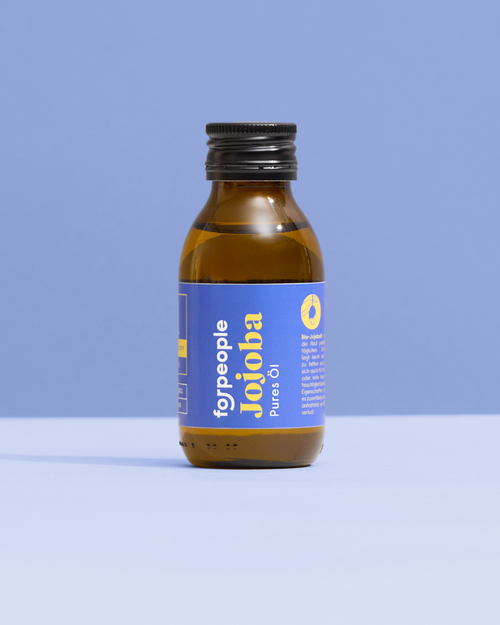
- Jojoba Oil - pure, 100 ml, €16.90: according to the ingredient list, jojoba oil only, without essential oils. Thin, for short beards and the skin underneath.
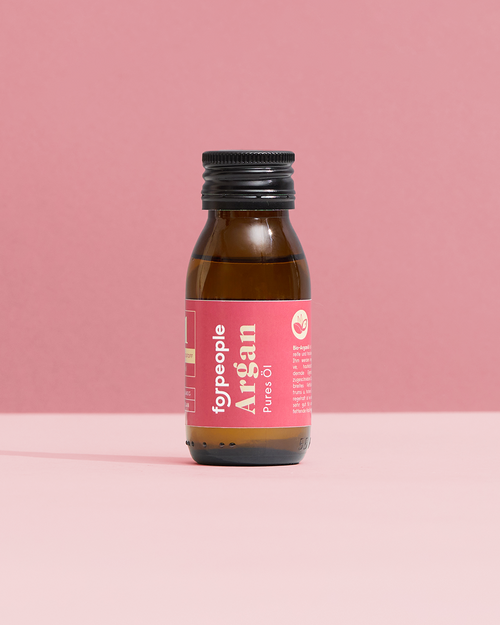
- Argan Oil - pure, 50 ml, €19.90: also a single oil with no added scent, slightly richer in feel than jojoba oil.
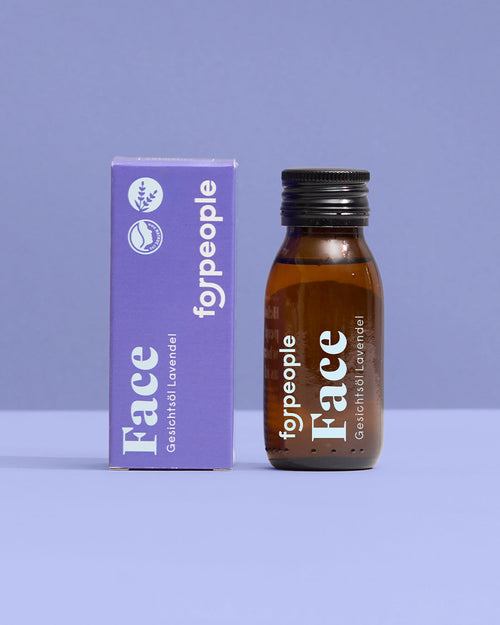
- Face Oil - Lavender, 50 ml, €21.90: a blend of argan, rosehip, jojoba, borage and hemp oil with essential lavender oil. A face oil for anyone who wants a scent.
- Care Oil Set – 4 Organic Oils for Face, Body & Hair, €69.90: argan, jojoba, almond and rosehip oil, one bottle of each, for trying them out.
For all four, the product pages say: avoid contact with the eyes and do not use on injured or irritated skin. If you notice a skin reaction, stop using the product.
More on this: Beard balm or beard oil: what is the difference? · Face care for men: what does the skin really need? · After shaving: what does facial skin need? · Caring for a shaved head: what does the scalp need?
From the blog: Face & Body Oils: Which Oil Suits Which Skin Type?
Sources
- Tolgyesi E, Coble DW, Fang FS, Kairinen EO (1983): A comparative study of beard and scalp hair. Journal of the Society of Cosmetic Chemists 34(7): 361–382. https://library.scconline.org/v034n07/25
- Maurer M, Rietzler M, Burghardt R, Siebenhaar F (2016): The male beard hair and facial skin – challenges for shaving. International Journal of Cosmetic Science 38 Suppl 1: 3–9. https://doi.org/10.1111/ics.12328
- Lynfield YL, Macwilliams P (1970): Shaving and hair growth. Journal of Investigative Dermatology 55(3): 170–172. https://doi.org/10.1111/1523-1747.ep12280667
- Gavazzoni Dias MF (2015): Hair cosmetics: an overview. International Journal of Trichology 7(1): 2–15. https://doi.org/10.4103/0974-7753.153450
- Draelos ZD (2010): Essentials of Hair Care often Neglected: Hair Cleansing. International Journal of Trichology 2(1): 24–29. https://doi.org/10.4103/0974-7753.66909