







The problem: the nail looks different – but why?
The big toenail has turned yellowish, it crumbles at the edges, perhaps it is lifting at the front. Or a fingernail has a dark spot, pits, a white edge. The first thought is often nail fungus, and pharmacies sell lacquers and kits for it. But many changes look deceptively like a fungus. A review states that a diagnosis without laboratory confirmation is highly inaccurate and advises ruling out other nail disorders before treating for fungus; otherwise misdiagnosis, unnecessary side effects and progression of the actual condition can follow (Lee & Lipner 2022).
How common is nail fungus anyway? Estimates suggest that 3 to 12 per cent of the population are affected, older people more often than younger ones (IQWiG: Nagelpilz). In medical practice it is the most common nail disorder and accounts for about 50 per cent of nail findings (Lee & Lipner 2022). Conversely, this means: about half of the nails shown in practice have a different cause.
Why fungus and other causes look so similar
Nail fungus. The nails turn whitish-yellow to brownish, become brittle, thick or misshapen, and the affected part can lift off the nail bed. The big toes are affected most often, and the fungus starts at the front or side edge; a special form produces white patches on the surface (IQWiG: Nagelpilz). In Europe the cause is mostly dermatophytes, a group of skin fungi (Nenoff et al. 2023). Many people with nail fungus also have athlete's foot; risk factors include athlete's foot, swimming pools and saunas, nail injuries, artificial fingernails, shoes that are too tight, psoriasis, poor circulation, for example with diabetes, and a weakened immune system. On the hands it mainly affects people whose hands are often wet (IQWiG: Nagelpilz).
Psoriasis of the nails. It can show on the nails and look like a fungus there (IQWiG: Nagelpilz). Typical clues are pits in the nail plate, yellowish-reddish spots under the nail that look like a drop of oil, fine red splinter haemorrhages, thickening and lifting from the nail bed (Lee & Lipner 2022). Almost everyone with long-standing psoriasis of the skin has nail changes at some point; psoriasis only on the nails, without skin or joints, is less common. And both can occur together: nail fungus can accompany or precede psoriasis of the nails (DermNet: Nail psoriasis).
Pressure and knocks. Friction in the shoe is a common reason for nail changes that look like fungus (Lee & Lipner 2022). Repeated pressure, for example from tight or ill-fitting shoes, can collect blood under the nail, often without you remembering a reason (DermNet: Subungual haemorrhage). Long runs, downhill hikes and toe boxes that are too short are typical situations; this is our assessment. An overly vigorous manicure or cleaning under the nail with sharp objects can also lift the nail from the nail bed (AAD).
A bruise under the nail. It colours the nail purple to black. After a few weeks a clear edge appears at the back, and the discolouration grows out towards the front with the nail (DermNet: Subungual haemorrhage). That is exactly what distinguishes it from a dark streak coming from the nail root: if the colour does not grow out, a melanoma must be ruled out (Lee & Lipner 2022).
Nail polish. Red nail polish without a base coat and smoking can stain nails yellow (AAD). This staining sits in the upper layers, and the nail stays smooth and firm. If nails turn yellow, thicken and hardly grow any more, however, they should be looked at by a doctor (AAD).
The "ram's horn nail". A very thick, hard, curved nail, often on the big toe, is medically called onychogryphosis; it can run in families, develop with age or after injuries, or be linked to psoriasis or circulation problems (AAD), (DermNet: Nail terminology). Cutting and treating it belongs in the hands of a podiatrist or dermatologist (AAD).
Green or greenish black. A greenish-black discolouration can come from bacteria under the nail (AAD); specialist sources also list it as something that can be confused with fungus (DermNet: Fungal nail infections).
And winter? In lined boots, feet stay warm and damp for hours, which fungi like (NHS: Fungal nail infection). Add indoor pools and saunas, pressure from new winter shoes and dark polish over the holidays. This is our assessment.
The following table sorts typical clues according to the specialist sources named. It is a guide, not a diagnosis; only a medical examination with a nail sample gives clarity.
| What you see | More likely | Note |
|---|---|---|
| Yellowish-brown, thick, crumbly, starting at the front or side edge, often the big toe, plus athlete's foot | nail fungus | have a sample examined in a laboratory |
| Chalky white patches on the surface | superficial nail fungus | can be scraped off and examined |
| Pits, "oil drop" under the nail, several fingernails, scaly skin | psoriasis of the nails | fungus can be present as well |
| One toenail changed after a run, a hike or tight shoes | pressure and friction | check your shoes, watch how it develops |
| Purple to black, clear edge at the back, grows forward | bruise | grows out; if not, have it checked |
| Evenly yellow after red polish, nail smooth and firm | polish staining | take a break from polish, grows out |
| Brown to black lengthwise streak | often harmless, rarely melanoma | always have it looked at by a dermatologist |
Sources for the table: IQWiG: Nagelpilz, Lee & Lipner 2022, DermNet: Fungal nail infections, DermNet: Nail psoriasis, DermNet: Subungual haemorrhage, AAD.
The solution step by step
| Step | What you do | Why |
|---|---|---|
| Right away | Remove polish, look at all finger- and toenails, take a photo with the date | Whether one nail or many are affected and whether the change grows out are important clues |
| Right away | Check between your toes: does the skin there itch, flake or crack? | Nail fungus often develops as a result of athlete's foot |
| Before any treatment | Have a nail sample taken at your GP or a dermatologist | Microscopy, culture or a molecular test show whether it is a fungus and which one |
| Every day | Dry your feet well after showering, also between the toes; change socks every day | Fungi grow mainly in damp conditions |
| Every day | Wear airy shoes that are not too tight and change them every day | Less pressure on the toenails, shoes can dry out |
| Prevention | Cut toenails straight and not too long; wear flip-flops at pools and saunas; do not share towels and socks | Protects against injuries and infection |
| If it is fungus | Discuss treatment with your doctor or pharmacist and stick with it; wash socks, towels and bed linen at 60 degrees or more | Treatment can take up to a year; spores survive in laundry and shoes |
Sources for the table: Nenoff et al. 2023, IQWiG: Nagelpilz, Lee & Lipner 2022, NHS: Fungal nail infection. The photo is our suggestion.
What athlete's foot looks like between the toes and on the sole is explained in Dry feet or athlete's foot? Signs and when to see a doctor; round, scaly patches on the body in Recognising fungal skin infections. If you run a lot, you will find tips on shoes and toenails in Foot care for runners.
What helps – and what doesn't
| Product or habit | Assessment |
|---|---|
| Nail sample before treatment | useful; without a laboratory result the diagnosis is uncertain |
| Antifungal products just in case | rather not; with psoriasis, pressure or a bruise they do not work and delay the right treatment |
| Tea tree oil or vinegar | not tested in good studies |
| Laser treatment | effectiveness not proven by good studies; you pay for it yourself |
| Filing down or cutting deep into a thickened nail yourself | rather not; risk of injury, risky with diabetes; this belongs with a podiatrist |
| Painting over a discoloured nail | rather not, as long as the cause is unclear; the change goes unnoticed |
| Dry feet, changing shoes, flip-flops | useful for prevention, even though this has not been tested in meaningful studies |
| Base coat under dark polish | useful against polish staining |
Sources: IQWiG: Nagelpilz, IQWiG: Lack, Creme oder Tabletten?, Lee & Lipner 2022, AAD. The entries on filing down and painting over are our assessment.
Common mistakes
- Treating for months against a fungus that isn't there. In medical practice, about half of abnormal nails have a different cause.
- Giving up too early. If it is a fungus, the nail only looks good once it has grown back normally; on the big toe that can take a year.
- Forgetting the athlete's foot. If the skin between the toes is not treated as well, the nail can become infected again.
- Hiding dark discolouration under polish. A bruise grows out, a melanoma does not.
- Carrying on with tight running shoes. Pressure on the nail keeps the change going.
- Cutting, filing or grinding yourself with diabetes. Small injuries go unnoticed when feeling is reduced.
When to see a doctor
Your first port of call is your GP or a dermatologist; pharmacies can also advise. Have your nails looked at before you use anything against fungus, and especially if
- you have diabetes, poor circulation in your legs or a weakened immune system; nail problems can then have more serious consequences (NHS: Fungal nail infection), (IQWiG: Nagelpilz); more on foot care in Dry skin with diabetes: causes and care for feet and legs,
- a brown to black streak or spot appears that does not grow out with the nail (Lee & Lipner 2022); warning signs are listed in Ridges in your fingernails,
- the nail hurts or the skin around it turns red, swells or produces pus, see Inflamed nail fold (paronychia): how to recognise it, what helps and when to see a doctor,
- the change spreads to other nails or pharmacy products have not worked (NHS: Fungal nail infection),
- you notice pits in the nail, scaly patches of skin or joint pain; more in Psoriasis in winter,
- a nail hurts badly after a knock or the finger or toe is swollen; a bone may also be injured (DermNet: Subungual haemorrhage),
- a child is affected, or you are pregnant or breastfeeding; many antifungal products are then not automatically suitable (NHS: Fungal nail infection).
The diagnosis is based on a sample of nail clippings examined under the microscope, in a culture or with a molecular test (Nenoff et al. 2023). A culture can take a few weeks (DermNet: Fungal nail infections). According to the German guideline, treatment depends on the extent, with a medicated nail lacquer or additionally with tablets (Nenoff et al. 2023); which products are suitable is decided by your doctor and pharmacist.
Frequently asked questions
Nail fungus or psoriasis: how can I tell the difference?
Pits, oil-drop-like discolouration and changes on several fingernails point more towards psoriasis; a yellowish, crumbly big toenail with athlete's foot more towards fungus. Both can occur together; only a nail sample gives clarity.
Nail fungus or a pressure mark?
After tight shoes, long runs or a knock, often only one toenail is discoloured. A bruise is purple to black and grows out. If the nail stays yellow, thick and crumbly, have a sample examined.
Is it nail fungus or staining from nail polish?
Polish staining is usually evenly yellowish, the nail stays smooth and firm and grows normally. If it gets thick, crumbly or lifts off, something else is more likely behind it.
What is a ram's horn nail?
A very thick, hard, often curved toenail. It often develops with age, after injuries or with psoriasis and circulation problems. It should be cut by a podiatrist.
Nail fungus or just dry nails?
Dry nails split into fine layers at the front but stay thin and pale. Fungus tends to make nails thick, discoloured and crumbly. How water and polish remover make nails brittle is explained in Brittle fingernails.
Does nail fungus go away on its own?
Rarely. Untreated, it can spread and destroy the nail, but in people who are otherwise well it usually has no serious consequences.
Is nail fungus contagious?
Yes, fungal spores can be passed on via floors, shoes, socks and towels. So wear flip-flops in shared showers, do not share anything and wash laundry at 60 degrees or more.
How long does it take for the nail to look normal again?
As long as it takes to grow back. On the big toe this can take a year; on the fingers it is quicker.
At forpeople
We have no product against nail fungus, psoriasis or bruising; that belongs in medical hands. Our foot cream is intended for dry heels and, according to its product page, does not belong on injured or irritated skin; do not apply it between the toes either. For dry fingernails without other changes and brittle cuticles, the product page of our jojoba oil names this care:
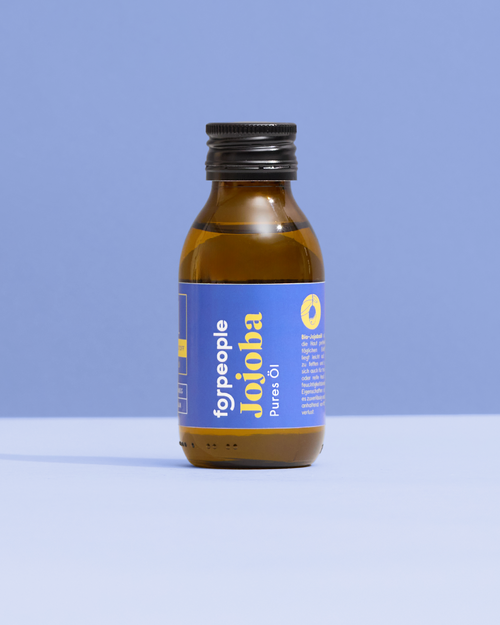
Jojoba Oil - pure, 100 ml, €16.90: pure jojoba oil without added fragrance; one drop for several nails. Not on a nail whose cause is still unclear.
More on this: White spots on your nails: not a calcium deficiency · Skin peeling between the toes · Corn, callus or plantar wart?
Sources
- Nenoff P, Reinel D, Mayser P, Abeck D, Bezold G, Bosshard PP et al. (2023): S1 Guideline onychomycosis. Journal der Deutschen Dermatologischen Gesellschaft 21(6): 678–692. https://doi.org/10.1111/ddg.14988
- Institute for Quality and Efficiency in Health Care (IQWiG): Nagelpilz (nail fungus). gesundheitsinformation.de, updated 9 July 2025, accessed 30 October 2026. https://www.gesundheitsinformation.de/nagelpilz.html
- IQWiG: Nagelpilz – Lack, Creme oder Tabletten? (nail fungus – lacquer, cream or tablets?). gesundheitsinformation.de, updated 9 July 2025, accessed 30 October 2026. https://www.gesundheitsinformation.de/nagelpilz-lack-creme-oder-tabletten.html
- Lee DK, Lipner SR (2022): Optimal diagnosis and management of common nail disorders. Annals of Medicine 54(1): 694–712. https://doi.org/10.1080/07853890.2022.2044511
- DermNet: Fungal nail infections. Hillan A (2022), accessed 30 October 2026. https://dermnetnz.org/topics/fungal-nail-infections
- DermNet: Nail psoriasis. Ngan V (2003), Oakley A (2016), updated 2021, accessed 30 October 2026. https://dermnetnz.org/topics/nail-psoriasis
- DermNet: Subungual haemorrhage. Phillips M (March 2020), accessed 30 October 2026. https://dermnetnz.org/topics/subungual-haemorrhage
- American Academy of Dermatology (AAD): 12 nail changes a dermatologist should examine. Accessed 30 October 2026. https://www.aad.org/public/everyday-care/nail-care-secrets/basics/nail-changes-dermatologist-should-examine
- NHS: Fungal nail infection. Last reviewed 27 March 2024, accessed 30 October 2026. https://www.nhs.uk/conditions/fungal-nail-infection/
- DermNet: Nail terminology. Oakley A (1997), reviewed by Coulson I (2023), accessed 30 October 2026. https://dermnetnz.org/topics/nail-terminology