The problem: rough bumps on fingers and hands – and more keep appearing
At first it is a small, hard bump on a finger that you take for a callus. A few weeks later a second one sits next to it, a third at the edge of the nail, and your child suddenly has warts on several fingers. They usually do not hurt, some itch or press (IQWiG: Warts). But they are a nuisance, when shaking hands, typing, or simply looking at your own hands.
Warts are very common. In studies up to a third of children and adolescents had warts; in adults the estimate is 3 to 5% (IQWiG: Warts). In a Dutch study of primary schoolchildren, 33% had warts, 9% on the hands (van Haalen et al. 2009).
The table shows which skin changes on the hands are typically meant. It is a guide, not a diagnosis: only a medical examination gives certainty.
| What you see | What it may be |
|---|---|
| A hard bump the size of a pinhead to a pea with a rough, scaly surface, often on the back of the hand, the fingers or the edge of the nail; sometimes small black dots | common wart (IQWiG: Warts) |
| A wart right at the edge of the nail or underneath it, the nail becomes uneven or lifts | wart at the nail; it can damage the nail (DermNet: Viral wart) |
| Small, only slightly raised, often light brown bumps of a few millimetres, on the hands, forearms or face | plane (flat) warts (IQWiG: Warts) |
| Skin changes that only appear in older age and stay | so-called age warts; harmless and not contagious (IQWiG: Warts) |
| A lump that grows, bleeds or changes | have it checked; rare forms of skin cancer can resemble warts (IQWiG: Warts) |
Warts on the sole of the foot, corns and calluses are covered in Corn, callus or plantar wart? How to tell them apart; this page is about the hands.
Where warts come from – and why winter hands are more vulnerable
Viruses that come through cracks. Warts are caused by human papillomaviruses, of which there are more than 100 types. They enter the skin through small injuries and fine cracks and stimulate the cells there to multiply; this creates the thickened horny skin of the wart. They are passed on mainly through direct skin contact, but also via objects such as towels. Infection is easier when the skin is moist and softened or injured (IQWiG: Warts). It can take months until a wart becomes visible (IQWiG: Warts); that is why it is rarely possible to say where it came from.
In winter the skin cracks more easily. Low temperatures and dry air weaken the skin barrier, and the skin becomes more susceptible to mechanical stress (Engebretsen et al. 2016). On the hands this shows up as split fingertips, cracked knuckles and torn cuticles. Each of these small cracks is a possible entry point. How to care for cracked fingertips is explained in Cracked, split fingertips: causes and what helps; for cuticles, see Dry, torn cuticles: how to care for them.
Why more and more appear. Scratching or picking at a wart can carry the viruses to other areas of skin, including under the nail (DermNet: Viral wart). Biting your nails and sucking fingers with warts on them are therefore things you should avoid (NHS: Warts and verrucas). People with atopic eczema, whose skin barrier is already impaired (DermNet: Viral wart), people with a weakened immune system and people who handle meat at work are also at higher risk (IQWiG: Warts).
Infection in families and classes. In primary schoolchildren the risk of new warts was about twice as high if someone in the family had warts, and it rose with the proportion of children with warts in the class (Bruggink et al. 2013b). Swimming pools, communal showers and walking barefoot, on the other hand, were not linked to warts in another study (van Haalen et al. 2009).
The solution step by step
| Step | What you do | Why |
|---|---|---|
| Straight away | Do not scratch, pick, cut off or bite your nails; wash your hands after touching the wart | This way you do not spread the viruses to other areas (DermNet: Viral wart), (IQWiG: Warts) |
| At home | Do not share towels and gloves; do not use files or pumice stones that have been used on a wart for other areas | Wart viruses can also be passed on via objects (IQWiG: Warts) |
| Every day in winter | Dry your hands well after washing and care for the dry, intact skin around the wart, not the wart itself; wear gloves in the cold and for wet work | Viruses enter through cracks, and softened or injured skin makes infection easier (IQWiG: Warts); dry cold makes the skin more prone to cracking (Engebretsen et al. 2016) |
| If it does not bother you | Wait and watch | Warts do not have to be treated; in about half of schoolchildren they had disappeared after one year, and after two years about 70% were free of warts (IQWiG: Warts), (Bruggink et al. 2013a) |
| If it bothers you | Ask at the pharmacy for a salicylic acid solution and apply it exactly as described in the package leaflet, or have it frozen by a dermatologist; do not treat the face yourself | These are the two main treatments used (IQWiG: Warts); the evidence for salicylic acid is more consistent, but the effect is limited; in one study freezing was better than salicylic acid and placebo only for warts on the hands (Kwok et al. 2012); pharmacy products should not be used on the face (NHS: Warts and verrucas) |
| Check first | With diabetes, nerve damage, a weakened immune system, during pregnancy and breastfeeding, get medical advice first | With nerve damage, for example due to diabetes, an examination beforehand makes sense, and pregnant and breastfeeding women are advised against treatment as a precaution (IQWiG: Warts) |
No treatment removes every wart, and viruses can remain from which a new wart grows (IQWiG: Warts). Treatment with salicylic acid takes several weeks; freezing is repeated at intervals of at least one week and can hurt, cause redness and form a blister (IQWiG: Warts).
What helps – and what tends not to
| Measure or home remedy | Assessment |
|---|---|
| Waiting | reasonable for harmless warts; in one study younger children became free of warts more quickly (Bruggink et al. 2013a) |
| Covering the wart with tape to "starve" it | no advantage over placebo in two studies (Kwok et al. 2012) |
| Home remedies, charming and rituals | for most other methods there is a lack of good studies (IQWiG: Warts); the fact that warts often disappear on their own makes some remedies seem more effective than they are |
| Removing it yourself with scissors, nail clippers or a knife | no: it bleeds, and the viruses spread (DermNet: Viral wart) |
| Hand cream on the wart | no: skin care belongs on the intact skin around it; it does not change the wart |
| Avoiding the swimming pool and school sport | normally no reason to; when swimming you can cover the wart with a waterproof plaster (IQWiG: Warts) |
Common mistakes
Squeezing the wart until it bleeds and then working on the cuticles with the same fingers. Using the callus file first on the wart and then on the heels. Applying acid solution generously so that the unaffected skin around it is attacked too; the package leaflet explains how to do it correctly. Reaching for acid at every new bump, although it could be something else. Treating a wart on the face yourself. And in winter only washing your hands but never caring for them until the fingertips split.
When should you seek medical advice?
Most warts are harmless. But have them looked at if
- they are on the face or in the genital area (NHS: Warts and verrucas),
- a wart bleeds, changes, is very large, painful or keeps coming back (NHS: Warts and verrucas); some skin changes only look like warts (IQWiG: Warts),
- you have diabetes or nerve damage, a weakened immune system, for example after an organ transplant, or if you are pregnant or breastfeeding (IQWiG: Warts),
- warts at the nail deform the nail (DermNet: Viral wart),
- the skin becomes very red, swollen, weeping or painful after treatment,
- your child has a great many warts or is bothered by them; then discuss with the paediatrician whether and how to treat them,
- you are not sure whether it is a wart at all.
In Germany, warts are not among the diseases for which the Infection Protection Act requires exclusion from nursery or school (IfSG § 34).
Frequently asked questions
Are warts on the hands contagious?
Yes, through direct skin contact and via objects such as towels. It happens more easily when the skin is cracked or softened. The risk is higher in families and school classes with many warts.
Why do the warts on my fingers keep multiplying?
Usually you spread the viruses yourself, by scratching, picking or biting your nails. Cracked skin in winter also makes it easier for the viruses to enter at new places.
What do warts on the finger look like in the early stage?
Often like a small, hard, skin-coloured bump that you take for a callus. Later the surface becomes rough and scaly, sometimes with black dots.
Warts in children: treat or wait?
Waiting is often reasonable, because in about half of schoolchildren the warts had disappeared after one year, and younger children became free of warts more quickly. If the warts bother your child, talk to the paediatrician about treatment.
Freezing warts or treating them with acid?
Both are used, neither always works. You apply salicylic acid from the pharmacy yourself over weeks; freezing is done by the doctor in several sessions. Which method suits depends on location, size and your general medical situation.
Can my child go to nursery or swimming with warts?
Yes. Warts are no reason to stay away from nursery, school or school sport. When swimming, a waterproof plaster can cover the wart.
Does tape or a home remedy help against warts?
Tape had no advantage over placebo in studies, and for most home remedies there is a lack of good studies. Warts often disappear without any intervention, which is why some remedies only seem to work.
Where do warts on the fingers come from?
From wart viruses caught through skin contact or objects. It can take months until a wart becomes visible, so the origin can rarely be traced.
At forpeople
We have nothing against warts, and none of our care products belongs on a wart. What we do have is care for dry, cracked hands, so that fewer small cracks develop in winter.
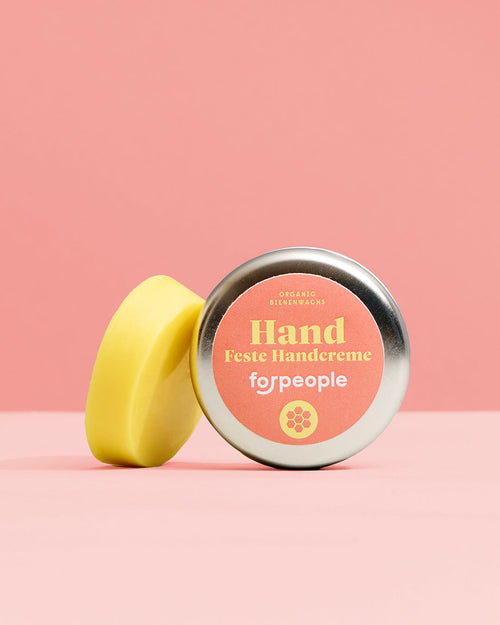
For adults, the Solid Hand Cream - Beeswax (30 g, €9.90) fits this purpose: according to the product page it is intended for dry, rough and heavily stressed hands, made from beeswax, olive and sunflower oil with St John's wort and aloe extract, and according to its ingredient list it contains no essential oils. Apply it thinly to intact skin and leave out the wart and any open areas. How to combine it with gloves is explained in Hand cream under latex or nitrile gloves?. For children's hands, ask your paediatrician or pharmacy about an unperfumed product; tips in Dry children's hands in winter: what helps.
More on this: Dry, cracked hands: causes and what helps · Recognising a fungal skin infection: round, scaly patches on the body – fungus or eczema? · Scabies or eczema? How to recognise scabies and what to do now
Sources
- Institute for Quality and Efficiency in Health Care (IQWiG): Warzen [Warts]. gesundheitsinformation.de, updated 2 January 2023, accessed 30 October 2026. https://www.gesundheitsinformation.de/warzen.html
- Bruggink SC, Eekhof JA, Egberts PF, van Blijswijk SC, Assendelft WJ, Gussekloo J (2013a): Natural course of cutaneous warts among primary schoolchildren: a prospective cohort study. Annals of Family Medicine 11(5): 437–441. https://doi.org/10.1370/afm.1508
- Bruggink SC, Eekhof JA, Egberts PF, van Blijswijk SC, Assendelft WJ, Gussekloo J (2013b): Warts transmitted in families and schools: a prospective cohort. Pediatrics 131(5): 928–934. https://doi.org/10.1542/peds.2012-2946
- van Haalen FM, Bruggink SC, Gussekloo J, Assendelft WJ, Eekhof JA (2009): Warts in primary schoolchildren: prevalence and relation with environmental factors. British Journal of Dermatology 161(1): 148–152. https://doi.org/10.1111/j.1365-2133.2009.09160.x
- Kwok CS, Gibbs S, Bennett C, Holland R, Abbott R (2012): Topical treatments for cutaneous warts. Cochrane Database of Systematic Reviews 2012(9): CD001781. https://doi.org/10.1002/14651858.CD001781.pub3
- DermNet: Viral wart. Oakley A (1996), updated by Gomez J, minor update November 2025, accessed 30 October 2026. https://dermnetnz.org/topics/viral-wart
- NHS: Warts and verrucas. Last reviewed 25 July 2023, accessed 30 October 2026. https://www.nhs.uk/conditions/warts-and-verrucas/
- Infektionsschutzgesetz (IfSG) [German Infection Protection Act], § 34. Accessed 30 October 2026. https://www.gesetze-im-internet.de/ifsg/__34.html
- Engebretsen KA, Johansen JD, Kezic S, Linneberg A, Thyssen JP (2016): The effect of environmental humidity and temperature on skin barrier function and dermatitis. Journal of the European Academy of Dermatology and Venereology 30(2): 223–249. https://doi.org/10.1111/jdv.13301