












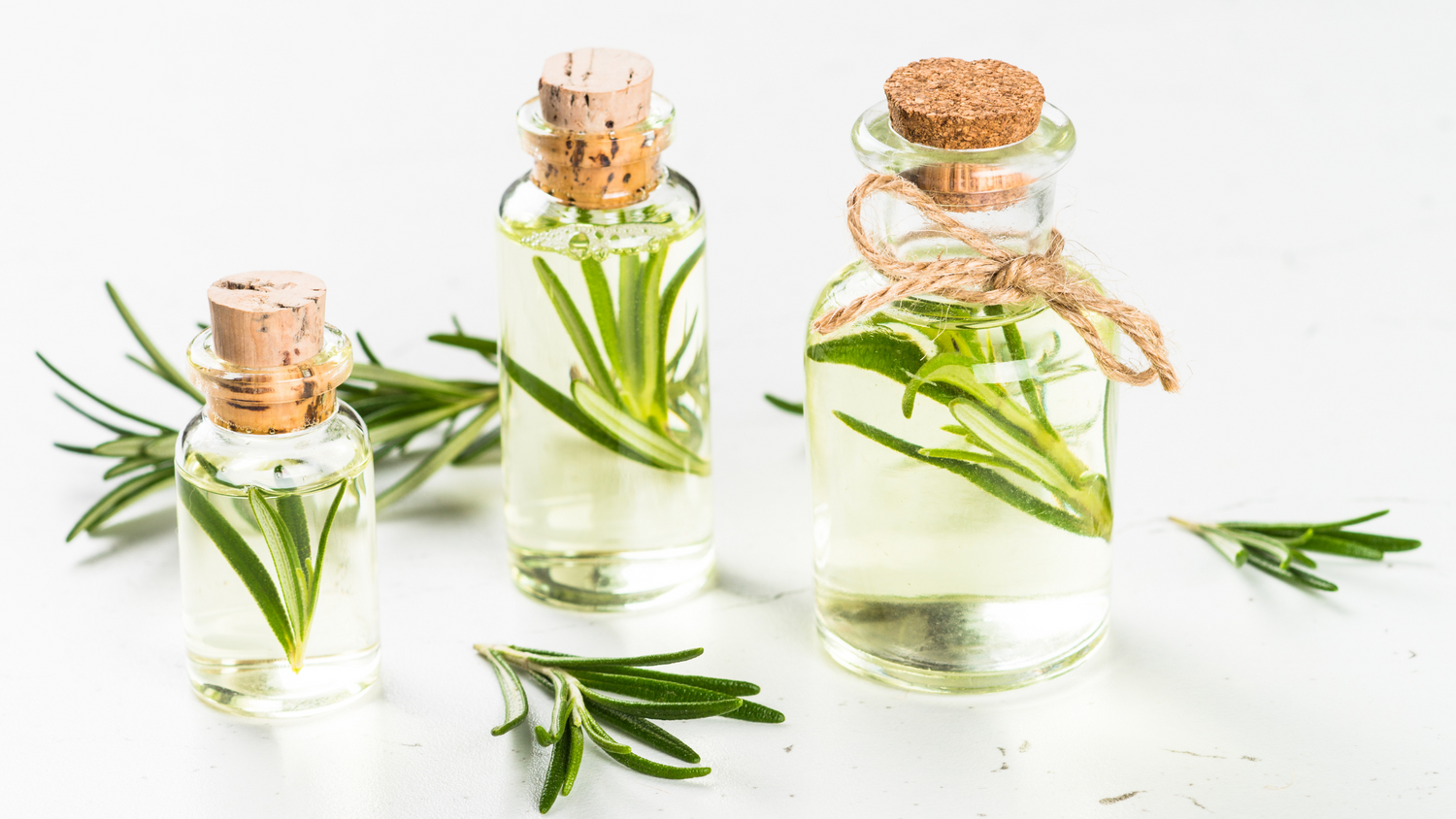
Is rosemary oil good for skin? In cosmetics its main job is scent, herbaceous, fresh and slightly resinous, and there is no good evidence so far that it does more than that on your skin. Rosemary oil is an essential oil obtained from rosemary by steam distillation and consists mainly of 1,8-cineole, camphor and α-pinene; like any essential oil, it only belongs on the skin in a strongly diluted form.
What rosemary oil is and what it is made of
Rosemary (Rosmarinus officinalis) is an evergreen shrub from the Mediterranean. The European Pharmacopoeia describes rosemary oil as an essential oil obtained by steam distillation of the above-ground parts of the plant: a clear, colourless to pale yellow liquid with a characteristic smell (EMA 2024). In the ingredient list of a cosmetic, the INCI, it usually appears as Rosmarinus Officinalis Leaf Oil.
Essential oils are not fatty oils like olive or sunflower oil. They are made up of many small, volatile fragrance molecules, which is why they smell and evaporate. The make-up of rosemary oil depends heavily on where it comes from. The Pharmacopoeia distinguishes two types:
| Component | Spanish type | Moroccan and Tunisian type |
|---|---|---|
| 1,8-cineole (eucalyptol) | 16–25% | 38–55% |
| α-pinene | 18–26% | 9–14% |
| Camphor | 13–21% | 5–15% |
| Camphene | 8–12% | 2.5–6% |
| β-pinene | 2–6% | 4–9% |
| Borneol | 2–4.5% | 1.5–5% |
| Limonene | 2.5–5% | 1.5–4% |
These are the ranges a rosemary oil has to meet under the European Pharmacopoeia, as quoted by the European Medicines Agency (EMA 2024). Which type is in a product is not shown in the INCI.
It is important to tell the oil apart from rosemary extracts. Extracts are not distilled but made with solvents, and they contain other substances, such as carnosic acid (Birutić et al. 2015). These are not among the components the Pharmacopoeia lists for the essential oil. What you read about rosemary extracts therefore does not automatically apply to rosemary oil.
What is proven on the skin and what is not
Scent: This is the one job rosemary oil reliably does in a cream or soap. It gives a herbaceous, fresh smell that fades gradually after you apply it. Whether the scent does anything beyond that has hardly been studied. The EMA describes a small study in 40 adults: after three minutes of rosemary scent their brain waves changed, and they did sums faster but not more accurately (Diego et al. 1998, cited in EMA 2024). A single small study is not enough to draw a reliable conclusion.
Antioxidant: Rosemary has a reputation for being antioxidant, meaning it protects against oxidation. That property is mainly linked to carnosic acid, a substance from rosemary and sage extracts that is used in food and cosmetics (Birutić et al. 2015). A test on human skin described by the EMA used such an extract, not the essential oil (EMA 2024). Whether rosemary oil in a cream has an antioxidant effect on your skin has not been shown.
Moisture: A small study tested gels with 1.5 and 3 per cent rosemary oil on the backs of the hands of ten people for one week. Measured skin moisture went up. It went up by a similar amount, though, with a gel that contained no rosemary oil at all, only tiny fat particles (Montenegro et al. 2017). So the study cannot tell whether the oil itself made the difference. The researchers themselves write that a benefit of rosemary oil on the skin has not yet been clearly demonstrated.
Further promises often made about rosemary oil cannot be backed up by these studies. As a traditional herbal medicine, rosemary oil is used for other purposes; that is not what this article is about.
Using rosemary oil safely
- Never undiluted: The German Federal Institute for Risk Assessment (BfR) advises applying essential oils to the skin only in a strongly diluted form, otherwise they can irritate it (BfR 2026). How much essential oil goes into a home-made blend, and how to convert per cent into drops, is explained in Mixing your own massage oil.
- Test first: Before using something for the first time, the BfR recommends trying it on a small patch of skin (BfR 2026). Our guide Trying a new product: how do I test it on a small area? shows you how.
- Keep away from eyes and broken skin: Rosemary oil should not get into your eyes or onto mucous membranes (EMA 2024), nor onto broken or irritated skin.
- Look out for fragrance allergens: Allergic reactions to essential oils are possible (BfR 2026). The EU Scientific Committee on Consumer Safety (SCCS) lists rosemary oil among the oils for which contact allergy in humans has been described: in an older study, 3 out of 86 people with a known fragrance allergy reacted to 2 per cent rosemary oil (SCCS 2012). Rosemary oil also contains substances such as limonene that have to be listed individually in the INCI above certain amounts. Our guide Essential Oils and Fragrance Allergens explains why.
- Infants and young children: Rosemary oil contains camphor. According to the BfR, camphor is generally not suitable for infants and young children (BfR 2026). Keep products with essential oils out of the reach of children.
Rosemary oil at forpeople
We do not sell essential oils on their own. According to the ingredient lists, rosemary oil is in these products:
- Solid Foot Cream – Rosemary & Sage, 40 g, €9.90: together with eucalyptus and clary sage oil in a water-free cream made from sunflower oil, beeswax, olive oil and shea butter. The refill without a tin is 40 g for €7.90.
- Aloe Vera Soap – Rosemary & Lemon, 75 g, €8.90: rosemary oil and lemon oil in a soap that you rinse off.
- Beeswax Salve Larch & Mandarin in a Glass Jar, 50 g, €12.90: rosemary oil alongside mandarin and fir oil. The salve also contains larch resin and propolis; there is separate guidance on resin and propolis allergy.
The fragrance components from the essential oils are marked with two asterisks in the ingredient lists of these products. You can read more about the raw material on Rosemary in cream and foot care: scent and use.
Frequently asked questions
What is rosemary oil good for?
In cosmetics, mainly for its scent. It is herbaceous and fresh and suits foot creams, salves and soaps. An effect on the skin beyond the scent has not been shown.
Can I put rosemary oil directly on my skin?
No. Essential oils only belong on the skin in a strongly diluted form, otherwise they can irritate it. In finished products the oil is already diluted.
Is rosemary oil good for your face?
There is no proven benefit for facial skin. If you use a product with rosemary oil on your face, keep it away from your eyes.
What does rosemary oil smell like?
Herbaceous, fresh and slightly resinous. Depending on the type, it smells clearer and cooler with more cineole and spicier with more camphor.
How should I store products with rosemary oil?
Tightly closed, cool and dark. Essential oils change with heat, light and air. If a product smells clearly different from when you first opened it, stop using it.
Sources
- European Medicines Agency, Committee on Herbal Medicinal Products (2024): Assessment report on Rosmarinus officinalis L., aetheroleum and Rosmarinus officinalis L., folium. Final – Revision 1. EMA/HMPC/681037/2021, 29 May 2024. ema.europa.eu
- Scientific Committee on Consumer Safety (SCCS) (2012): Opinion on fragrance allergens in cosmetic products. SCCS/1459/11, adopted 26–27 June 2012. ec.europa.eu
- Bundesinstitut für Risikobewertung (BfR, German Federal Institute for Risk Assessment) (2026): Ätherische Öle: Duftende Wirkungen mit Einschränkungen [Essential oils: fragrant effects with limitations]. FAQ of 2 September 2026. bfr.bund.de
- Birutić S, Dussort P, Pierre FX, Bily AC, Roller M (2015): Carnosic acid. Phytochemistry 115: 9–19. doi:10.1016/j.phytochem.2014.12.026
- Montenegro L, Pasquinucci L, Zappalà A, Chiechio S, Turnaturi R, Parenti C (2017): Rosemary Essential Oil-Loaded Lipid Nanoparticles: In Vivo Topical Activity from Gel Vehicles. Pharmaceutics 9(4): 48. doi:10.3390/pharmaceutics9040048




Leave a comment
This site is protected by hCaptcha and the hCaptcha Privacy Policy and Terms of Service apply.