








Your hands are cracked after a hike. The heel is split, the cut on your knee just won't heal after days. You reach for the drugstore wound ointment — and somehow it still feels unfinished. Like something's missing.
What many people don't know: the remedy your grandma always kept in the cupboard isn't all that far, pharmacologically, from modern products. In many cases it's better.
This article explains why pitch salve has worked for centuries — what the science says about it, how to use it properly, and why three ingredients are sometimes all you need.
What exactly is pitch salve?
Pitch salve — also called resin salve or turpentine salve — is one of the oldest healing preparations in human history. Its main active ingredient: tree resin, harvested from conifers like larch, spruce or pine.
For the tree, the resin is vital. It seals off injuries, keeps bacteria, fungi and insects away — a highly developed defence strategy perfected over millions of years. For people, exactly the same principle is useful.
„The resin of the larch seals wounds, protects against infection and stimulates healing — the same mechanisms that protect the tree also help our skin."
— From natural-remedies research, University of Oulu, FinlandIn the folk medicine of Central Europe and Scandinavia, pitch salve was the first-aid remedy for centuries: for cuts, grazes, poorly healing wounds, muscle pain, abscesses and cracked skin. Not because people didn't know better — but because it simply worked.
What the science says
Finnish researchers have studied the effect of tree-resin salves in clinical trials — and strikingly confirmed what folk medicine had long claimed.
Antibacterial: In lab studies, conifer resin (including spruce resin) showed an inhibiting effect on various bacterial strains, among them Staphylococcus aureus. These results come from in-vitro testing.
Antifungal: Lab testing demonstrated fungistatic properties of conifer resin — particularly against skin-relevant fungal strains.
Anti-inflammatory properties: Resin acids such as abietic acid are linked in scientific research to anti-inflammatory mechanisms. No therapeutic effect is claimed for this cosmetic product.
Traditional use: Resin-based salves have been used in folk medicine for centuries to care for skin and small injuries. Clinical case studies with resin-based wound dressings describe positive observations.
¹ Sources: Sipponen A. et al., Brit. J. Dermatology 2008; Rautio M. et al., Phytomedicine 2012; Rautio M. et al., Eur. J. Clin. Microbiol. 2007. — Note: SOS pitch salve is a cosmetic product. The study results mentioned relate to ingredients or comparable resin preparations and do not constitute any promise of cure.
Especially interesting: in studies, tree-resin salves also showed an effect on chronic, poorly healing wounds — exactly where synthetic alternatives often reach their limits.
The three active ingredients — more than the sum of their parts
The SOS pitch salve by forpeople gets by with exactly three ingredients. No filler, no water, no synthetic stabilisers. Just what works.


The result: a salve that's kept in a glass jar, uses hardly any resources and still does more than most products with ten times as many ingredients.
Where pitch salve helps — six uses
What makes pitch salve special: it's not a specialist remedy for one complaint, but a real first-aid kit in a jar.
Pitch salve vs. synthetic wound ointment — a fair comparison
Synthetic wound ointments aren't bad as a rule. But the comparison shows where natural alternatives can score — especially with regular use and sensitive skin.
| Property | forpeople pitch salve | Synthetic wound ointment |
|---|---|---|
| Ingredients | 3 natural active ingredients | 5–20 substances incl. preservatives |
| Antibacterial | Broad spectrum via resin acids | Usually yes, synthetic antibiotics |
| Antifungal | Yes, naturally | Usually not |
| Contains water | No — 100 % active ingredients | Yes, often the main component |
| For children & babies | Yes (from infancy, consult first) | Limited, depending on the active ingredient |
| Packaging | Glass jar, plastic-free | Usually plastic tubes |
| Smell | Typical of natural resin, pleasantly woody | Usually neutral to perfumed |

How to use pitch salve properly
It couldn't be simpler to use — which makes pitch salve an ideal companion on the go and when travelling, too.
-
Clean the skin Gently clean the wound or affected area with clear water and pat dry.
-
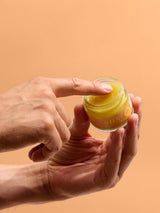
Apply thinly Apply a small amount of pitch salve thinly to the affected area with your finger or a clean cotton pad. Less is more — the active-ingredient content is high.
-
Repeat several times a day Especially for wounds and dry skin: apply two to three times a day until the area has healed.
-
Cover if needed On areas exposed to friction (heel, elbow), a plaster can protect the spot after applying.
Note: Do not use on mucous membranes or around the eyes. Do not use if you have a known allergy to beeswax, resin or olive oil. If complaints persist or get worse, seek medical advice.
Frequently asked questions about pitch salve
Is pitch salve the same as turpentine salve?
Similar, but not identical. Turpentine salve contains turpentine oil (distilled from pine resin), pitch salve contains the raw resin itself — at forpeople specifically larch resin. Both belong to the resin-salve family, but larch resin has a broader antibacterial and antifungal profile than pure turpentine oil.
Can I use pitch salve on children?
Yes, pitch salve is generally suitable for children too — the ingredients are natural and well tolerated. For infants and toddlers under 2 years, and if there's a known allergy to one of the ingredients (resin, beeswax, olive oil), please speak to your paediatrician first. For older children it's ideal for small wounds, grazes and rough skin.
How long does pitch salve keep?
Since the salve contains no water, it's naturally very stable. Stored cool and dark, it easily keeps for 2–3 years. The glass jar protects the ingredients far better than plastic, since no plastic can off-gas. After opening, simply keep it cleanly closed and take it out with dry fingers or a spatula.
Why does pitch salve smell so distinctive?
The typical resin smell comes from the natural terpenes in larch resin — among them pinene, terpinolene and alpha-terpinene. These compounds are also responsible for part of the antimicrobial effect. If you're not used to a synthetic perfume smell, you'll usually find the scent pleasantly natural and fresh-woody. No artificial perfume, no masking.
Does pitch salve really help with nail fungus?
In studies, larch resin shows a proven antifungal effect against the most common fungal pathogens. As the sole treatment for advanced nail fungus it usually isn't enough — but as supplementary, natural supporting care it makes sense: apply daily to the affected nail and the surrounding skin, especially after showering. It does not replace a medical diagnosis and, where needed, systemic treatment.
Can pitch salve go on open wounds?
On clean, small open wounds (cuts, grazes) it can be applied directly after cleaning. The antibacterial properties help prevent infection, while beeswax and olive oil keep the area around the wound supple. For deep wounds, bite injuries or wounds with foreign objects, always seek medical help first.
Does pitch salve feel very greasy?
Thanks to the combination of olive oil and beeswax, the salve absorbs well and leaves no heavy, sticky film. A light protective film is intended — it protects the skin and keeps the active ingredient in place. If you use it on your hands during the day, simply apply a little less.
Can you make pitch salve yourself?
Yes, you can in principle make pitch salve yourself — the base is tree resin (e.g. larch or spruce resin), beeswax and a plant oil like olive oil. The resin is gently melted in a water bath, stirred together with beeswax and oil, and poured into jars. If you pay attention to locally sourced raw materials, you can produce a high-quality salve. If you'd rather save yourself the effort: the SOS pitch salve by forpeople uses exactly these three ingredients — in tested raw-material quality, NaTrue-certified and Made in Germany.
Does pitch salve work against warts?
Larch resin has proven antiviral properties that may also be effective against the viruses (human papillomaviruses, HPV) that cause warts. In folk medicine, pitch salve was traditionally used for warts — applied regularly and covered with a plaster. Scientifically, this effect on warts is less well documented than on wounds. As a supplementary measure for small, uncomplicated warts, giving it a try can make sense; for stubborn cases, dermatological treatment is recommended.
Is pitch salve suitable for animals — dogs and horses?
Pitch salve is traditionally used on animals too. For dogs it works well to care for cracked paw pads and small wounds; for horses it's proven for skin irritations and pastern-area care. The ingredients larch resin, beeswax and olive oil are generally harmless for animals. Important: make sure the animal doesn't lick the salve off, as larger amounts of resin can irritate digestion. For deep injuries or if you're unsure, always consult the vet.


